Public-domain ebook
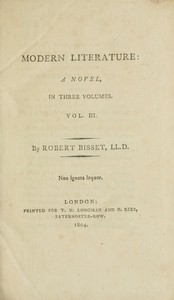
Modern literature: a novel, Volume 3 (of 3)
Language: en505 downloads on Project Gutenberg
Subjects
Public-domain ebook sourced from Project Gutenberg #68917.
Public-domain ebook
Language: en505 downloads on Project Gutenberg
Subjects
Public-domain ebook sourced from Project Gutenberg #68917.
The opening · free to read
HAMILTON, possessed of his lovely and beloved Maria, was stimulated to more constant and vigorous intellectual exertions than at any former period of his life. He consulted with his friends, and balanced with himself, whether he should persevere in the study of the law, or entirely devote himself to literature. To the latter his inclinations prompted; but the former appeared the more conducive to his interest. The ability and industry which would enable an Erskine to acquire twelve thousand in one year, could scarcely earn so much to a Robertson or a Gibbon in the course of a literary life. He had been the means of preventing Maria from affiancing herself to opulence; ought not he to attempt to supply the defect? His friends thinking that no attainments were beyond his reach, if directed to the study of the law, very strongly urged him to be called to the bar. He at length determined to persevere in his legal studies, but at the same time to carry on his other pursuits. He made very great progress in the work which he had undertaken, and by the approach of winter an octavo volume was ready for publication.
Maria, considering the world as centered in her husband, desired no amusements or pleasures that could interfere with his engagements, duties, and ardent wish to fulfil them speedily and effectually; and except two or three plays, a party to Vauxhall, jaunts for a day to some of the adjacent villages, she was entirely domesticated. About the middle of August, however, William finding that his labours were so far advanced as to afford him respite for a few weeks, proposed to carry his wife and Charlotte an excursion, by a route of which the greater part would be new to him, and all beyond the first stage to his fair fellow travellers. The ladies had never seen Windsor; this, therefore, was the first object of their destination. On a Sunday morning early they took the road to Hounslow; changing horses at Cranford Bridge, they hurried over the bleak and dreary heath; and turning Colnbroke, were gladdened with the prospect of the grand and commanding battlements of Windsor Castle, amidst scenery striking and magnificent, at once uniform and diversified; VARIED in the distribution and assortment of the beautiful, the romantic, the sublime, ONE in the interest and impressiveness of the whole. The first care of their conductor was to give them a complete and comprehensive view of the situation and prospects of the royal residence. He therefore led them to the super-eminent elevation of the round tower; where such an extent of space opens on every side to the astonished spectator, and exhibits such a multiplicity of objects, as fill him with amazement, which subsiding sufficiently to permit distinct attention to the several compartments, is changed into delight. After viewing in succession the verdant and wooded ridge of St. Leonard’s Hill; the more gentle eminences, that diversified with dales, line the approaches from the great park; the romantic environs of Runymede, the sacred theatre of vindicated rights; the pastoral scenery of Frogmore; the rich fertility of the northern view long level, by its mantling corns that had now assumed their ripened yellow hue, diversifying the verdure of the southern prospect; fringed with distant woods, and bounded by acclivities, which, without lessening the interest of the nearer scenery, served to limit contemplation to definite objects. Immediately under the eye occupied in that direction, the nurse of British learning raised her venerable head; the Thames, meandring through those woods and dales and lawns, and washing the glittering towers and hills with its gilded streams, beautiful itself, and enhanced every other beauty, and, like the poet’s magic pen, whatever it touched adorned.
To a spectator of genius, a prospect does not merely present the objects that assail his eyes; its chief effect is often by association. Destitute of sensibility and fancy a beholder must be, who reaching the top of Portsdown hill, and descrying the distant Isle of Wight, or the Fareham forest, the former a more prominent, and the latter a more beautiful object, than the flat environs of Portsmouth, would not chiefly regard the town he was approaching, not as a place containing a certain number of buildings, but as the grand receptacle of English strength. Hamilton viewing Windsor transcending every place that he had beheld in the various excellencies of external nature, cultivated, but not overwhelmed by art, now regarded it in a different light; as the seat of royalty, subjecting to the survey of its owner almost every different characteristic of English rural beauty. In its agricultural and pastoral objects it involves the grand inlet of transcending commerce; there its benignant possessor can, with the exultation of conscious patriotism, happy in the accomplishment of its benevolent purposes, say--“these are the pastures and farms of ability, enterprize, and industry, fostered by freedom that is regulated by order, and which having produced opulence, with skilful taste employs part of it in super-adding ornament to utility, and an opulence diffused through various ranks, giving to the mechanic and the peasant those neat and comfortable houses which constitute the many flourishing hamlets and villages that present themselves to the gladdened eye. Before us glides the Thames, wafting merchandize between my inland country and my metropolis, and, even here, long before it imbibes the ocean, it presents a growing scene of the industry and traffic which so eminently distinguish its matured course beyond all other rivers.” “Here,” said our hero, pointing to the chapel, “our Sovereign seeks, in religion, the best support of moderate and virtuous royalty. There learning employs her stores in inuring youth to sound knowledge, just principles, and sentiments which must ever support mingled loyalty and freedom.”
From this general survey they now descended to particularization. They viewed the apartments of the castle, which are decorated with such magnificence of diversified ornaments; contain so numerous an assemblage and exquisite a selection of monuments of the fine arts; combine the best productions of the Flemish and Italian schools, and also shew that English genius taking that course, can excel as well as in any other. From the royal suite of rooms they now betook themselves to the Terrace, to view the SOVEREIGN A PRIVATE GENTLEMAN ON HIS OWN GROUNDS, frankly mingling with his people, and deriving pleasure from the many and strong testimonies of loyalty, delighted with contemplating the welfare and happiness of its objects. They saw him accompanied by his queen, and surrounded by his family. The scenery, the music, the company, and above all, the royal party, rendered the effect peculiarly impressive. Our travellers spent the whole of that day at Windsor: the following morning they took a ride round the great park, and afterwards visited Eton College. After an early dinner they took the road to Oxford; they were charmed with the romantic beauties between Salt Hill and Henley, where having stopped half an hour, it was the dusk of the evening, when the spires and cathedrals of Oxford presented themselves in solemn grandeur through the gloom of the twilight. The next morning they walked out to survey the venerable city. It was the season of the vacation, and stillness appeared to prevail throughout; every scene seemed retired and sequestered--the chosen abodes of profound reflection and philosophy--
“----Deep solitudes and awful cells, Where ever pensive contemplation dwells.”
These were reservoirs of theoretic wisdom, whence issued streams that being guided by practical skill and experience, produced most important benefits to society. Here our hero recalled to his mind a reflection he had made at Cambridge, of the benefit that arose from the commixture of religious with literary institutions. He mentioned this remark to his intelligent fellow travellers, and finding a copy of Newte’s tour, read to them a very striking passage on the subject. “Oxford and Cambridge,” says that very able writer, “may be justly considered not only as venerable monuments of ancient times, but as a kind of garrison, established by public authority, for the preservation of loyalty, literature, and religion. If our universities may be thought, in some respects, to check and retard the progress of knowledge, by means of fixed forms, laws, and customs, it is at least equally certain, that they are salutary bulwarks against the precipitate and desolating spirit of innovation. The reverence paid by our ancestors to piety and to learning, strikes us in Oxford as by a sensation, and shews how fit objects these are of esteem and veneration, to the common sense of mankind. For different nations, and races of princes and kings, have concurred, in the course of many centuries, to pay homage to the shrine of saints and the seats of the muses. It is not an easy matter to prevent or shake off a respect for any noble or royal family, whose antient representatives, the founders and benefactors of the different colleges and halls, are brought to remembrance by pictures, statues, charters, and stately edifices. These take fast hold of the ductile mind of the students, and are associated in their memory with many of the most pleasing ideas that have ever occupied their minds. From impressions of this kind, a love of their early haunts and companions, naturally associated together in their imaginations, is nourished in the breasts of the generous youth, and also an attachment to their king and country. Take away these memorials of antiquity, those noble and royal testimonies of respect to sanctity of life, and proficiency in learning, remove every sensible object, by which sentiments of early friendship, loyalty, and patriotism are kindled and inflamed in young minds, and disperse our young gentlemen in other countries for their education, or even in separate little academies and schools in our own, and you weaken one of the great pillars by which the constitution and spirit of England is supported and perpetuated.”
They now proceeded to view the different colleges and libraries. When they were in Pembroke College, our hero observed, that as one of the chief glories of English literature had been educated at this seminary, as a monument that they had fostered so very eminent a pupil, they should erect a statue to Samuel Johnson. They passed several hours in the Bodleian library; they viewed also the various chapels, and were particularly pleased with some of the paintings. The city and university in general impressed our travellers with reverence and awe, and the contemplation furnished to our hero various ideas that he afterwards found useful in his literary pursuits. Having remained a day and two nights at Oxford, they set off for Woodstock to view Blenheim, one of the most signal monuments of national gratitude to an illustrious hero for discomfiting the ambitious enemies of his country. From Woodstock a spacious portal of the Corinthian order conducted them into the park, and opened to them the lake, the bridge, but conspicuous beyond the rest the castle. Designed by Sir John Vanbrugh, and like the other structures of that architect, ponderous; the palace of Blenheim, nevertheless, exhibited regularity and proportion. Admitted into the house they found the apartments grand and magnificent, decorated with monuments of genius and of taste, especially paintings. To the spectator who with the exhibitions combined the renowned founder of the Marlborough family, the most interesting were the representations of his heroic actions. The holy family; the offering of the Magi; our Saviour blessing the children; filial affection exemplified in the Roman daughter; return of our Saviour from Egypt; bearing testimony to the genius of Rubens, or an honour to the taste and selection of any nobleman, but have no appropriate relation to that illustrious family more than any other. The same observation will apply to the Dorothea of Raphael; the Pope Gregory and Female Penitent of Titian. But the most appropriate decorations are the battles of Marlborough represented on tapestry. The disposition of the grounds was also extremely skilful; but to the historical or political reader the most interesting portion was, that which either described or alluded to the exploits and victories of John Churchill, Duke of Marlborough, and especially the lofty column which serves as a pedestal to the statue of the consummate general, and presents an inscription describing the talents and qualities of the head and heart of this extraordinary personage; the atchievements of so efficacious and singular a character, and the effects which they had produced; the following inscription composed by Bolingbroke, appears to be singularly adapted.--
The book keeps going
Reading is free forever. Sign up and watch scenes appear while you read.



Scenes Storieta drew for other classics.
New illustrated classics
Once or twice a month: the latest books to get full character casts, scene art, and free comic editions. No account needed.
![Cover of Love and Freindship [sic]](/covers/1212.jpg)