Public-domain ebook
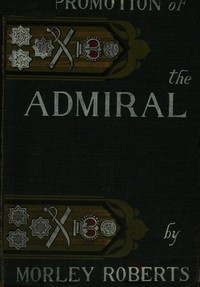
The promotion of the admiral, and other sea comedies
Language: en412 downloads on Project Gutenberg
Subjects
In: Short Stories·Humour·British Literature
Public-domain ebook sourced from Project Gutenberg #68919.
Public-domain ebook
Language: en412 downloads on Project Gutenberg
Subjects
In: Short Stories·Humour·British Literature
Public-domain ebook sourced from Project Gutenberg #68919.
The opening · free to read
THE PROMOTION OF THE ADMIRAL.
Mr. Smith, who ran a sailors' boarding-house in that part of San Francisco known as the Barbary Coast, was absolutely sui generis. If any drunken scallawag of a scholar, who had drifted ashore on his boarding-house mud-flats, had ventured in a moment of alcoholic reminiscence to say so in the classic tongue, Shanghai Smith would have "laid him out cold" with anything handy, from a stone-ware match-box to an empty bottle. But if that same son of culture had used his mother tongue, as altered for popular use in the West, and had murmured: "Jerusalem but Mr. Smith's the daisy of all!" Smith would have thrown out his chest and blown through his teeth a windy oath and guessed he was just so.
"Say it and mean it, that's me," said Smith. "I'm all right. But call me hog and I am hog; don't you forget it!"
Apparently all the world called him "hog." For that he was no better than one, whether he walked, or ate, or drank, or slept, was obvious to any sailor with an open eye. But he was hard and rough and tough, and had the bull-headed courage of a mad steer combined with the wicked cunning of a monkey.
"Don't never play upon me," he said often. "For 'get even' is my motter. There ain't many walkin' this earth that can say they bested me, not from the time I left Bristol in the old dart till now, when I'm known the wide world over."
So far as ships and sailormen were concerned he certainly spoke the truth. He was talked of with curses in the Pacific from the Prybiloffs to the Horn, from San Francisco to Zanzibar. It was long odds at any given time in any longitude that some seaman was engaged in blaspheming Shanghai Smith for sending him on board drunk and without a chest, and with nothing better to propitiate his new shipmates with than a bottle of vinegar and water that looked like rum till it was tasted. Every breeze that blew, trade wind or monsoon, had heard of his iniquities. He got the best of every one.
"All but one," said Smith in a moment of weakness, when a dozen men, who owed so much money that they crawled to him as a Chinaman does to a joss, were hanging upon his lips--"all but one."
"Oh, we don't take that in," said one of the most indebted; "we can 'ardly believe that, Mr. Smith."
Sometimes this unsubtle flattery would have ended in the flatterer being thrown out. But Smith was now gently reminiscent.
"Yes, I was done brown and never got the best of one swine," said the boarding-house keeper. "I don't ask you to believe it, for I own it don't sound likely, me being what I am. But there was one swab as give me a hidin', and he give it me good, so he did."
He looked them over malignantly.
"I kin lick any of you here with one hand," he swore, "but the man as bested me could have taken on three of you with both hands. And I own I was took aback considerable when I run against him on the pier at Sandridge when I was in Australia fifteen years ago. He was a naval officer, captain of the Warrior, and dressed up to kill, though he had a face like a figure-head cut out of mahog'ny with a broad-axe. And I was feelin' good and in need of a scrap. So when he bumped agin me, I shoved him over--prompt, I shoved him. Down he went, and the girls that know'd me laughed. And two policemen came along quick. I didn't care much, but this naval josser picks himself up and goes to 'em. Would you believe it, but when he'd spoke a bit I seed him donate them about a dollar each and they walked off round a heap of dunnage on the wharf, and the captain buttoned up his coat and came for me. I never seen the likes of it. He comes up dancin' and smilin', and he kind of give me half a bow, polite as you like, and inside of ten seconds I knew I'd struck a cyclone, right in the spot where they breed. I fought good--(you know me)--and I got in half a dozen on his face. But I never fazed him none, and he wouldn't bruise mor'n hittin' a boiler. And every time he got back on me I felt as if I'd been kicked. He scarred me something cruel. I could see it by the blood on his hands. Twarn't his, by a long sight, for his fists was made of teak, I should say. And in the end, when I seemed to see a ship's company of naval officers around me, one of them hit me under the ear and lifted me up. And another hit me whilst I was in the air, and a third landed me as I fell. And that was the end of it, so far's I remember. When I came to, which was next day in a kind of sailors' hospital, I reached up for a card over my head, and I read 'concussion of the brain' on it. What's more, I believed it. If the card had let on that I'd been run over by a traction engine and picked up dead, I'd have believed it. And when I reely came to my senses, a med'cal student says as Captain Richard Dunn, of the Warrior, had bin to inquire when the funeral was, so's he could send a wreath. They said he was the topside fighter in the hull British Navy. And I'm here to say he was."
He breathed fierce defiance and invited any man alive to tell him he was lying.
"And you never got even?" asked the bar-tender, seeing that no one took up the challenge.
"Never set eyes on him from that day to this," said his boss regretfully.
"And if you did?"
Smith paused, took a drink.
"So help me, I'd Shanghai him if he was King of England!"
And one of the crowd, who had put down the San Francisco Chronicle in order to hear this yarn, picked it up again.
"S'elp me," he said, in a breathless excitement, "'ere's a bally cohincidence. 'Ere's a telegram from 'Squimault, saying as how the flagship Triumphant, Hadmiral Sir Richard Dunn, K.C.B., is comin' down to San Francisco!"
"Holy Moses, let's look!" said Shanghai Smith.
He read, and a heavenly smile overspread his hard countenance. He almost looked good, such joy was his.
"Tom," he said to the bar-tender, "set up the drinks for the crowd. This is my man, for sure. And him an admiral, too! Holy sailor, ain't this luck?"
He went out into the street and walked to and fro rubbing his hands, while the men inside took their drink, and looked through the uncleaned windows at the boss.
"Holy Mackinaw," said Billy, who had drifted West from Michigan, "I reckon never to hev seen Mr. Smith so pleased since he shipped a crowd in the Harvester, and got 'em away that night and shipped 'em in the Silas K. Jones."
"He's struck a streak o' luck in his mind," said one of the seamen; "and it's this 'ere hadmiral. Now mark me, mates, I wouldn't be that 'ere hadmiral for the worth of California. Mr. Sir Blooming Hadmiral, K.C.B., et setterer, is going to 'ave a time."
He shook his head over the melancholy fate of a British admiral.
"Rot!" said one of the younger men; "'tain't possible to do nothin' to the likes of an admiral. Now, if 'twas a lieutenant or even a captain, I'm not sayin' as Mr. Smith mightn't do somethin'. But an admiral----"
"You mark me," said the older man, "I'd rather be as green as grass and ship as an able-bodied seaman with Billy Yates of the Wanderer, than be in that hadmiral's shoes. What do you say, Tom?"
Tom filled himself up a drink and considered.
"Wa'al," he answered after a long pause, "it's my belief that it won't necessary be all pie to be an admiral if the boss is half the man he used to be. For you see 'tis quite evident he has a special kind of respect for this admiral, and when Mr. Smith has been done by any one that he respects, he don't ever forget. Why, you know yourselves that if one of you was to do him, he'd forgive you right off after he'd kicked the stuffing out of you."
This clear proof that Mr. Smith did not respect them and was kind was received without a murmur. And as the boss did not return, the tide of conversation drifted in the narrower more personal channels of the marvels that had happened in the "last ship." And in the meantime H.M.S. Triumphant, known familiarly on the Pacific Coast station as "the Nonsuch, two decks and no bottom," was bringing Rear-Admiral Sir Richard Dunn, K.C.B., to his fate in San Francisco.
"Was there ever such luck--was there ever such luck?" murmured Mr. Shanghai Smith. "To think of him turnin' up, all of his own accord, on my partic'lar stampin' ground! And I'll lay odds he's clean forgot me. I'll brighten up his memr'y with sand and canvas and souji-mouji, so I will! Holy sailor, was there ever such luck?"
The morning of the following day H.M.S. Triumphant lay at her anchors off Saucelito in San Francisco Bay, and was glad to be there. For this was in the times when the whole British fleet was not absolutely according to Cocker. She leaked not a little and she rolled a great deal, and she would not mind her helm except upon those occasions when the officer in charge of the deck laid his money and his reputation on her going to starboard when, according to all rules, she should have altered her course to port. But though she was a wet ship with a playful habit of trying to scoop the Pacific Ocean dry, and though her tricks would have broken the heart of the Chief Naval Constructor had he seen her at them, she was the flagship in spite of her conduct, because at that time she was half the whole Pacific Squadron. The other half was lying outside Esquimault Dry Dock waiting for it to be finished. And when the Chronicle said that "Dicky Dunn" was the admiral, it had not lied. If any of that paper's reporters had known "Dicky" as his men knew him, he would have spread himself in a column on the admiral's character and personal appearance.
"He's the dead-spit of a boson's mate, to be sure," said the crew of the Triumphant when they received him at Esquimault. "An 'ard nut he looks!"
And a "hard nut" he certainly was. Though he stood five feet nine in height, he looked two inches less, for he was as broad as a door and as sturdy as the fore-bitts. His complexion was the colour of the sun when it sets in a fog for fine weather: the skin on his hands shone and was as scaly as a lizard's hide. His teeth were white and his eyes piercing. He could roar like a fog-horn, and sing, as the crew said, "like any hangel." There wasn't the match of "Dicky" on any of the seas the wide world over. The only trouble was that he looked so much like the traditional sailor and buccaneer that no one could believe he was anything higher than a warrant officer at the most when he had none of his official gear about him.
Though the admiral did not know it, one of the very first to greet him when he set his foot on dry land at the bottom of Market Street was the man he had licked so thoroughly fifteen years before in Melbourne.
"Oh, it's the same," said Smith to his chief runner, who was about the "hardest case" in California. "He ain't changed none. Just so old he was when he set about me. Why, the galoot might be immortal. Mark him, now; will you know him anywhere?"
"It don't pay me ever to forget," replied the runner. He had to remember the men who owed him grudges.
"Then don't forget this one," said Smith. "Do you find me a considerate boss?"
The book keeps going
Reading is free forever. Sign up and watch scenes appear while you read.



Scenes Storieta drew for other classics.
New illustrated classics
Once or twice a month: the latest books to get full character casts, scene art, and free comic editions. No account needed.