Public-domain ebook
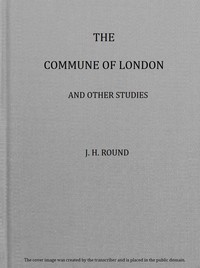
The Commune of London, and other studies
Language: en3,548 downloads on Project Gutenberg
Subjects
In: History - British·History - Medieval/Middle Ages
Public-domain ebook sourced from Project Gutenberg #68933.
Public-domain ebook
Language: en3,548 downloads on Project Gutenberg
Subjects
In: History - British·History - Medieval/Middle Ages
Public-domain ebook sourced from Project Gutenberg #68933.
John Horace Round’s The Commune of London, and other studies is a collection of scholarly essays that examine the institutional and political development of England from the Norman Conquest through the early thirteenth century. The volume opens with a letter of gratitude from Walter Besant, a contemporary official of the Survey of London, who praises Round’s earlier work for clarifying the creation of the City’s municipality, the conveyance of the Portsoken, and the role of the clergy in the twelfth‑century capital. From there the contents list reveals a systematic exploration of topics such as the settlement of the Saxons, the origin of the Exchequer, Anglo‑Norman warfare, and the formation of the London commune, each framed by a meticulous critique of primary documents and earlier historiography.
The author writes in a rigorous, nineteenth‑century academic voice, combining detailed diplomatic analysis with a polemical edge toward prevailing theories. His prose is dense but precise, reflecting the era’s confidence in archival research and the desire to correct “misunderstandings” in official histories. Readers who relish meticulous source criticism, the evolution of medieval municipal institutions, or the broader tapestry of Norman‑period England will find Round’s methodical arguments and extensive footnotes both rewarding and intellectually stimulating.
The opening · free to read
I have to thank you for kindly letting me see the advance proofs of your new book. It is difficult for me to explain the very great advantage which the study of your books has been to me in my endeavour to get at the facts, especially those of the 12th century, connected with the history of London. For instance, I have found in your pages for the first time a working theory of the very difficult questions connected with the creation of the municipality. I have adopted your conclusions to the best of my ability with, I hope, an adequate expression of thanks to the source from which they are derived.
I would also point out the great service which you have rendered to the history of the City by giving, for the first time, the exact truth regarding the conveyance of the Portsoken to the Priory of the Holy Trinity, an event which has been hitherto totally misunderstood.
Thirdly, I must acknowledge that it is only from your pages, especially a certain appendix to ‘Geoffrey de Mandeville,’ that one can understand the ordinary position of the clergy of the City of London in the 12th century.
It is unnecessary for me to enumerate many other obligations which I owe to your pages.
I remain, dear Mr. Round, Very faithfully yours, WALTER BESANT.
OFFICE OF THE SURVEY OF LONDON, July 6th, 1899.
The book keeps going
Reading is free forever. Sign up and watch scenes appear while you read.



Scenes Storieta drew for other classics.
New illustrated classics
Once or twice a month: the latest books to get full character casts, scene art, and free comic editions. No account needed.