Public-domain ebook
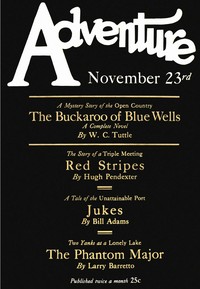
Red stripes
Language: en397 downloads on Project Gutenberg
Subjects
In: Historical Novels·Adventure·American Literature
Public-domain ebook sourced from Project Gutenberg #68942.
Public-domain ebook
Language: en397 downloads on Project Gutenberg
Subjects
In: Historical Novels·Adventure·American Literature
Public-domain ebook sourced from Project Gutenberg #68942.
The opening · free to read
From the moment he was made captive near the station on the Big Sandy, the Virginian began looking for an opportunity to escape. He was ferociously angry at himself for venturing outside the station against the advice of the small garrison. Recently arrived from Richmond, he had presumed to know more about red men than did the border people. He had insisted the Indians had abandoned the siege after losing three warriors and having two wounded. And within easy gunshot of the stockade he had been jumped by the Wyandots and hustled away. His captors were from the Lower Sandusky village. Throughout the journey down the Sandy and up the Ohio to the Guyandotte Crossing he had nursed his resentment against the Indians and himself. In the back of his mind was the hope he would find an opportunity to break clear before crossing to the Indian shore. But the Guyandotte was reached and the Ohio was crossed without a minute of carelessness on the part of the raiders. At night the Virginian slept as best he could with a rawhide thong around his waist, from which lines were attached to the waist of a warrior on each side. In addition to this precaution his feet and hands were tied. When canoes were abandoned for forest travel his hands were tied at his back and he was led along by a length of rawhide around his neck. He fell and bruised himself. He was hauled through bushes and was scratched by briers from head to waist. At times the cord tightened, and he was all but strangled.
The leader of the Wyandots was a short, thick-set man. Unlike his followers he wore no paint on his face and his countenance was agreeable and very intelligent. His only attempt at adornment was the red stripe following the backbone from the nape of his neck to his waist. All of his men were similarly painted and in addition were grotesque and frightful because of the patterns masking their faces. The raid had been a failure, and the warriors were in an evil mood. The chief realized that his popularity as a leader would quickly wane did he encounter one more defeat, yet he treated the prisoner kindly once a camp was made. In person he saw to it that the Virginian had water and meat. This consideration led the prisoner to believe that at the worst he would be held in some red village until he could be ransomed.
After he reached the Indian shore several ambitious young men remained behind and did not rejoin the band until the evening of the second day. They brought in two scalps and one prisoner. The chief rejoiced greatly. He would be credited with victory by a slight margin. The horrid proofs of the tragedy were danced with much enthusiasm that evening.
When he found himself by the prisoner the Virginian asked for details.
“We was took by surprize while setting traps for beaver and otter,” the man explained in a monotonous voice. “I’m Abner Bryant. There was the three of us, Ben an’ Tom Durgin an’ me. Ben ’lowed he could make a fire-hole in a clump of willers that no Injun could see. Well, both the Durgins are dead.”
He was a thin, dried-out wisp of a man whose head was thinly frosted by a round number of years. He spoke without emotion, as one who is weary. His acceptance of his capture and the death of his friends smacked of fatalism. The incident was closed and did not interest him. However, he was curious enough to inquire--
“Who might you be?”
“Harry Knight. A fool. Knew more’n my elders at the station on the Big Sandy,” was the bitter reply. “We got three of them. Then I had to go outside the stockade to prove I knew it all and that the Injuns had gone. Now I s’pose I’ve got to put in a winter in some filthy village.”
Bryant eyed him in mild surprize and asked--
“Know their lingo?”
Knight shook his head impatiently.
“No sense to their jabber. The leader treats me well. I think he likes me.”
Bryant pursed his thin lips and glanced appraisingly at the well-knit figure of the younger man and decided.
“You oughter last three days. They’ll manage to keep you alive for two, anyway.”
“Keep me alive?” repeated Knight. “But I ain’t sick. Bruised and scratched--”
“Young man, you’n me will be painted black once we git to the Lower Sandusky village. Better they treat us now, the worse they’ll treat us when we make the village. I won’t need much killing. But you’re younger an’ stronger. You’ll be stubborn an’ die hard. I’m nigh to eighty. Forty-odd year ago they’d had a rare time with me. My pride would a held me up. Now they won’t git much fun out of my dying.”
“Merciful heavens!” hoarsely whispered Knight, and he turned to stare at the leaping, gesticulating figures circling the scalp poles.
“Of course I tried to git killed along with Ben an’ Tom. Didn’t have no luck. Chief there is Cap’n Jimmy, his white name. Red name’s Little Beaver. If you see the slimmest chance for ducking out, grab it. Don’t make over your back track. Strike west an’ lose yourself. If you live to hit the Scioto, travel southwest to the Ohio and follow it down to Massie’s Station.[1] As a fact you’ll prob’ly be overhauled mighty sharp an’ sudden. But that’s all right if they don’t take you alive. That’s the prime p’int I always tried to ding into our settlers. Never be took alive. Now see me! Trussed up like this! ’Low I’ll raise the chief’s dander. Sometimes you can git them mad enough to swing an ax and cheat themselves out of the torture.”
[Footnote 1: Manchester, Adams County, Ohio.]
He threw back his head and in the Huron dialect loudly called out:
“Ho! Ho! They say a chief runs back whipped from a red path. They say he throws away his warriors like a foolish man. Has a wolf stepped over his gun and spoiled his medicine? His young men break away and bring two scalps. Where are the scalps Little Beaver has taken?”
The chief stared at him ferociously. A man near-by reached forward and struck him across the mouth.
“Best this way. If you git a glimmer of a chance to scoot you’ll need all your strength. I couldn’t make a race of it if I had half a mile start. I’ve lived my years an’ I’ve sent a sizable number of them on ahead of me.” He paused and lifted his head the better to watch two men busy with something on the opposite side of the small fire. Then he was whispering, “They’re fixing black paint.”
“Black paint!” gasped Knight. “You said I’d be painted black.”
“Not yet. They’ll keep you to show at the village. Got to make some showing to offset the men he’s lost. The women folks would be mad if a prisoner wasn’t fetched in. Here they come. Keep a bold face.”
Two men briskly advanced bearing a bowl taken from some settler’s cabin. This was filled with a rough paste made from charcoal and water. The other Wyandots gathered around to witness the ceremony. A man released Bryant’s legs and jerked him roughly to his feet.
“Are you women to be afraid of a man about to talk with ghosts? Untie my hands. You are young and foolish men. You do not know how to paint a man who will do you great honor by the way he will die. Are you afraid?”
The Indians approved of this sturdy bearing. He was old, just a shell of a man, but his heart was strong. Little Beaver said:
“He will die very brave. Let him paint himself.”
His wrist thongs were unfastened and his hunting-shirt was removed. He rubbed his hands and arms briskly to stimulate circulation. One young man stood behind him and the man holding the dish was before him. With much deliberation he took the fragment of pounded bark, serving as a brush, and began smearing the mixture over his scrawny chest. Little Beaver looked on approvingly.
Wild of gaze, Knight watched the old man calmly decorate himself for the fire. Bryant slowly drew a spiral and informed the interested watchers:
“This is a smoke medicine. It will keep me from choking.”
Those in the background edged closer, ever keen to learn about new medicines. Little Beaver grimly suggested--
“Let the white man draw a medicine that will keep the fire from burning.”
“He will do that after the smoke medicine is finished,” quietly assured the old man. “Let Little Beaver watch closely and learn about strong medicines. I heard an owl in the woods telling the ghost of my grandfather that Little Beaver’s medicine is sick, or asleep.”
Knight understood nothing of this exchange but felt the drama of it. The chief was now glaring malevolently and all were watching the prisoner with the greatest interest. Despite his terrible plight the younger man found himself likening the curious, expectant Indians to inquisitive little children. The comparison was grotesque, yet it persisted. The old man finished the smoke-spiral and held the dripping bark-brush high and sharply called out:
“Look! Look! With sharp eyes and see a strong medicine!”
The gaze of all was lifted to watch the brush, now slowly describing a small circle. With incredible quickness the thin claw-like hand shot forward and plucked a skinning-knife from a Wyandot’s belt and almost with the same movement thrust it deep between the man’s bare ribs. Simultaneously the brush was smeared across the face of the next nearest man. It was done and the prisoner was leaping toward the dusky woods before an Indian could make a move. Then Little Beaver threw up his gun and fired just as the prisoner was making cover.
Yelling like wolves, men raced after the fugitive. Knight huskily exclaimed aloud--
“He got clear!”
The book keeps going
Reading is free forever. Sign up and watch scenes appear while you read.



Scenes Storieta drew for other classics.
New illustrated classics
Once or twice a month: the latest books to get full character casts, scene art, and free comic editions. No account needed.