Public-domain ebook
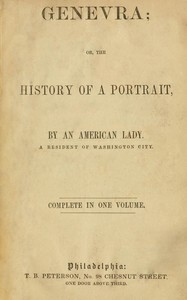
Genevra; or, the history of a portrait by an American lady. A resident of Washington City.
English439 downloads on Project GutenbergDownload EPUB
Public-domain ebook sourced from Project Gutenberg #69029.
Public-domain ebook
English439 downloads on Project GutenbergDownload EPUB
Public-domain ebook sourced from Project Gutenberg #69029.
The opening · free to read
“Clarence, my dear fellow, pray ring the bell, and let us know when that confounded dinner will be ready; the carriage will be here before we are ready for a drive to the Campagna.”
I felt out of spirits and in an ill mood; but mechanically I rose and rang the bell. Our Italian attendant soon made his appearance. “Peppo,”—demanded my friend, the Hon. Augustus Morton, in a mixture of bad Italian and French, which he had learned during our two weeks’ sojourn at Rome,—“Peppo, when will dinner be ready? Don’t you know I told you this morning to prepare for us a nice English dinner, and have it early too?”
“Si Signor,” replied Peppo, standing with his toes bent in, twisting a dirty velvet cap in his hand, ornamented round the edge with tarnished gilt lace, “ma Signor Inglese, say cinque bra, non rolamente che tre ora adesso.”
“O, it’s only three, eh—how came I to make such a mistake?” He looked at his watch: it had stopped. “Well, Peppo,” he continued, in Italian, “can’t you tell them to hurry their operations, and let us have our dinner now. We have an engagement. Go and see if they cannot serve it at once.”
Peppo made his obeisance, and disappeared through the low, narrow door. “It is unfortunate that I did not think to set the time. We need not have returned from Tivoli for an hour.”
“I am not at all sorry, for my part,” I rejoined. “I take but little interest in broken columns, decayed monuments, and old ruins, places of assignations for owls and bats; in fact, one half the persons who visit Rome care no more about these remains of Rome’s ancient grandeur than the doves who make their nests amid the ruins. It has become fashionable of late years to visit Rome, and carry home from the city a collection of antique relics, busts, and every variety of curiosities, all of which are treasured as rare trophies of travel in classic land; a feeling I cannot at all sympathize with. You have the enthusiasm of the grandeur of Rome almost entirely to yourself, my friend. I assure you I have had but few attacks of the fashionable epidemic since my arrival.”
“You are in an ill humor to day, I see, Clarence,” goodnaturedly replied Morton, as he walked to and fro in our dingy dining-room with his hands under his coat tails; “but it is not Rome that vexes you, half as much as the comfortless dreary way in which they manage everything here. If we could only transport our English neatness and comfort to this beautiful climate, it would be a heaven on earth.”
At this moment Peppo returned with the intelligence that the cook absolutely could not serve dinner a moment before the time appointed.
“Well, what can’t be cured, must be endured,” responded Morton, with a shrug of the shoulders. “But since we have two hours on our hands, and nothing to amuse us in-doors, suppose we take a walk toward the Coliseum, and take another look at it. It bears observation more than once. There is a fine artist, Signor Carrara, who lives in that vicinity, and, with your leave, we will drop in at his studio, and examine his gallery of paintings.”
“As you please, Augustus,” I answered; for Morton being five years my senior, naturally took the lead. We had graduated at Oxford together; and on leaving England for a two years’ jaunt to the continent, my father had particularly recommended his darling son to Morton’s fraternal care. We had spent some time in Paris, flirting with the prettiest women we saw; but that’s not saying much for them, after all; for the French women do not depend for their attractions on beauty. They are sprightly, piquant, and witty generally, but they do not possess that native beauty of form and face, we meet with so frequently among the higher classes of the German and English women. Taste in dress and the arts of coquetry, so well understood and practised by the French women, supply the place of greater personal beauty. While in Paris, Morton had purchased and shipped for England a perfect cabinet shop of curiosities; but I, being less influenced by the mania for everything foreign, bought but little.
We had descended the Rhine together, and together admired the wild majesty of its scenery. And sometimes as our bark glided past one of those perpendicular mountains, whose summit seems to kiss the clouds, on top of which, you frequently see perched the ruins of one of those castles built in the olden days of feudal war and terror. Sometimes, I say, I felt a desire to fix my abode, and pass my days in solitude, far from the busy haunts of men, on the banks of that noble river. But then, the thought recurred to my mind: A life spent in dreamy abstraction is a useless one. A life without action, is like a body without a soul. The busy world; the cares, disappointments, and numberless vexations one meets with, all tend to develope many faculties of mind, which, buried in the depths of solitude, might remain forever undiscovered.
We had visited Vienna, the seat of elegance and learning; and after spending sometime in the smaller towns of Germany and Switzerland, we found ourselves one bright day at Rome. During a fortnight we had been occupied every day in sight-seeing; visiting the Vatican, Saint Peter’s, his Holiness the Pope, and all the wonders of the eternal city; and eternal to me, in sober truth, it seemed, as, entering the ancient town by Romulus’ gate, the city dawned upon my view like a vast ocean before me.
But where did I leave my friend? Oh, he took his hat, and so, cautious reader, will I take mine, and follow him. We traversed several grass grown streets, faced on each side, by old houses, built in the Italian style, now fast tottering to decay. Before one of these, stood a company of street singers. A man advanced in years, whose gray hair was illumined by the bright rays of the sun, stood playing on a hand-organ, while a sweet little girl of eight or nine years, with light hair and fine blue eyes, jingled a tambourine at his side. There was something in the sad subdued look of the child, as she timidly advanced toward us, perceiving we were strangers, that almost called the tears to my eyes, as Morton and myself simultaneously threw a gold piece into the old tambourine she extended to receive it.
We passed on, and the next corner hid them from our view. “What a pity such a pretty child should be trained to beggary,” remarked I, as we walked on.
“Yes, it is; but such things are so common in this country, they have ceased to astonish me: indeed, it would be difficult to say what had best be done for the amelioration of the Italians; like everything else, they have had their day; and now night and darkness are hanging over them.”
I scarcely heard him; for now we came full in view of that massive structure, the Coliseum. One side of it is much decayed and crumbled away, and forms a gap in the round outline. We entered through one of the ivy-hung arches, and found ourselves in the vast interior. Several little shrines, the devout offerings of humble superstition, occupied the vast space, where, so many hundred years ago, the gladiators had fought in the yearly games. At one of these, covered with a white cloth, on which were placed a crucifix and bottle of holy water, knelt a young woman with her hands clasped in prayer. She wore the picturesque costume of the Neapolitans. The attitude of devotion contrasted strangely with my recollection of the scenes of which that place had once been the theatre of action.
“This is a most extraordinary structure, so immense!” exclaimed Morton, whose ideas were of the most matter-of-fact description.
I made no reply. My mind was abstracted, it had flown back to the olden times. I thought I saw the dying gladiator leaning on his sword, while the arena rung with shouts of triumph for his conqueror. I saw start up from all parts of the old ruin, that vast wall of human faces, all gazing upon the dying man; but what mattered it to him, the world and all its cares was vanishing fast from his view; his glazed eyes close, his clenched hands stiffen, and his spirit leaves its earthly tenement with the last shout of applause for his conqueror.
I started from my day-dream, and looking for my friend, saw him standing at the other end of the amphitheatre, gazing wistfully up at the sky, through the gap which yawned above us. As I approached him, he exclaimed, “We had better go, or we shall not have time to see Signor Carrara’s paintings before dinner, as we have been here an hour.”
“An hour! impossible, it is not more than ten minutes.”
“I know it seems no more than that to you; but it is, nevertheless, an hour since we entered here; and I am afraid of taking cold from the dampness of the ground; but you were dreaming of the ‘Sorrows of Werter,’ or some other sentimental subject, and of course, thought not of time. Come, mon ami, let us depart.” He linked his arm in mine and we passed out into the street, leading to that part of the city he had designated as the abode of Signor Carrara.
After a few minutes’ walk, he stopped before an old mansion, built in the Venetian style, with a balcony and latticed windows, jealously closed. The appearance of the house was antique and gloomy, even more so than any of the private mansions I had yet seen in Rome. Morton ascended the door-steps, and vigorously rang the bell. The sound seemed to echo through the whole house, as though it were deserted. A moment after I heard the grating of bolts being undone, the door swing back heavily on its hinges; and, standing on its threshold, I saw an old domestic, with a grave, sad countenance, and dressed with greater neatness than the generality of Italian servants. He smiled gaily, and greeted Morton with a respectful obeisance, saying something in Italian, which I did not understand; for Morton was an old friend of the Signor’s, having visited Rome four years before. His question, “Was the Signor at home?” he answered, “Yes,” and requested us to follow him. We traversed a long gallery, then ascended a lofty staircase, ornamented with fine paintings and statues, placed in niches along the wall. At the end of another gallery, the Italian stopped at a door, and knocked. An elderly man, whose hair was slightly tinged with gray, attired in a plain suit of black velvet, opened the door, and, upon seeing Morton, shook him heartily by the hand, and welcomed him back to Rome, in terms of the most polite affability. His manner seemed to partake more of English cordiality than of the grave distant manner the Italians generally preserve to strangers. To my surprise, he spoke to me in good English, upon Morton’s presenting me as Mr. Mowbray of London. Augustus entered the room with the air of one perfectly familiar to its precincts, and seated himself in a crimson velvet arm-chair, near the artist’s easel. Persia’s carpets covered the floor; curtains of crimson velvet fell in heavy folds from the windows; but the splendid paintings with which the walls of the studio were hung, constituted its greatest ornament. There were the faces of youth, and the faces of age. Side by side they hung. There were Cardinals in their black velvet hats, and the heavy folds of their black robes. There were the handsome faces of many of Italy’s proudest sons, and the fair, unfurrowed brow, the black eye, large and languishing, of many a one of its fair daughters.
The book keeps going
Reading is free forever. Sign up and watch scenes appear while you read.



Scenes Storieta drew for other classics.
New illustrated classics
Once or twice a month: the latest books to get full character casts, scene art, and free comic editions. No account needed.