"Yes, sir, it's been rather quiet along this sector for a week or two past, Chase, but believe an old veteran in the ambulance service when he says that it isn't going to remain so very long. An attack by one side or the other is bound to happen; and then--whizz!--bang! You'll hear more shells popping than you ever could have dreamed existed in the world. This is no children's party--eh, fellows?"
A volley of assents came from nine hearty voices.
The "old veteran," who had spoken with a great deal of earnestness, fixed his gaze quite searchingly, even sternly, upon Chase, a big, husky chap sitting close by, who had made no answer.
"Say, mon ami, what made you join the Red Cross, anyway?" he asked.
Chase, disregarding his question, rose to his feet, stretched himself and yawned. He wore the air of one who is entirely out of harmony with his surroundings. Whereas all the rest, in spite of the hazardous nature of their calling, appeared to be full of life and spirits, he looked sullen and discontented.
"I declare, these nights are about the limit!" he exclaimed, in a growling tone--"nothing to do but loaf around and----"
"One kicker in a crowd is one too many," remarked the "old veteran," or, rather, Dunstan Farrington, with a laugh which softened the bluntness of his observation.
"Too bad he didn't remain in the states," added Hugh Wendell.
The observations of the two had only the effect of causing Chase to shrug his shoulders and lapse into a silence which no one seemed inclined to disturb.
On the table in the middle of a large, bare room occupied by the boys stood an oil lamp which cast a yellowish glimmer over the surroundings and threw upon the walls and floor huge, grotesquely-shaped shadows. In the far corners the feeble light could not cope successfully with the darkness, and there somber gloom and mystery lurked.
To a casual observer the gathering might have appeared to be a social affair--a mere coming together of young chaps who had no very serious object in view; in reality, however, it was something far different--they belonged to a unit of Red Cross ambulance drivers, stationed for the time being in an abandoned hotel at a little shell-torn village not far from the now famous city of Verdun. The eleven were within a zone of death and destruction--a zone where peril was never absent for a single hour.
From the roadway outside came a ceaseless rumble. Motor lorries, huge supply trucks, ammunition wagons, in fact practically every kind of vehicle belonging to the transportation service of an army in the field was making its way under cover of darkness toward the front. And in the opposite direction a continuous line of "empties" flowed steadily past.
The constant growling and grumbling of the French batteries, from their masked positions in the hills to the east and northeast, were growing louder. The German artillery, too, located to the north and northwest, kept booming away.
After a while Dunstan Farrington brought out a sketch book, and with swift, sure strokes began to record some impressions he had received during the day. Dunstan was not a collegian, but a former student of the Ecole des Beaux Arts at Paris. During the early part of the great war, like numerous other young men, he had felt the call to action and had volunteered under the Red Cross.
More than once while under fire the boyish-looking young chap had performed some valiant deed in conveying the wounded soldiers from the battle-field, and had incidentally narrowly escaped death or serious injury. Dunstan, with several other equally brave Americans, also ambulance drivers, had received the Croix de Guerre, or War Cross, which the Médicin Divisionnaire had himself pinned to their breasts.
During the last few years the art student had roughed it as few young men of his culture and education are called upon to do. But no amount of hard knocks could have taken away from Dunstan a certain air of refinement and a suavity of speech and manner which stamped him as an aristocrat. It was not, however, that form of aristocracy which sometimes instinctively arouses a feeling of antagonism or dislike.
The ambulance unit was installed in the abandoned Hotel de la Palette, a one-time favorite rendezvous for artists, situated several kilometers behind the lines.
During various bombardments of the village so much damage had been caused that it was now scarcely more than a mass of débris--an inhospitable waste, with but few of its inhabitants remaining, and the hotel had also suffered considerably. The ambulanciers, however, set to work, and by a judicious use of materials succeeded in making it fairly water-tight and comfortable. Formerly they had slept on straw spread around the sides of a big barn; now real beds and real rooms were reminders of the comforts which each had left behind him.
The appearance of the Hotel de la Palette was quite suggestive of some old print, such as might be found hanging in the window of a second-hand book shop. It seemed to be something wholly apart from this modern era; an air of a century past hovered over its discolored walls and the dingy cobbled courtyard which they enclosed. Very tranquil and peaceful indeed it looked--just the sort of a place where one might expect to see a farmer's cart or a hay wagon drawn up before the door and peasants occasionally wandering in and out.
A wide, arching porte-cochère, battered and grimy, led into the courtyard, where some of the Red Cross cars were parked. And so the neighing of horses and the stamping of their iron-shod hoofs, as well as the shouts of hostlers, had long since ceased to be, and now the enclosure resounded and echoed to the blasts of the motorist's horn or to the fresh, clear voices of youthful Americans.
The cars which the courtyard could not accommodate stood in inconspicuous positions in side lanes or behind the houses. The section was composed of thirty men and twenty-two ambulances. Lieutenant Fourneaux, a French officer, had entire charge, but the actual commanders were two college men from the United States--Hugh Wendell, Chef, and Gideon Watts, Sous Chef. French army cooks supplied the meals, and the section also included several French mechanics, though of course all the drivers were fully competent to overhaul and repair their cars.
From four to ten men and a number of ambulances were always on duty near the dressing stations, a few thousand yards from the front-line trenches--a dangerous post indeed, where the men were very often obliged to make a precipitous rush for their dugouts in order to escape the rain of devastating shells.
Yes, there was plenty of action, plenty of thrill and excitement in the life.
Chase, who had arrived but a short time before, during a lull in the fighting on that part of the western front, had as yet seen no dangerous service. The young chap was not very popular--persons of a sullen or taciturn disposition seldom are--and though he must have realized this he made no effort to turn the tide in his favor.
Bodkins, the musical member of the unit, had just brought forth his banjo, ready to indulge in his favorite pastime, when a noise at the door stopped him.
"Hello! Somebody's coming in," he exclaimed, looking up.
At that moment the door opened, and a dim, very vague form was seen standing at the threshold about to enter.
"Hello, fellows! Bon soir, Messieurs!" cried a cheery, youthful voice.
Whereupon every one in the room except Chase gave utterance to a hearty shout of welcome, Dunstan Farrington's voice rising high above the others.
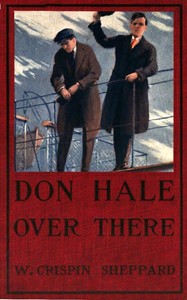
"Hello yourself, Don Hale!" he shouted. "Back from your ten days' furlough, eh? You're a sight for sore eyes! Well, well, we're mighty glad to see you!"
A Mystery
"Say, what kind of a time did you have in Paris, boy?" exclaimed Gideon Watts. "Give us the latest news from civilization. What's in that bundle? Newspapers, by Jove! Hooray!"
It seemed as if every one in the room were intent upon shaking the newcomer's hand at the same identical moment.
"Had a perfectly dandy trip," returned the smiling Don Hale. "Maybe I didn't enjoy every minute of it, too. What do you think?--I actually saw an air raid on Paris. But the anti-aircraft guns soon sent the Kaiser's bomb-droppers flying to the cover of the nearest clouds. Hello!--a new member?"
"Ah, Monsieur, nous avons oublié quelquechose. Pardon our lack of politeness," laughed Bodkins--"also, I might say, my use of French. Honestly, fellows, it's like second nature to me now to let it roll off the tip of my tongue, and----"
"I've seen some Frenchmen almost roll over with mirth when they heard it," broke in Watts, cruelly.
"Jealousy!--there's another mean fling thee has to thy credit," sighed Bodkins. "Really, somebody ought to take a correspondence school course in manners. But here's what I intended to say: Mr. Chase Manning and Mr. Don Hale--let me introduce you to each other."
The newest member of the section and the youngest driver thereupon shook hands.
Then, after each had spoken the pleasant words appropriate to such an occasion, Chase drawled, slowly:
"'Pon my word, Mr. Hale, I never expected to see a youngster like you holding down such a responsible position! Why in the world did you come to France?"
Don gave a merry, infectious laugh, though he flushed a trifle at the reference to his boyish appearance; for he, in common with many lads of his age, liked to be considered as approaching man's estate.