Public-domain ebook
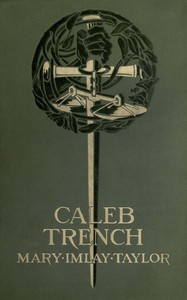
Caleb Trench
Language: en345 downloads on Project Gutenberg
Subjects
In: Romance·Novels·American Literature
Public-domain ebook sourced from Project Gutenberg #69145.
Public-domain ebook
Language: en345 downloads on Project Gutenberg
Subjects
In: Romance·Novels·American Literature
Public-domain ebook sourced from Project Gutenberg #69145.
The opening · free to read
DIANA ROYALL pushed back the music-rack and rose from her seat at the piano.
“Show the person in here, Kingdom.”
The negro disappeared, and Diana moved slowly to the table at the farther end of the long room, and stood there turning over some papers in her leisurely, graceful way.
“Who in the world is it now?” Mrs. Eaton asked, looking up from her solitaire, “a book agent?”
“Caleb Trench,” Diana replied carelessly, “the shopkeeper at Eshcol.”
“The storekeeper?” Mrs. Eaton looked as if Diana had said the chimney-sweep. “What in the world does he want of you, my dear?”
Diana laughed. “How should I know?” she retorted, with a slight scornful elevation of her brows; “we always pay cash there.”
“I wonder that you receive him in the drawing-room,” Mrs. Eaton remonstrated, shuffling her cards with delicate, much be-ringed fingers, and that indefinable manner which lingers with some old ladies, like their fine old lace and their ancestors, and is at once a definition and classification. Thus, one could see, at a glance, that Mrs. Eaton had been a belle before the war, for, as we all know, the atmosphere of belledom is as difficult to dissipate and forget as the poignant aroma of a moth-ball in an old fur coat, though neither of them may have served the purposes of preservation.
The girl made no reply, and the older woman was instinctively aware of her indifference to her opinions, uttered or unexpressed. There were times when Diana’s absorption of mood, her frank inattention, affected her worldly mentor as sharply as a slap in the face, yet, the next moment, she fell easily under the spell of her personality. Mrs. Eaton always felt that no one could look at her youthful relative without feeling that her soul must be as beautiful as her body, though she herself had never been able to form any estimate of that soul. Diana hid it with a reserve and a mental strength which folded it away as carefully as the calyx of a cactus guards the delicate bloom with its thorns. But the fact that Mrs. Eaton overlooked was still more apparent, the fact that a great many people never thought of Diana’s soul at all, being quite content to admire the long and exquisite curves of her tall figure, the poise of her graceful head, with the upward wave of its bright hair, and the level glance of her dear eyes under their thick dark lashes. There was something fine about her vitality, her freshness, the perfection of her dress and her bearing, which seemed so harmoniously accentuated by the subdued elegance of the charming old room. Nature had specialized her by the divine touch of a beauty that apparently proclaimed the possession of an equally beautiful spirit; not even the flesh and blood surface seemed always impenetrable, but rather delicately transparent to every spiritual variation, like the crystal sphere of the magician. But Mrs. Eaton, pondering on her young cousin’s personality from a more frivolous standpoint, took alarm most readily at her independence, and was overcome now with the impropriety of receiving a village shopkeeper in the drawing-room after dinner.
“My dear,” she remonstrated again, “hadn’t you better speak to him in the hall?”
Diana looked up from her paper, slightly bored. “In that case, Cousin Jinny, you couldn’t hear what he said,” she remarked composedly.
Mrs. Eaton reddened and put a three spot on her ace instead of a two. “I do not care to--” she began and paused, her utterance abruptly suspended by the shock of a new perception.
For, at that moment, Kingdom-Come announced Diana’s unbidden guest and Mrs. Eaton forgot what she was going to say, forgot her manners in fact, and gazed frankly at the big man who came slowly and awkwardly into the room. His appearance, indeed, had quite a singular effect upon her. She wondered vaguely if she could be impressed, or if it was only the result of the unexpected contact with the lower class? She was fond of speaking of the Third Estate; she had found the expression somewhere during her historical peckings, and appropriated it at once as a comprehensive phrase with an aristocratic flavor, though its true meaning proved a little elusive.
Meanwhile, the unwelcome visitor was confronting Miss Royall and there was a moment of audible silence. Diana met his glance more fully than she had ever been aware of doing before, in her brief visits to his shop, and, like her elderly cousin, she received a new and vital impression, chiefly from the depth and lucidity of his gaze, which seemed to possess both composure and penetration; she felt her cheeks flush hotly, yet was conscious that his look was neither familiar nor offending, but was rather the glance of a personality as strong as her own.
“You wish to speak to me?” she said impatiently, forgetting the fine courtesy that she usually showed to an inferior.
As she spoke, her father and Jacob Eaton came in from the dining-room and, pausing within the wide low doorway, were silent spectators of the scene.
“I wished to see you, yes,” said Trench quietly, advancing to the table and deliberately putting some pennies on it. “When you bought that piece of muslin this morning I gave you the wrong change. After you left the shop I found I owed you six cents. I walked over with it this evening as soon as I closed the doors. I would have left it with your servant at the door, but he insisted that I must see you in person.” He added this gravely, deliberately allowing her to perceive that he understood his reception.
Diana bit her lip to suppress a smile, and was conscious that Jacob Eaton was openly hilarious. She was half angry, too, because Trench had put her in the wrong by recognizing her discourtesy and treating it courteously. Beyond the circle of the lamplight was the critical audience of her home-life, her father’s stately figure and white head, Mrs. Eaton’s elderly elegance, and Jacob’s worldly wisdom. She looked at Trench with growing coldness.
“Thank you,” she said, “shall I give you a receipt?”
He met her eye an instant, and she saw that he was fully cognizant of her sarcasm. “As you please,” he replied unmoved.
She felt herself rebuked again, and her anger kindled unreasonably against the man who was smarting under her treatment. She went to the table, and taking a sheet of folded note-paper wrote a receipt and signed it, handing it to him with a slight haughty inclination of the head which was at once an acknowledgment and a dismissal.
But again he met her with composure. He took the paper, folded it twice and put it in his pocketbook, then he bade her good evening and, passing Eaton with scarcely a glance, bowed to Colonel Royall and went out, his awkward figure in its rough tweed suit having made a singular effect in the old-fashioned elegance of Colonel Royall’s house, an effect that fretted Diana’s pride, for it had seemed to her that, as he passed, he had overshadowed her own father and dwarfed Jacob Eaton. Yet, at the time, she thought of none of these things. She pushed the offending pennies across the table.
“Cousin Jinny,” she said carelessly, “there are some Peter pence for your dago beggars.”
Cousin Jinny gathered up the pennies and dropped them thoughtfully into the little gold-linked purse on her chatelaine. For years she had been contributing a yearly subsidy to the ever increasing family of a former gondolier, the unforgotten grace of whose slender legs had haunted her memory for twenty years, during which period she had been the recipient of annual announcements of twins and triplets, whose arrivals invariably punctuated peculiarly unremunerative years.
“That man,” she said, referring to Trench and not the gondolier, “that man is an anarchist.”
Mrs. Eaton had a settled conviction that all undesirable persons were anarchists. To her nebulous vision innumerable immigrant ships were continually unloading anarchists in bulk, as merchantmen might unship consignments of Sea Island cotton or Jamaica rum; and every fresh appearance of the social unwashed was to her an advent of an atom from these incendiary cargoes.
“I hope you were careful about your receipt, Diana,” said Jacob Eaton, stopping to light a cigarette at the tall candelabrum on the piano. “How far did your admirer walk to bring that consignment of pennies?”
“My admirer?” Diana shot a scornful glance at him. “I call it an intrusion.”
“Did he walk over from that little shop at Cross-Roads?” Mrs. Eaton asked. “I seem to remember a shop there.”
“It’s seven miles,” said Colonel Royall, speaking for the first time, “and the roads are bad. I think he is merely scrupulously honest, Diana,” he added; “I was watching his face.”
Diana flushed under her father’s eye. “I suppose he is,” she said reluctantly, “but, pshaw--six cents! He could have handed it to a servant.”
“Do you send the servants there?” Colonel Royall asked pointedly.
“No,” she admitted reluctantly, “I suppose he rarely sees any one from here, but there was Kingdom at the door.”
“Who insisted on his seeing you, you remember,” objected her father; “the soul of Kingdom-Come is above six pennies.”
“Well, so is mine!” exclaimed Diana pettishly.
“Seven miles in red clay mud to see you,” mocked Jacob Eaton, smiling at her.
“Nonsense!” she retorted.
“I don’t see why you take that tone, Jacob,” warned his mother a little nervously. “I call it bad taste; he couldn’t presume to--to--”
“To walk seven miles?” her son laughed “My dear lady, I’d walk seventeen to see Diana.”
“My dear courtier, throw down your cloak in the mud and let me walk upon it,” retorted Diana scornfully.
The book keeps going
Reading is free forever. Sign up and watch scenes appear while you read.



Scenes Storieta drew for other classics.
New illustrated classics
Once or twice a month: the latest books to get full character casts, scene art, and free comic editions. No account needed.