Public-domain ebook
Miracle
by Ray Cummings
English413 downloads on Project GutenbergDownload EPUB
Public-domain ebook sourced from Project Gutenberg #69150.
Public-domain ebook
by Ray Cummings
English413 downloads on Project GutenbergDownload EPUB
Public-domain ebook sourced from Project Gutenberg #69150.
The opening · free to read
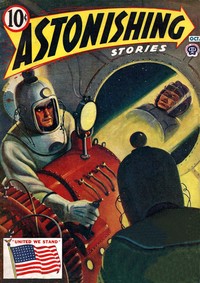
[Transcriber's Note: This etext was produced from Astonishing Stories, October 1942. Extensive research did not uncover any evidence that the U.S. copyright on this publication was renewed.]
"But how can you possibly know that time traveling has never been done?" the chemist protested. "Someone from our future may have gone into the past many times."
"I should think they'd have created quite a commotion," the lawyer observed. "Wouldn't we have heard of it from our historical records?"
"Of course." The chemist was smiling now. "We probably have. History tells of many important occasions on which a 'vision' appeared. A miraculous presence, such as Joan of Arc, for instance, or the Angel of Mons."
"Or the appearance of the Sun God to the Aztecs. I get your point," one of the other men interjected. "You think that there might have been a time traveler who materialized just long enough to take a look--and the superstitious natives took him for a god. Why not? That's probably just what would happen."
Young Alan Dane sat in a corner of his grandfather's laboratory, listening to the argument of the group of men. He was well over six feet in height, a sun-bronzed, crisply blond young Viking. Beside him sat Ruth Vincent, his fiancée, a slim girl of twenty. Alan's heart was pounding. Somehow it seemed as though this bantering talk of time traveling were something momentous to him, something requiring a great and irrevocable decision.
Then abruptly old Professor Dane held up his hand and, quite casually, said, "What you do not know, gentlemen, is that for half my life I have been working to discover the secret of time travel."
His audience was suddenly tense. Professor Dane was loved and respected by each of them, and his word in his chosen field of physics was final. If he said a thing could be done there was no mistake.
The chemist broke the silence. "You've succeeded?" he asked. "You've made experiments that show--"
The old man shook his head. "No, not yet. But I'm close to it. I know I am." He was staring at some infinitely distant thing beyond the room in which they were sitting. Staring as though he were trying to penetrate the grim curtain of the future, or the past.
Almost as though to himself, he went on, "I've often wondered what made me work on this thing all these years. It's been like an inner urge driving me, a preordained destiny that is making me accomplish something."
"Metaphysics!" the lawyer interrupted. "Do you believe in predestination?"
"I believe there is a plan," Professor Dane said simply. "But what it is, and what my part in it may be ... I don't know. That's the queer part. I know instinctively that I must do something, something connected with traveling through time. Some task I must accomplish. But what it is, and how I am to do it ... I don't know. Yet I feel that if the moment came, I would know what to do." He was gently smiling now at Alan and his fiancée. "But perhaps I am too old--I have thought that is true," he continued. "So I sent for my grandson. And, as you see, he brought his fiancée here with him."
The old professor was staring at the startled Ruth now. "And, gentlemen," he added earnestly, "meeting her has somehow seemed to intensify that feeling. There is something to be accomplished, in the past or the future, and it concerns Ruth Vincent!"
Alan's hands were gripping the arms of his chair. These things which his grandfather had been feeling--he was feeling them now. This urge, this apprehension that something was left undone....
"I'm going to ask Alan now to carry on for me," his grandfather finished abruptly. "He is young and strong, educated and able. I want him to feel the things I've been feeling--"
"Oh, I do!" Alan exclaimed. "I'll do what I can, grandfather. I'd have to do it, even if I didn't want to! Don't you see--I feel that same urge!"
The gray moving shadows all around Alan Dane were blurred, formless. He was seated hunched on what had been the ground. It was the ground no longer, but now an undulant gray surface that was under him, supporting his weight, but imperceptible to his touch. He couldn't feel it; he couldn't feel anything but the racking strain of his headlong drive through the vast infinities of time.
He alone, of all things in this great gray monochrome of scene, seemed substantial. Everything else flowed invisibly away into emptiness. The thin skeleton of the metal headgear clamped on his forehead so that his temples throbbed; the wires to his wrists and ankles were luminous glowing strands. The electroidal current from the batteries lashed across his back was throbbing and pulsing into every fiber of his tingling body.
Alan shifted restlessly and glanced at the little time-dial on his wrist. The needle was creeping slowly back, showing a hurtling progression through time to the past. He closed his strained eyes, glad of the relief from the impossible attempt to focus his gaze on the weirdly distorted scene before him.
Where should he stop? And what would he find?
Alan's imagination went back to the scene when his grandfather had first told others of his fantastic creation that would permit voyaging through the years. What had the old man said then? Something about a purpose--
Alan was almost on fire with the consciousness of that set purpose now. Something within him, something that could not be denied, was guiding his hand on the control switch of the time traveler.
He was voyaging backward into time! So strange a thing--and so simple in fundamental conception. He recalled how his grandfather had explained it, back in the laboratory. Everything had been created at once. On the scroll of time everything is permanent. We live our infinitesimal lifetime progressing forward through ordained, predetermined events. All the past and all the future exist--but we can only be aware of that forward-moving instant which we call the present.
And old Professor Dane's fundamental conception--certainly it could now be considered finally proven, with his grandson actually applying it to really travel through time. He had thought that all material things, strewn in sequence on the scroll of time, were of different physical characteristics.
Different states of matter; a different vibration-rate, so that to change the vibratory frequency of any object would be to change its position on the time-scroll!
Alan had started from his grandfather's laboratory, near Riverside Drive in mid-town New York. The date had been May of 1942. His watch, set above the other time-recording instrument on his wrist, told him that his start had been made only a scant half hour before, by his personal consciousness of time. How long ago--how far away that seemed now! There had been a reeling of his senses, the soundless clapping of swiftly alternating light and darkness at the shadowy laboratory windows. Then as his rate of change accelerated, the days and nights had merged into this flat, dead emptiness of gray.
Then the house had abruptly dwindled, thinned out, and disappeared from around him! He had reached a time-era before its construction. Still with greater speed, the shadowy shifting outlines of the great city were in motion, shrinking into smaller and smaller buildings, narrower, shorter roads.
More shadowy open spaces appeared, then were replaced by towering giants of trees. 1850 he reached and passed--then 1800, and 1750. The city had been long gone by then--the little village of British New York was a shrunken settlement of a few thousand persons clustered down about the Battery, four miles from where Alan Dane was. He could see that he was poised now on what seemed a little wooded hill, sloping down to the broad Hudson River a few hundred feet away.
It was a strange transition indeed. And yet to Alan Dane, the strangeness of his own emotions seemed not the least of it. Three years of his life had passed since that night when he had promised his grandfather he would carry on the experiments--three years in which he had lost his grandfather, but gained a wife and son. Ruth Vincent had married him and together they had worked on the fragile thing that he bore now on his back--fragile, but more potent in a strange, incredible way than any other device.
Alone Alan would have failed. Even with Ruth helping him he could not have hoped to succeed so soon. But his grandfather had left researches only a hair's-breadth from completion ... and the young couple had finished them.
Even so, the thing had come almost by accident. Alan was far from sure that he could again compound the strange, unstable mixture of rare chemicals from which his nameless alloys were made--alloys which formed the plates in the time-batteries. But at least he had enough for this one brief trip.
Alan was curiously sure that this one trip was all he needed to make--that, after it was done, the curious driving compulsion that had seized him three years before would leave him, his task completed.
Alan glanced again at the time-dial. The transition was slowing now; he had hardly been aware that a moment ago he had decreased the current. 1699-98-97.... The retardation was progressive. It was almost as though the apparatus itself were dictating his stopping point.
And then the date 1650 flashed into his mind. That was when he had to stop. It was as though he'd always known it....
Was this a cave, here at his back? He was aware that he was sitting at its entrance, facing the shadowy declivity and the deep woods through which he could see the broad, gray river.
An instant later he shoved the lever to shut off the current. The shock of the halt made his senses swoop. Then, as he steadied, with the ground solid under him, he was aware that it was night. The hum of the throbbing electroidal current was gone. But there was still a pulsing note in the air--the throbbing voice of the deep forest through which the river was shimmering, pallid in the moonlight.
Alan staggered to his feet, steadied himself. A shaft of moonlight was on him; and abruptly in the dimness of the cave he heard a sound. A man's muttered, astonished exclamation blended with the startled high gasp of a girl.
As he turned, he saw them. The man was hardly more than a boy--twenty, perhaps, and garbed curiously in gray blouse and brown, baggy pantaloons, knitted brown stockings and thick, clumsy shoes. The girl was even younger, a slim little thing in a quaint bodiced dress with her braided flaxen hair tumbling forward over her shoulders in double strands.
Terrified, wide-eyed with utter astonishment, they mutely gaped at Alan.
The book keeps going
Reading is free forever. Sign up and watch scenes appear while you read.



Scenes Storieta drew for other classics.
New illustrated classics
Once or twice a month: the latest books to get full character casts, scene art, and free comic editions. No account needed.