Public-domain ebook
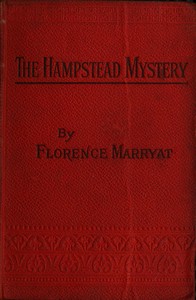
The Hampstead mystery: a novel. Volume 2 (of 3)
Language: en449 downloads on Project Gutenberg
Subjects
In: Crime, Thrillers and Mystery·Novels·British Literature
Public-domain ebook sourced from Project Gutenberg #69217.
Public-domain ebook
Language: en449 downloads on Project Gutenberg
Subjects
In: Crime, Thrillers and Mystery·Novels·British Literature
Public-domain ebook sourced from Project Gutenberg #69217.
The opening · free to read
In a few seconds the door opened again, to admit Frederick Walcheren, leaning on the arm of his cousin, Philip. At first the jury wished the latter to withdraw, but he refused to do so.
‘Is it not sufficient,’ he cried, ‘for you to look at this unfortunate man, to see what he is suffering, and that he is incapable of confronting you alone? I refuse to leave him; if you insist upon it, we will both withdraw. This is a court of inquiry, not of justice; how dare you treat this gentleman as if he were a criminal?’
‘I am not aware that the jury were doing so, Mr Walcheren,’ retorted Mr Procter. ‘However, as he seems ill, and you insist upon remaining by his side, let it be so. It is not, however, the usual thing for a witness to be examined in the presence of another person.’
‘I don’t care if it is the custom or not,’ replied Philip firmly. ‘You may commit me for contempt of court, if you like, but my cousin is too ill to stand by himself, and I refuse to leave him.’
‘Very well, sir, very well!’ replied the coroner tartly, ‘if Mr Frederick Walcheren answers the questions put to him, nothing more will be said about it.’
Frederick did indeed look more like a criminal than anything else. His dark hair, which he wore rather long for the general fashion, was dull and damp with the sweat which agony had forced from him. His features were pinched and his eyes sunk, whilst his clear olive complexion had assumed a yellow, waxen hue. The whole man seemed to have collapsed under the force of his grief. He did not raise his eyes to the faces of his inquisitors, but sat leaning back in his chair, with his gaze fixed on the ground, and his hands clasped together between his knees.
‘Rouse yourself, if you please, sir,’ commenced the coroner, ‘and let us have as succinct an account as you can of all you know concerning this distressing affair. Do you recognise the deceased, Jane Emily Walcheren, as your late wife?’
‘Yes!’ answered Frederick in a low voice.
‘Speak up, if you please! The jury cannot hear your replies. When did you see the deceased lady last?’
‘On Saturday morning.’
‘Well, well, what more?’ cried Mr Procter, impatiently; ‘tell us all about it. Where did you see her, and when did you part with her, and what did you do in the interim? We want the whole story, and can’t go dragging it from you piecemeal.’
‘Say all you know, Frederick,’ whispered Philip, ‘it will be so much the sooner over and done with.’
The unhappy young man made a visible effort, and said,--
‘I saw her last alive on Saturday morning at the Castle Warden Hotel at about half-past eleven or twelve o’clock. We had just finished breakfast, and I left her to have a swim. I never saw her again until I came--here.’
‘How long were you away from the hotel?’
‘I did not return till nearly three. That hour was fixed for our luncheon.’
‘Three hours is a long time to be taking a swim. What were you doing for the rest of the time?’
‘I was occupied in the water, all, or nearly, all the time,’ replied Frederick.
But Mr Procter, who had never indulged in a bath but once in his life, and that was the day before his wedding, when he caught such a cold that he had never ventured into the water since, was not to be taken in by so transparent an untruth.
‘In the water for three hours, sir! Do you expect the jury to believe that?’
‘I was in the sea for the best part of the time, swimming and doing feats of skill. Some part of it must be allowed for dressing and undressing myself. But the day was fine, and I did not care to come out sooner than was necessary.’
‘I believe I am right, Mr Walcheren, in saying that you were only married to the deceased on the Friday previous?’
‘That is the case.’
‘Is it usual for a bridegroom to leave his bride alone for three hours the day after their wedding in order that he may have a swim?’
‘I don’t know,’ said Frederick, wearily; ‘but I did.’
‘Well, when you came back at three o’clock you found your wife was gone?’
‘I did.’
‘Was it not rather strange, considering that you had gone to the beach, that she did not go to the beach also, in order to find you?’
‘At first I thought she must have done so, but I searched the beach and the town, and, finally, the cliffs, without finding any trace of her.’
‘And then you returned to the hotel! At what time might that have been?’
‘I am not sure. At about five, or half-past, I think.’
‘With the exception, then, of a run home for a few minutes, you were absent from the Castle Warden from half-past eleven to half-past five--six hours? And all that time you were bathing or looking for your wife?’
‘I have already told you so,’ answered Frederick.
‘Who saw you during that time, Mr Walcheren? What witnesses can you bring forward to testify that it was spent as you tell us?’
‘Witnesses!’ reiterated Frederick, with a stare. ‘How can I bring witnesses from a place where I am utterly unknown? I have never been in Dover to stay a night before now. Nobody in the town knows me. I have not spoken to an individual, excepting a young man who accosted me whilst swimming, and a girl whom I asked if she had seen--had seen--my--my--wife.’
‘That is unfortunate,’ remarked the coroner, drily. ‘Now, Mr Walcheren, am I right in supposing that your marriage was not conducted very regularly--that it was undertaken, in fact, entirely against, and in opposition to, the wishes of the parents of the deceased?’
‘I don’t know what the devil business that is of yours!’ exclaimed Frederick, roused from his lethargic condition by the impertinence of the question.
‘Everything is my business, sir, in the pursuit of my duty, and, if you address me again in that manner, I shall commit you for contempt of court. I understand, further, that not only was your marriage with the deceased an irregular one, but that you took a false oath in order to procure a licence for it, by stating the deceased to be of age, when she wanted a year of that time.’
‘I did, if you will have it so!’ said the young man, sullenly.
‘Are you aware, Mr Walcheren, that in consequence of your behaviour in the matter, your father-in-law, Mr Crampton, altered his will and cut his daughter’s name out of it?’
The book keeps going
Reading is free forever. Sign up and watch scenes appear while you read.



Scenes Storieta drew for other classics.
New illustrated classics
Once or twice a month: the latest books to get full character casts, scene art, and free comic editions. No account needed.