Public-domain ebook
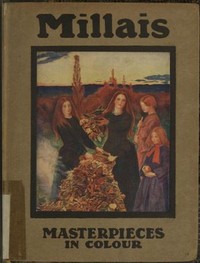
Sir John Everett Millais
by A. L. Baldry
Language: en416 downloads on Project Gutenberg
Subjects
In: Biographies·British Literature·Art
Public-domain ebook sourced from Project Gutenberg #69227.
Public-domain ebook
by A. L. Baldry
Language: en416 downloads on Project Gutenberg
Subjects
In: Biographies·British Literature·Art
Public-domain ebook sourced from Project Gutenberg #69227.
The opening · free to read
Although John Everett Millais was born, on June 8, 1829, at Portland Place, Southampton, his father was an inhabitant of Jersey, and a member of a family which had been settled in that island from a date anterior to the Norman conquest. The first five years of the child's life were spent in Jersey, but in 1835 he was taken by his parents to Dinan, in Brittany, where he began, by his sketches of the scenery of the place and the types of the people, to give the first convincing proofs of the remarkable artistic capacity that was in him. These early efforts were so surprising, and attracted so much attention outside his family circle, that when he was not more than nine years old he was brought to London for an expert opinion on his chances in the profession for which he seemed predestined. The President of the Royal Academy, Sir Martin Archer Shee, was consulted, and his encouraging declaration, that "Nature had provided for the boy's success," decided the future of the young artist, who was at once allowed to begin serious study.
In 1838 he entered the drawing-school in Bloomsbury which was carried on by Henry Sass, and regarded as the best available place for the training of budding genius. In the same year he took the silver medal of the Society of Arts, for a drawing from the antique, and caused quite a sensation when he appeared, at the distribution of the prizes, to receive his award from the Duke of Sussex, who was presiding. The surprise of the spectators is said to have been unbounded when "Mr. Millais" came forward, a small child in a pinafore, to answer to his name, and even the officials at first found it hard to believe that he could be really the winner of the medal.
For two years he remained under the tuition of Mr. Sass, and, helped by his teaching and by a good deal of work from the casts in the British Museum, the boy developed so rapidly that when he was only eleven years old he gained admission to the Royal Academy Schools, the youngest student, it is said, that has ever been received into them. His career there was a series of successes. For six years he laboured indefatigably, and plainly proved his ability by taking prize after prize, beginning with a silver medal in 1843, and ending, in 1847, with the gold medal for a historical picture, The Tribe of Benjamin seizing the Daughters of Shiloh.
Subjects of this type seem at that time to have attracted him strongly, and to have occupied a great deal of his attention, for in 1846 he had painted, and exhibited at the Academy, Pizarro seizing the Inca of Peru, which is now in the South Kensington Museum, and in the following year another study of violent action, Elgiva seized by Order of Archbishop Odo. To 1847 also belongs the great design, The Widow bestowing her Mite, for the Westminster Hall competition, a canvas fourteen feet long by ten feet high, covered with life-size figures. Such an effort speaks well for the energy and ambition of a lad of eighteen, who could within the space of a few months carry out so vast an undertaking in addition to the Elgiva, and his gold medal picture.
So far his progress had been, from the point of view of his elder contemporaries, very promising and satisfactory. He had proved himself to be possessed of unusual gifts; and apparently historical art was to have in him an exponent of rather a rare type, a painter who would carry on its traditions with some degree of vitality. But really he had only been feeling his way, and, not having had time as yet to analyse his inclinations, he had temporarily accepted, with youthful imitativeness, the precepts of his teachers and fellow-students. It did not take him long to discover that he was on the wrong track, and to decide that there was in another direction a far better opportunity for the assertion of his own independent convictions.
About the middle of the year 1848, he, and his friends Rossetti and Holman Hunt, inspired partly by the example of Ford Madox Brown, and partly by their own study of the works of the Italian Primitives who, before the time of Raphael, had laboured with devout and simple naturalism, decided that the principles which guided the early masters were being deliberately ignored by the modern men. So these three youths agreed among themselves to break away from most of the regulations by which they had been bound in their student days and to formulate a new art creed of their own. From this agreement sprang into existence an association, that, despite the small number of its members, and the shortness of its life, has left upon the history of the British School a mark clear and ineffaceable.
The Pre-Raphaelite Brotherhood, as this association was called by way of declaring the intentions and ambitions of the men who belonged to it, was formally constituted during the autumn of 1848. It included, in addition to the three originators, two other painters, James Collinson and F. G. Stephens; a sculptor, Thomas Woolner; and a writer, William Michael Rossetti, who acted as secretary of the Brotherhood. Ford Madox Brown never became a member, although he entirely sympathised with the artistic aims of the group, for he had, it is said, doubts concerning the utility of such a banding together, and was more inclined to favour independent action; but several other young painters, who were never formally of the company, gave it practical support, and openly adopted its methods. Indeed, the list of these outside sympathisers soon became a long one; it included such able workers as William Bell Scott, Arthur Hughes, Thomas Seddon, W. L. Windus, and W. H. Deverell, who were directly inspired by the beliefs of the Brotherhood, and if, as would be quite legitimate, it were extended to take in all the others whose first essays in art were controlled by Pre-Raphaelite principles, an astonishing number of artists who have reached high rank in their profession could be added to it.
At first the inner significance of the Pre-Raphaelite movement was lost upon the general public. When, in 1849, Millais exhibited at the Academy his Lorenzo and Isabella, by which his adoption of the new creed was plainly enough asserted, the picture was not unkindly received. It was ridiculed, perhaps, by the people who realised that it showed an artistic intention somewhat unlike that which was then generally prevalent; but its novelty of manner was put down to the youth and inexperience of the artist, and was regarded as a minor defect that a few more years of practice would remedy.
But in January, 1850, the Brotherhood took a step that very effectually removed any doubts that were felt by the public about the meaning of such canvases. They began to issue a monthly magazine, called "The Germ," in which they and their friends stated with sufficient frankness what Pre-Raphaelitism really meant, and what were the opinions that they professed. As a commercial speculation the magazine must be reckoned a failure, for after the fourth number it ceased to be issued, and at no time had it any general circulation. It served its purpose, however, of making quite intelligible the creed of its promoters; and it gave to the world certain etchings of Holman Hunt, Collinson, Madox Brown, and Deverell, and much literary matter by Coventry Patmore, Woolner, W. B. Scott, F. G. stephens, the two Rossettis and their sister Christina, and some other writers. An etching was prepared by Millais for the fifth number, an illustration of a story that Dante Rossetti was to write; but this fifth number did not appear.
Though "The Germ" died so quickly for want of support, it had fully accomplished what was required of it in the way of propagandism. When the next batch of Pre-Raphaelite efforts was exhibited in the spring of 1850 there was no trace of hesitation or toleration in the comments of the older artists and the press. A perfect storm of abuse broke out. Against Ferdinand lured by Ariel and Christ in the House of His Parents, which were the chief pictures sent by Millais to the Academy, the bitterest attack was directed. Everything that could be said or done to minimise their influence, and to discredit the motives by which they were inspired, was lavished upon them without restraint, in a kind of frenzy of anguished excitement.
All this, however, was mild in comparison with the agitation in the following year, when it was seen that the Pre-Raphaelites, instead of bowing to the storm and recanting their opinions, were prepared to go to even greater lengths in the avowal of their convictions. The opposition had done its best to howl them down, and to frighten them by ferocious threats; but all this expenditure of misapplied energy had had no result. Millais exhibited The Woodman's Daughter, The Return of the Dove to the Ark, and Mariana in the Moated Grange, and Holman Hunt Valentine and Sylvia; while the other members of the group gave equally definite proofs of their intention to persevere in the course they had adopted.
Alarm at this defiance, and perhaps an uneasy consciousness of the real strength of a movement that gave so little sign of yielding to pressure, drove the supporters of the existing condition of affairs to almost incredible lengths. They demanded that these canvases should be removed from the exhibition of the Academy, summarily expelled as outrages on good taste; they urged the students in the art schools to shun the Brotherhood and everyone connected with it; they descended to the lowest depths of misrepresentation, and drew the line at nothing in the way of exaggeration. Calm and critical judgment ceased, for the moment, to exist, and a hysterical absence of balance threw into confusion even the best ordered and judicious minds.
This outburst had one immediate effect, an unpleasant one for the young artists, it checked for a while the sale of their pictures. Christ in the House of His Parents had been painted on commission for a well-known dealer, and it remained for many years on his hands; but Ferdinand lured by Ariel, which had also been commissioned, was refused by the intending purchaser. It was afterwards sold to Mr. Richard Ellison, a collector of rare discrimination, who was introduced to Millais by a mutual friend. Other canvases belonging to the same period either returned from the exhibitions to the artist's studio, or were parted with at low prices and on terms of payment none too favourable.
But after a little while things began to mend. The attack exhausted itself by its very excess of virulence; and here and there strong men came forward to champion the cause of the Pre-Raphaelites. Mr. Ruskin, especially, appeared in the arena as an enthusiastic advocate of an undertaking that was in every way calculated to appeal to his vivid sympathies. He declared with acute and prophetic insight that the pilloried artists were laying "the foundations of a school of art nobler than the world has seen for three hundred years." His explanations of their methods were just what were wanted to set people thinking. Some years, it is true, elapsed before his enthusiasm, and the dogged perseverance of the young men, finally converted the great majority of art lovers; but the conversion did come, and it was complete.
The book keeps going
Reading is free forever. Sign up and watch scenes appear while you read.



Scenes Storieta drew for other classics.
New illustrated classics
Once or twice a month: the latest books to get full character casts, scene art, and free comic editions. No account needed.