Public-domain ebook
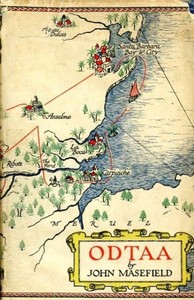
ODTAA: A novel
Language: en560 downloads on Project Gutenberg
Subjects
Public-domain ebook sourced from Project Gutenberg #69339.
Public-domain ebook
Language: en560 downloads on Project Gutenberg
Subjects
Public-domain ebook sourced from Project Gutenberg #69339.
The opening · free to read
Santa Barbara, being the most leeward of the Sugar States, is at the angle of the Continent, with two coasts, one facing north, the other east. The city of Santa Barbara is in a bay at the angle where these two coasts trend from each other.
Those who will look at the map of the State will see that it contains, in all, ten provinces: three eastern, four central, three western, each of which must be briefly described. The visitor sees the land as low-lying coast, growing sugar, with immense ranges of scrub, wild land and pasture behind the sugar country, then foothills above and behind the ranges, and behind the foothills, as the southern boundary of the State, the Sierras of the Three Kings, all forest to the snowline.
The easternmost province of the State is that of Santa Barbara, which contains the capital city. This, Meruel and Redemption, are the three eastern provinces.
Meruel, to the south of Santa Barbara, has a more temperate climate than the western provinces, owing to the cold Southern Drift which follows the prevalent southerly along the coast. Meruel, the capital of the province, stands on a rise of iron outcrop which gives the earth a reddish look. The people of Santa Barbara nicknamed the Meruel land “the Red Country” and the Meruel people “the Reds.”
Redemption, the coal country, lies to the south and west of Meruel. It was formerly a small independent Republic. It was seized by Santa Barbara in 1865, in the war of aggression known as the Redemption War, when a young man, Lopez Zubiaga, the son of a Meruel landowner, “wedded” (as they put it) “the Meruel iron to the Redemption coal.”
The four central provinces are Pituba, near the sea, San Jacinto, in the heart of the State, and the two mountain masses, Gaspar and Melchior.
Pituba, once the home of the warlike Carib race, the Pitubas, is now one of the richest sugar countries in the world. It stretches along the northern coast for nearly two hundred miles, no mile of which is without its plantation, either of sugar or of coffee.
San Jacinto, which lies to the south of Pituba, is the most barren of the provinces; most of it is of that poor soil known as scrubs or burnt land: it is mainly thorny waste, with patches of pasture. In spite of its barrenness, it is most beautiful, because of its expanses. Its chief town, the Mission city of San Jacinto, stands on a peninsula rock above the river of San Jacinto, which rises in the Sierras and comes down in force there, in a raddled and dangerous stream (now controlled so as to be navigable).
Gaspar and Melchior, to the south of San Jacinto, are vast, wild, forested mountain masses.
The three western provinces are Baltazar, Encinitas and Matoche.
Baltazar, to the south, is a mountain mass, forested to the snowline: it is part of the Sierra, like Gaspar and Melchior.
Encinitas, to the north of Baltazar, lies between the San Jacinto River and the Western Bay. Of all the provinces, Encinitas is the most delightful to an English mind. It is mainly an expanse of grass, marvellous to see. It rises from the river into a range of downs or gentle hills, called the Encarnacion Hills, which are crowned with a little walled town, called Encinitas, because the Conquistador, who founded it, came from the village of that name in Spain.
To the north of Encinitas there is a narrow, hilly strip which thrusts out a snout into the ocean. The strip is the western province of Matoche: the snout is the northernmost point of the State, Cape Caliente. The copper found in the hills is smelted and exported at Port Matoche, on the western coast of the snout, in the deep water at the mouth of the Western Bay, the State’s western boundary.
The bay is a deep, dangerous expanse dotted with volcanic islets.
At the time of this story, and for many years afterwards, only seven of the ten provinces ranked as inhabited. The mass of the Sierras, forest to the snowline, were hardly visited by white men: the three forest provinces of Gaspar, Melchior and Baltazar had not been explored. Seasonal rains made the forest unendurable from November until April: the forest fever, to which the Indians burnt copal in copper bowls, was fatal to man and beast from April till November.
At the time of the Spanish Conquest the lowlands were inhabited by small warlike tribes of Caribs who lived in stockaded settlements near the coasts. Of these tribes, the Araguayas, of Meruel, and the Pitubas, of Pituba, were the most important. When the Spaniards landed, Don Manuel of Encinitas, the Conquistador of the State, allied himself to the Pitubas by marrying the daughter of their chief. With the help of his allies he exterminated the Araguayas and drove the survivors of all other tribes into the forests of the south, where a few of their descendants still exist, as forest-Indians; that is, as the shadows of what they were.
After the conquest, vast tracks of land in Encinitas were granted to Don Manuel: other tracts in San Jacinto were granted to a Castilian noble, from whom they passed to a branch of the de Leyvas.
The colony or province of Santa Barbara was administered like all other Spanish possessions in the New World for a little more than three centuries. Jesuit missionaries converted the Indians; the owners of haciendas imported negroes. In the course of the three centuries the northward provinces became sparsely inhabited by horse and cattle breeders, sugar-growers, rum-makers and copper-miners, governed (if it can be called government) by a Viceroy in Santa Barbara city.
In the year 1817, the inhabitants, following the example of other Spanish colonists, broke the link with Spain, by declaring the land to be the Republic of Santa Barbara, with a Constitution partly modelled upon that of the United States. At the time of the foundation of the Republic the State contained, perhaps, one hundred thousand souls, of whom not more than one-third were white.
It happened that a retired English naval lieutenant named William Higgs-Rixon took a prominent part in the capture of Santa Barbara from the Spanish garrison. For this reason, and from the fact that English merchants were the only traders to and from the country, English was taught in the schools, and English people were (as they still are) popular throughout the State. After the War of Independence a good many Englishmen came (and were welcomed) as settlers in the land about Santa Barbara city. In the ’fifties and ’sixties the copper boom brought others, mostly Cornishmen, to Matoche. After the Redemption War a good many more (mostly from the northern Midlands) came to Meruel, to mine iron or coal. In the ’seventies others, from all parts of England, settled as sugar-planters along the northern sea coast in the Pituba country. These men, though they were but a sprinkling, helped profound changes in the land, which in three generations of men multiplied the population tenfold.
It is well, now, to talk of these changes.
Soon after the establishment of the Republic the two political parties in the land became defined as Feudalist and Modernist. In Encinitas and in western San Jacinto, the will of the great landowners was still law: in Santa Barbara City, Pituba and in Meruel a new and vigorous race was demanding freedom from the feudal lords and wider teaching than the priests gave. As the feeling between the two parties ran highest upon the point of Church teaching, the Church party, which was that of the great landlords, came to be known as the Surplices or Whites. For a while, as the Reds were without a leader, the governments of the Republic were White.
Mention was made of one Lopez Zubiaga, who seized the coal country of Redemption in 1865. This Lopez, born in 1840, was the first leader of the Red or forward party to count in affairs. At the time of the Redemption raid, he was a tall, strongly built, masterful and very handsome young man, with a contemptuous manner and savage courage. He was fair-haired and blue-eyed, which made some think that he was not the son of the landowner, but of an Englishman, named variously Corbet, Corphitt or Cardiff, about whom there had been talk.
After his success in seizing Redemption, Lopez was elected President of the Republic in place of old General Chavez, the White. As President he rallied the Reds, and carried through what was called “the Liberal Struggle,” which made all Meruel and Redemption places of mines and factories, and took the schools from the control of the Church. After four years of his Presidency, the Whites returned to office, under the hidalgo, Miguel de Leyva, of San Jacinto, a man of burning faith, more ardent than wise, who provoked the forward party almost to the point of civil war. At the next election, the Whites were turned out of office and the Reds put in, with such unanimity that Lopez could rule as he chose. After the election of 1878, which repeated his triumph, Lopez declared himself Dictator, “while his country had need of him.”
Miguel de Leyva, disgusted, retired from politics: the Whites had no other leader, save young General Luis Chavez, who was indolent, and Hermengildo Bazan, who was only a speaker.
The Dictatorship of Lopez was marked outwardly by a great increase in the foreign trade of the eastern provinces, the threefold growth of the city of Santa Barbara, and an improvement of all the ports, harbours and coastwise railways. After 1884, those who studied the land’s politics felt that the real Dictator was no longer Lopez, but old Mordred Weycock, the manager of the United Sugar Company, an unscrupulous business man.
It was at this time that the oddness and brusqueness in Lopez’ character changed to a madness not likely to be forgotten.
The madness began to show itself in a passion for building big and costly public works. He rebuilt the cathedral (a Colonial Renaissance building) on the lines of the temple at Hloatl. He built himself a palace of glass, having heard, though wrongly, that the Queen of England lived in one. He then built himself a summerhouse, roofed with silver plates, and added to it an ivory room inlaid with gold. Being a Red, he caused all the bread used in his palace to be coloured red. He frequented shambles in order to see, as he said, “the divine colour.”
He had two favourites. Livio and Zarzas; two negro servants, Green Feather and the Knife; and one son, the child of his youth, Don José, born in 1860, a depraved youth of sickly beauty, who headed a clique of vicious lads at the court.
Late in the year 1886, the Dictator’s madness began to take other forms, of hatred and suspicion of the Whites, fear of assassination, and the belief that he was god. All these obsessions were fostered by Mordred Weycock, who contrived to win, from each of them, advantages for himself or his firm.
In all his schemes, Mordred was helped by his nephew, Roger Weycock, twenty-seven years of age, who had been in Santa Barbara since 1883, after having failed for the Diplomatic Service. Roger was a tall, polite, brown-haired, fair-bearded man, with a pleasant manner and a pale, inscrutable face. He was the channel through which Englishmen knew Santa Barbara. It was through his able weekly letters to the English press that English opinion was in favour of Lopez for so long. He knew Lopez to be mad; but the Red party favoured his firm and he had no pity for the Whites: old Miguel de Leyva had once kept him waiting in the hall, and had then brushed by to lunch.
The book keeps going
Reading is free forever. Sign up and watch scenes appear while you read.



Scenes Storieta drew for other classics.
New illustrated classics
Once or twice a month: the latest books to get full character casts, scene art, and free comic editions. No account needed.