Public-domain ebook
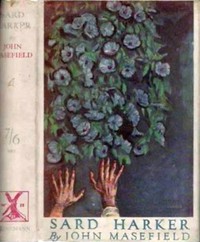
Sard Harker: A novel
Language: en509 downloads on Project Gutenberg
Subjects
In: Historical Novels·Adventure·Novels
Public-domain ebook sourced from Project Gutenberg #69340.
Public-domain ebook
Language: en509 downloads on Project Gutenberg
Subjects
In: Historical Novels·Adventure·Novels
Public-domain ebook sourced from Project Gutenberg #69340.
The opening · free to read
Santa Barbara lies far to leeward, with a coast facing to the north and east. It is the richest of the sugar countries. Plantations cover all the lowland along its seven hundred miles of seaboard, then above the lowland is foothill, covered with forest, rising to the Sierras of the Three Kings, which make the country’s frontier.
The city of Santa Barbara lies at the angle of the coast in the bight of a bay. The Old Town covers the southern, the New Town the northern horn of the bay: in between are the docks and quays.
In the northern or New Town there is a plaza or square, called Of the Martyrdoms. Until about thirty years ago, there was a block of dwelling-houses on the western side of this square, which attracted the notice of visitors. Though the other buildings in the square were gay or smart, with flowers, colours and lights, these were always dingy, by decree. If any asked why they were dingy, they were told that those were the houses of the last sighs, “las casas de los sospiros ultimos,” and that they dated from the time of the Troubles under Don Lopez, who was Dictator de Santa Barbara from 1875 till 1887.
This Don Lopez de Meruel, called The Terrible, after nine years of murder and cruelty, began a year of madness by decreeing that he should be given divine honours in all the churches of the State. Finding himself opposed by some of the clergy and by many of the hidalgos, he seized the daughter of one of his richest landowners, Señorita Carlotta de Leyva de San Jacinto, then on a visit to the capital, and ordered her to pray to him while he sat throned in public on the high altar of the mission church. On her refusal, he ordered her to be enclosed in a house of common prostitutes.
The mistress of this house, an Englishwoman known as Aunt Jennings, refused to obey the order to receive her. “Miss Carlotta is a lady,” she said, “and she does not come in here. And none but a dirty dog would have thought of sending her. And as for praying to the dirty dog, Miss Carlotta has done quite right. If he wants folk to pray to him, let him come here, and my little Sunday school will give him all the pray he wants with a wet rag off the dresser.”
When this was reported to Don Lopez, he ordered that Carlotta and Aunt Jennings should be taken along the water-front by the hangman as far as the Plaza in the New Town, and that there their throats should be publicly cut against the walls of the houses on the west side, then used as houses of charity. This deed was at once done. The two women were killed by Don Lopez’ son, Don José, then a lad of twenty, assisted by a negro (Jorge) and two half-breeds (Zarzas and Don Livio).
Don Manuel San Substantio Encinitas, the betrothed lover of Carlotta, was then at his estate of Las Mancinillas, two hundred miles away. When the news of the crime was brought to him, he gathered his friends, sympathisers, and estate servants, some seven hundred in all, and marched to unseat Don Lopez and avenge the murder.
His army was routed by Don Lopez in a green savannah near the city; many of his friends, not killed in the fighting, were hunted down and killed; he himself, with about forty horsemen, rode from the battlefield, then swerved and made a dash for the city. They appeared at the Old Town at sunset and summoned the fortress to surrender.
Don Livio, who commanded in the fortress, recognised Don Manuel and determined to outwit him. While parleying at the gate as though for terms, he sent a lad, one Pablo de Chaco-Chaco, to some Republican troops quartered outside the fortress in a sugar warehouse. These troops, being warned by Pablo, took up their positions in windows commanding Don Manuel’s troop and suddenly fired in among them. In the skirmish which followed, Don Manuel’s men fell back along the water-front, and were shot down as they went. As darkness closed in, the last six of them, including Don Manuel, gathered at what is known in the ballads as the Bajel Verde, a green boat or lighter drawn up on the beach. Here they made a stand till their ammunition failed. They then took to the water, swimming, in the hope of reaching some English ship in the harbour. But by this time Don Livio had sent out soldiers in boats to patrol the water-front. All of the six except Don Manuel, were shot or clubbed, as they swam, by these patrols. Don Manuel, through fortune, and because he took to the water some minutes after the others, managed to reach the English barque Venturer, whose captain (Cary) took him aboard, and brought him a few days later to safety in Port Matoche.
Eighteen months later, having laid his plans with care, Don Manuel sailed from Calinche with another company, in a tramp steamer. He landed unexpectedly at Santa Barbara, shot Don Lopez with his own hand and made himself Dictator.
In spite of frequent risings of the Lopez faction, most of them led or inspired by Don José, who had escaped Don Manuel’s justice, the rule of the New Dictator was the most fruitful of modern times.
Lopez had caused a rhyme to be carven over the door of the cathedral of Santa Barbara. In translation it runs:
Lopez found me brick And left me stone.
When the new cathedral was built upon the site of the old, men remembered this rhyme, and pled that it should be recarven:
Lopez found me brick and left me stone, Manuel made me like an angel’s throne.
For indeed Don Manuel, in his rebuilding of the city, made the cathedral the marvel of the New World. That and the chapel of Carlotta at his palace, were the chief of his works in his own mind; but in truth he made Santa Barbara as eminent for the arts and sciences as for religion. He founded, built and endowed four big universities, three opera-houses, nineteen theatres. He discovered, encouraged, helped, and at last employed through the years of their power, all the architects, sculptors, painters, musicians and poets who have made Santa Barbara the glory of Spanish-speaking America.
In his person Don Manuel was as glorious as his mind. He has been described in a sonnet:
A calm like Jove’s beneath a fiery air. His hands most beautiful and full of force, Able to kill the wolf and tame the horse Or carve the granite into angels’ hair. His brow most noble over eyes that burn At thought of truth or knowledge wanting aid. His mind a very sword to make afraid, A very fire to beacon at the turn.
His step swift as a panther’s, his will fierce To be about the beauty of some deed, Since beauty’s being is his spirit’s food. His voice caressing where it does not pierce; His wrath like lightning: he is King: indeed He is much more, a King with gratitude.
Chisholm Harker, rector of Windlesham, in Berkshire, wrote a pamphlet on English Mediæval Mystical Romances, and died young, leaving a widow and one son, Chisholm, the “Sard” Harker of these pages, who was thirteen at his father’s death.
Mrs. Harker married again two years later. Sard, at his own request, went to sea, sailing first in the barque Venturer, Captain Cary, mentioned a page or two back. He was on his first voyage in her when Don Manuel took refuge in her. She was one of Messrs. Wrattson & Willis’s sugar-clippers, then regularly trading to the ports of Santa Barbara. Later in his time Sard followed Captain Cary into the Pathfinder and remained with him in her as third, second and at last as chief mate. He was mate of the Pathfinder and had been for ten years at sea when this tale begins. He was called “Sard” Harker (though seldom to his face) because he was judged to be sardonic. He, too, has been described in a sonnet:
A lean man, silent, behind triple bars Of pride, fastidiousness and secret life. His thought an austere commune with the stars, His speech a probing with a surgeon’s knife.
His style a chastity whose acid burns All slack false formlessness in man or thing; His face a record of the truth man learns Fighting bare-knuckled Nature in the ring.
His self (unseen until a danger breaks) Serves as a man, but when the peril comes And weak souls turn to water, his awakes Like bright salvation among martyrdoms.
Then, with the danger mastered, once again He goes behind his doors and draws the chain.
Captain Cary, who had made the Pathfinder a famous ship, thought him the best officer he had ever had.
The Pathfinder was the last and finest of Messrs. Wrattson & Willis’s sugar clippers. She made some famous passages in the sugar and wool trades before she went the way of her kind. She has been mentioned in several sonnets:
She lies at grace, at anchor, head to tide, The wind blows by in vain: she lets it be. Gurgles of water run along her side, She does not heed them: they are not the sea. She is at peace from all her wandering now, Quiet is in the very bones of her; The glad thrust of the leaning of her bow Blows bubbles from the ebb but does not stir.
Rust stains her side, her sails are furled, the smoke Streams from her galley funnel and is gone; A gull is settled on her skysail truck. Some dingy seamen, by her deckhouse, joke; The river loiters by her with its muck, And takes her image as a benison. * How shall a man describe this resting ship, Her heavenly power of lying down at grace, This quiet bird by whom the bubbles slip, This iron home where prisoned seamen pace?
Three slenderest pinnacles, three sloping spires, Climbing the sky, supported but by strings Which whine in the sea wind from all their wires, Yet stand the strain however hard it dings.
Then, underneath, the long lean fiery sweep Of a proud hull exulting in her sheer, That rushes like a diver to the leap, And is all beauty without spot or peer.
Built on the Clyde, by men, of strips of steel That once was ore trod by the asses’ heel.
A Clyde-built ship of fifteen hundred tons, Black-sided, with a tier of painted ports, Red lead just showing where the water runs. Her bow a leaping grace where beauty sports. Keen as a hawk above the water line Though full below it: an elliptic stern: Her attitude a racer’s, stripped and fine, Tense to be rushing under spires that yearn.
She crosses a main skysail: her jibboom Is one steel spike: her mainsail has a spread Of eighty-seven feet, earring to earring. Her wind is a fresh gale, her joy careering Some two points free before it, nought ahead But sea, and the gale roaring, and blown spume. *
Las Palomas, where this story begins, is far away to windward on the sea-coast of the Tierra Firme. It has grown to be an important city since the northern railway was completed. It has been a frequented port since the days of the Conquistadores, because it is a safe harbour in all winds save the north, with good holding ground and an abundance of pure water for the filling. In the years 1879-80 it had an evil name, for it was then the nearest seaport to the newly discovered goldfields at Entre las Montanas in the province of Palo Seco, three hundred miles inland. Many diggers returning with gold from the fields were knocked on the head at Las Palomas.
Las Palomas means the Doves. It got its name from the blue rock-pigeons which used to haunt the cliffs just south of the old (or Spanish) town. The cliffs are now covered with buildings and the pigeons are gone. The only doves thereabouts now are the Little Doves of Santa Clara in a Convent school so named.
The book keeps going
Reading is free forever. Sign up and watch scenes appear while you read.



Scenes Storieta drew for other classics.
New illustrated classics
Once or twice a month: the latest books to get full character casts, scene art, and free comic editions. No account needed.