Public-domain ebook
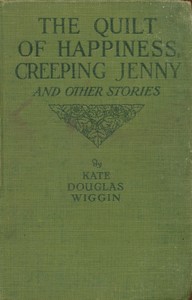
The quilt of happiness; Creeping Jenny; and other New England stories
Language: en392 downloads on Project Gutenberg
Subjects
In: Short Stories·American Literature
Public-domain ebook sourced from Project Gutenberg #69395.
Public-domain ebook
Language: en392 downloads on Project Gutenberg
Subjects
In: Short Stories·American Literature
Public-domain ebook sourced from Project Gutenberg #69395.
The opening · free to read
Jenny Lane lived in a shabby little farmhouse on the Back Nippin' Road that led from Riverboro to Moderation Village. The house was small and compact and as neat as wax inside, for there Jenny was Master of her fate and Captain of her soul.
Outside, alas, things were different. There was only the shell of a former stable; the shed was tumbling down, and, when rain descended in anything worse than gentle showers, Jenny's "indoors" looked like a syndicate of milk pans, the leaks were so many and the dripping of water so continuous.
It had been that way for three years, ever since the autumn that her mother had died; and her father, who had followed his wife in everything, followed her to the grave a month later.
His last words to his daughter had been: "I'm sorry to leave you alone, Jenny, but I'd feel better if only I'd left you shingled. Your mother and me was laying up and laying up ever since we got married. We bought the house and field, paid off the mortgage and gave you good schooling. We are furnished up as well as most o' the neighbors, but when your mother's health got slim and my strength begun to fail, we couldn't seem to get any farther than meat, drink, and clothes for the three of us. The buildings couldn't be kept up, that was the long and short of it."
"I know, I know, Father. Haven't I seen how hard you tried?"
"Now I'm on my death-bed," said the old man. "There's money enough in the bank to buy the shingles, but God knows whether you can afford to hire a man to put 'em on, labor's so scarce and so high."
"Don't worry, Father! I don't want your last days troubled with fears about me and the roof. I'm twenty-two and I can earn my living somehow, somewhere!"
"'Tisn't so easy to earn your living and keep your buildings shingled too!" sighed her father.
"Maybe not, but I'll do it, in course of time!" said Jenny stoutly. "I've heard enough, all my life, about shingles; also about clapboards and paint. There isn't a young man in the neighborhood that I'd want to go to church with, but if one of them should ever chance to ask me to have him, I'd say: 'Shingle the house and I'll say yes!'"
The girl's father smiled in spite of his pain as he whispered: "Don't be too easy when it comes to bargaining, Jenny! Stiperlate first quality cedar shingles, him to buy 'em as well as put 'em on! You're worth it!"
"I shall never have a chance to 'stiperlate,'" thought Jenny, as she went to the kitchen to make gruel; and, as a matter of fact, although Jenny was good to look upon, and had an acre of timber land that would bring in something, fifteen years later, no lovelorn swain had offered to take her and her leaky house for better, for worse.
Later on there were other reasons why Jenny had no opportunity to "stiperlate." The anxious and dreary months went on relentlessly after her father's death, when new misfortunes descended upon her--an accident--unskillful treatment, too long delayed--finally, the loss of a foot--a crutch--eternal lameness. No wonder, as she dragged herself about the house and little garden before she had had time to accustom herself to her infirmity, that Riverboro sympathetically called her "Creeping Jenny." Her nearest neighbor, Mrs. Day, a widow, lived within easy walking distance (it seemed longer when you limped!), and the village itself was only a quarter of a mile away, so she did not lack an occasional call, the offer of an errand or message, and often a drive to church, made wretched by the difficulty of mounting and descending the wagon, with the added mortification of limping into a rear pew.
Still she kept things together, sewing, crocheting, knitting, sending braided and drawn-in rugs to Boston, selling the butter from the one cow's milk and the hay from her eight-acre field.
She got "Pollyanna" from the village library and read it faithfully, but she was rebellious and it did her no good. She allowed to herself grudgingly that if she had lost a hand instead of a foot she couldn't have earned her living; but she never got to the point of being grateful that it was a foot, not a hand; she was unregenerate and wanted both.
It was late November now, and even at the end of the month there was a hint of Indian summer in the air, though a soft rain had been falling for many hours. Jenny's side-door stood open; there was a pale flicker of sun now and then and she was in the pantry wondering if she could venture to take away some of the milk pans that dotted the kitchen floor, all of them a third full of drippings from the ceiling.
She heard the swinging of the garden gate and a knock made her take her crutch and limp to the kitchen door.
A good-looking young man, fairly well clad, with his left sleeve hanging in a strange sort of stiffness, raised a shabby felt hat with his right hand and asked:
"Is this Miss Jenny Lane?"
"Yes, sir."
"They told me at the station you were minus a man and might have a few days' work for me."
"Everybody in Riverboro is minus a man, and everybody needs a little help. There's plenty to do here, for I live alone, but I have little money to spend on keeping up the place."
The young man glanced in at the door with a boyish sort of informality and asked: "Do you keep a dairy farm?"
Jenny laughed outright, and kept on laughing as she answered: "No wonder you asked, but I shouldn't set milk on the floor and it's water in the pans. It's a water farm!"
The laughter was mutual now, and the audacious youth, moving to the lower step and glancing upward, said: "I see you're a little shy on shingles?"
"Just a trifle, but I'm long on milk pans!"
"They told me you were a first-class farmer but--er--a little handicapped on outside work."
Jenny leaned against the door-frame and stroked her crutch with a smile.
"Footicapped would be a better word," she said. "Are you a stranger in Riverboro? Won't you rest a moment? Make your way through the milk pans to the rocking chair. I do need a little help in getting my winter wood in."
"You'll require a lot of wood unless you get a tight roof over your head," said the stranger. "I'm a Western farmer's son, or at least I was; but my mother and father died while I was in France and I'm alone in the world."
"France?" echoed Jenny, with a new glance in her eye and a new tone in her voice.
"Yes, but we'll cut that out! I landed in Boston the other day and now I'm just kind of 'adventuring' till I get my 'peace legs' on."
"You couldn't have come to a worse place than Riverboro. There hasn't been an adventure here in a hundred years."
"I don't know about that! I've only been in town half an hour and I've seen a water farm and a lady that runs it to the Queen's taste!"
Jenny laughed again; the sweetest, most tuneful laugh in the world; one that she seldom used nowadays but had kept over from her long-ago youth. What a droll stranger! And how much more interesting he would be in the intervals of sawing and splitting wood, than old George Gibson.
"It is too ridiculous that you should have seen the milk pans and noticed the shingles. I am going to have the roof fixed next spring if I live. Father saved up money for the stock but--but, I had to use it in a long illness."
"Yes, yes!" interrupted the stranger. "It beats all how that runs through life! You save up money for shingles and then you can't get enough more to put 'em on."
"I'm nearly ready for the second time," Jenny's tone was cheerful and incisive, "but I don't think I have quite enough to pay for labor. Besides, you couldn't, I mean you wouldn't--shingle--could you?"
"Sure I would, and could! You're strong on the subjunctive, aren't you? You've noticed I'm handicapped (I don't have to invent a word, it's all right for my case!). But just you wait and see what I can do with the substitute presented me by the U.S.A.! I'm going to have something more stylish later on, but I don't believe it will serve me any better; you see it's only my left arm!"
Jenny stopped her ears.
"Don't tell me you've read 'Pollyanna' and are glad it isn't your right arm!"
The book keeps going
Reading is free forever. Sign up and watch scenes appear while you read.



Scenes Storieta drew for other classics.
New illustrated classics
Once or twice a month: the latest books to get full character casts, scene art, and free comic editions. No account needed.