“_No man is hero to his valet_”; so runs the cynical adage. But you can reverse the saying with reference to the other sex. Every woman is a heroine to her lady’s maid; it may not be true in all cases, but ’tis true enough for any proverb.
The romance of a lady’s own woman is centred in her mistress. She will clothe her in finery with a greater joy than if she were draping herself; rather than see her go shabby she would wear sackcloth; she will hang over the banisters, on a dinner-party night, to observe the sit of her train as she sweeps downstairs on the arm of some notable personage; she will lean out of the window to watch her step into her sedan, and if there are Beaux hovering and my Lady tosses her plumes and whisks her panniers to proper advantage it is Abigail’s heart that beats high with pride.
Even Miss Lydia Pounce, own woman to my Lady Kilcroney, a damsel remarkable from her earliest youth for her tart and contradictious ways, who was verging on elderliness now with the acidity and leanness peculiar to the “born old maid,” would have laid down her life to ensure that my Lady’s court gown should fit her trim waist without a wrinkle, or that the pink silk stocking that clothed her pretty leg was drawn to its proper skin-tight limit.
(Both the Incomparable Kitty and her Lydia were exceedingly particular that these same stockings should never be worn with the gross slovenliness that permitted a sag. Not indeed that anything but the merest glimpse of slender, arched feet, like the “little mice” of an earlier poet’s fancy, peeping in and out from under the flutter and foam of lace and silken flounce, was ever displayed to the vulgar eye; but to know these niceties complete in the smallest and most delicate detail was necessary to the comfort of any self-respecting Woman. And on this point Lydia was in thorough sympathy with her mistress, as upon all others connected with the elegance and bon ton of the most modish of Mayfair belles; of that leader of Fashion, Feeling and Style which the Lady Kilcroney undoubtedly was.)
If Woman be a heroine to her lady’s maid, in what light does she appear to her Milliner?
Here we come upon debatable ground. At first sight it would seem that the milliner, being dependent upon her customers for her very existence, it must follow that whatever her private opinion may be with regard to their appearance and taste, she can have but one burning desire: to please her patronesses. There is nevertheless another side to the question.
What Woman of intelligence but does not realise that a Mode may make or mar her? How much may hang on the droop of a feather; the tilt of a hat-brim; the glow of a rose in cunning juxtaposition with the soft carmine of a blushing cheek? Blue eyes may flash into sudden significance under a knot of azure ribbon, that had before languished their tenderest in vain. Saucy innocence may triumph beneath a shepherdess wreath; or tired charms kindle into new brilliancy stimulated by the consciousness of the perfect inspiration. In fine, all that life holds best is at the mercy of the mantua maker where the Lady of Fashion is concerned. Let but a clever business woman grasp this great and awful truth; and she who combines the brain that can devise, the taste that never fails, the acumen that knows no hesitation, the finger that is at once light and firm, unerring and ethereal, becomes to her employers a treasure beyond the mines of Golconda!
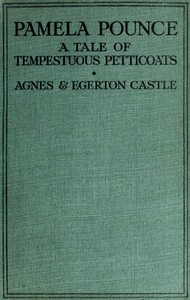
Such a treasure did Miss Pamela Pounce, with whom these pages are concerned, prove herself to the noted Madame Mirabel of Bond Street. And such an influence, far-reaching and subtle, did she exercise on the lives of the Elégantes who consulted her, with the eager submission and reverence of the believing Greek for his Oracles, though with far other and comfortably practical results!
Miss Pamela Pounce, Goddess of Modes, was ipso facto Goddess of the Machine of Life, deciding, with a lucky toss of ribbons or hitherto undreamt of combination of fallals, the fate of her fair customers, and incidentally that of their Beaux, their lovers and their husbands; my Lady Kilcroney and her lazy, jolly life-loving Lord; dark-browed Susan Verney, who would fain have bent the whole world to her sway as she did her weary Baron; Lady Anne, her sister, still fondly, foolishly in love with her stalwart, countrified Squire, Philip Day; their young sister, the last of the fair Vereker Ladies and the naughtiest, with her tangled love-stories; Mr. Stafford, the once famous Beau, proud of the startling beauty of his excellent, dull, childish wife, and anxious that she should flaunt it à la mode with the best of them; Sir Jasper Standish, the sporting Baronet, who, bereaved of his exquisite, clinging Julia, found himself entangled beyond belief with Miss Pamela Pounce’s ribbons; the noted young actress, Miss Falcon, known as “Fair Fatality,” whose brief life drama was more tragic than any she had enacted for the benefit of the public; the plain Miss Vibart, who found beauty and love and happiness all in a Pounce bandbox; Mistress Molly Lafone, own sister--who would believe it?--to the pearl of ingenuous womanhood, Prue Stafford, Molly Lafone that minx, whom the members of my Lady Kilcroney’s coterie were so unanimously leagued to suppress and exclude, and who, in spite of their efforts contrived to insinuate herself disastrously into all their combinations (was it not under a wreath twisted by Pamela’s long clever fingers that this elegant little adventuress came to her most deserved catastrophe?)--there was not one of them but came under her wand!
But at the same time the arbiter of the fate of others, in the shape of a very human young woman, guided the shuttle of her own destiny, and wove a remarkably pretty design for herself.
Milliners, unlike Oracles and Sybils, have each their personal human span with its joys and fears, pleasures, pains and triumphs. Pamela’s romance ran like a cherry-coloured thread through the warp and woof of those other existences, so far above her, in which her profession had involved her. To show the whole pattern, light and dark, sparkling and deep-hued, flowered, dotted, arabesqued, of this brocade of earthly life, the poor Modiste must assume as important a place as that of her clientele.
While Miss Pamela Pounce was serving her third year as apprentice to the great art of Hat Confectionery, under the ægis of no less a personage than the world-famous Madame Eglantine of Paris--once “the little French Milliner” of Bath--her aunt and benefactress, who had placed her in these favourable circumstances, had begun to taste the proudest triumph of her life.
Miss Lydia Pounce was about to become own woman to a Court lady! My Lady Kilcroney--to whom she had so faithfully and ruthlessly devoted herself--from the days when, as the Widow Bellairs, she first scintillated in the world of fashion, to her present position of Viscountess--was chosen by Her Majesty, Queen Charlotte, to fill the post of Lady-in-Waiting to her own Sacred Person.
To enter Court circles had been the dream of Lydia’s angular and ambitious breast. Her mistress’s gratified vanity was a trifling emotion compared to the bursting satisfaction which this upward step on the social ladder afforded the maid. It is not too much to say that she regarded herself in the light of a Prime Minister who has successfully brought about some great political event, and who is a far more important person than the Sovereign whom he serves.
It came to pass in this wise.
His Most Gracious Majesty, King George III, had been ordered to Cheltenham Spa for the waters by his physicians; his state of health was causing anxiety, the extent of which was as yet quite unknown to the bulk of his loyal subjects. Queen Charlotte, the most devoted of spouses, of course determined to accompany him; and the Royal party duly proceeded to the Spa.
It happened to be Lady Flora Dare-Stamer’s term of attendance on Her Majesty, and that stout estimable Lady-in-Waiting happened to be Lady Kilcroney’s very close and dear friend. There was nothing remarkable, perhaps, in the conjunction of these two happenings; but it was indeed singular that Kitty Kilcroney should happen to discover a delicacy in her son and heir which necessitated an instant visit to the celebrated health resort now so vastly honoured.
These events having succeeded each other, nothing more natural than that my Lady Kilcroney should invite her “poor dear Flo” to a dish of tea and a chat at her lodgings, to rest her of the fatigue consequent upon her eminent but exhausting office.
Though Lady Flora had made no secret to her intimates of her intention to rid herself of her honours as soon as might be, who so surprised as her dearest Kitty to learn that she now believed her emancipation at hand?
“To tell you the truth, my dear,” said Lady Flo, chewing a macaroon, “it’s not a job that suits me in the least. ’Twould fit you vastly better.”
“O, Lady Flo!” cried Kitty in accents of amazement. “What a strange thought! I vow and declare such an idea never crossed my mind. And, in truth, ’tis rank impossible. There are a hundred reasons, a thousand reasons, why I am the last person likely to be selected by Her Majesty. I am too young.”
“Upon my word,” said her companion bluntly. “I doubt if there’s so much between us, my dear, were it not that I have run to fat. These macaroons are excellent. ’Tis like your genius to be so well served in lodgings. You’ve brought the best of your staff with you, I make no doubt.”
“And, O, my love! the difficulty of housing them! There’s scarce a tradesman in the town that hath not a servant of mine.”
Kitty spoke with the careless self-importance of the wealthy woman. And Lady Florence approved.
“How right of you, my love, to insist on Comfort!” Comfort was the first and last of her aspirations. “Aye, I will have a little more cream. This whipped stuff--I dare swear ’tis your idea to have it so lavishly flavoured with the vanilla; vastly delicate. Your chocolate is as incomparable as your agreeable self! But yours are not the years of giddiness. I speak in all friendship, I beg you to believe.”
Kitty murmured in an absent voice, that she had married her first--worthy Bellairs--a mere child, practically out of the nursery.
“Anyhow, my sweet Kilcroney, no woman who has had two husbands can deny a certain amount of experience, and upon rep,” with a rolling laugh, “I don’t care who knows that I’m on the wrong side of thirty! You must be pretty well advanced on the right side of it?”
“If you can call twenty-eight----”
“Admit to twenty-eight, by all means!--nevertheless, ’tis an age of discretion. And Her Majesty----”
“I understand----” said Kitty, balancing her teaspoon on the rim of her handleless cup with a musing air--she wondered in her soul if the excellent Lady Flo could really be taken in by this pretence; if it were possible she did not guess that she, Kitty Kilcroney, was longing, grilling to step into her Court shoes--as if she cared who knew that she was over thirty her last birthday, and warming but to riper beauty as the months slipped by!