Public-domain ebook
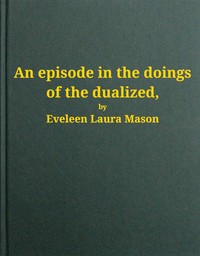
An episode in the doings of the dualized
Language: en267 downloads on Project Gutenberg
Subjects
In: Novels·American Literature
Public-domain ebook sourced from Project Gutenberg #69450.
Public-domain ebook
Language: en267 downloads on Project Gutenberg
Subjects
In: Novels·American Literature
Public-domain ebook sourced from Project Gutenberg #69450.
The opening · free to read
This was the way it happened. Like all beginnings of things, the roots were in the dark. Ethelbert Daksha came of a family in which girls counted for a big half of all that was bright and interesting.
The Dakshas were a delightful family every way, except, perhaps, in the matter of money-wealth. That seemed constitutionally lacking, because you will see yourself that people who take great interest in devising ways of spending money, and very little in devising ways of getting it to spend, in the constitution of things are lacking in money-wealth. But they had everything else except money, and their chief thought in regard to that lack was an amiable perplexity that it seemed to be such a desideratum in affairs of society. There was a big but exhausted English property on the mother’s side; and this strain of high English blood was mixed with a dash of hard-headed German culture and a few drops from the veins of a Spanish dame, lady-mother of the Hidalgos. So, you see, when, ninety years before, a discontent with something in the Old World society had set the elder Daksha down on American soil, various European nationalities were transplanted to root as best might be in American civilization. In addition to all this, as faith in all things high, bounded brightly in the Daniel O’Connell blood which coursed through Daniel Daksha’s veins, it was very natural that his daughter Ethelbert, considering as she did that all nationalities were equally admirable for different virtues, should be greatly astonished that there should be quarrels between those of different countries, when the blood of four nations coursed so amicably in her own veins. If ever there were a girl who, in the nature of things was a typical American, it was Ethelbert Daksha, with the race-drift of Europe, Asia and Africa in her individual veins, as our nation carries it in its aggregated citizenship.
Mr. Daksha recognized all this. He was one of the dreamers who work, at whose feet life lays its crown of success; although so far his many admirable schemes for regenerating society had made him at once the most serviceable and the most impecunious of mortals. He had abundant means, but little money; and while it might be stretching a point to say the Dakshas cultivated a life of beauty on a little oatmeal, yet it would give a hint at the way in which beauty was cultivated in that simple home, where oatmeal was the chief of their diet; that is, if you leave out of the reckoning the best periodicals and old writings of all climes and ages. These things were really the chief of their diet, and had much to do with the fact that they, like the old lady who lived on the hill, were scarce ever quiet concerning the topic of the ideal order of society which is soon coming to our nation, and through us to the world.
Life among the Dakshas was like a bit of Greek art transplanted to the robust civilization of this country, which is trying so hard to assimilate its many diverse elements. The theory of the elegant Greeks was: “What the spirit wills, the body must.” This theory had been practicalized more or less fully by O’Connell, who knew no law stronger than that of the necessities, which he deemed were laid on him as liberator of his people. The same theory had been the impelling power of the Spanish proverb which, translated, reads: “In his own soul, and not in that of another, must the principle of one’s actions be established.” While the German element, which fills the veins of England’s crowned family, in quick response to the same idea, cried out: “Let every man hear for himself, and hearing, then speak.”
So as you may well suppose, the theory that spirit is master and body is only the good servant to do the spirit’s bidding, met some rebuffs as the Dakshas lived it out midst that portion of the newly rich who devote their energies to saving—not MAN, but money. And so much were the Dakshas in love with their beautiful ideals that but for their good common sense they would have become domineering dogmatists; and thus, properly, would have made themselves greatly disliked, and therefore, incapacitated for service.
About forty odd years before this episode the heads of the Daksha family had settled themselves to the recognition that the inordinate frenzy for money-making which was deluging its possessors, would insure many low tragedies in high (?) life; and to the recognition that society was becoming but like a witch’s caldron with its seethe and bubble of toil and trouble, and with its inodorous stench of poison things, flung into it by the witches and wizards, as they carry out their passion-dance on the old Harry’s pavilion.
Of course the Dakshas had their opinion of this besotted high (?) life, with its stimulation of that excitement which wrecks nerve and brain. But they did not presume to force the virtues of self-culture on persons whose highest dream of success was TO INCREASE THEIR CHANCES FOR THIS INDULGENCE IN HIGH OLD TIMES, and who were more than willing to pay for them, with the after years of that disease, remorse and reek of ill-fame in which “the name of the wicked rots.”
Whatever they might choose to do with their knowledge, the fact remained that the younger Dakshas knew that they, by inheritance, were rooted in different purposes and back-history than such as this, which reveals itself in these forms of faith-breaking, love-outraging, humanity-destroying bewilderments. So when this other kind of girls and boys, with their mothers and fathers flying around in society’s whirligig, flitted about them, the Dakshas thought steadily on the truth as they knew it; and “hearing for themselves, then spoke,” thus giving their companions a chance to catch on at any point of spiritual contact which they found available.
So the roots of Ethelbert Daksha’s life had gathered force and fibre in wisdom religions known in ancient America, Europe, Asia and Africa; and the might of this force was now annealed in her nature, and was forming into a unified strength of character, which to the ignorant seemed like a thing of very different quality.
Reginald Grove altogether misunderstood Ethel when first they met; for he did not so much as know that there were girls in the world with character-roots so deep and far-reaching. There were two things he recognized at sight, but character was not one. He knew money when he saw it, and he thought he knew poverty, too. His father belonged to the class of people who laugh at “blood,” and worship money. His blood was made up of such things as a man who lays the reins on the neck of his impulses can get into his veins, if in his early days his father strikes a “money lead” and he “a society life”; but then he had a mother, too, and there came in the difference.
Since he was seventeen years old Reginald had bought all the high-priced things that our fast civilization has to offer in exchange for “soul,” and now the ashes of that past were beginning to grit between his teeth; for he had a sweet memory of peace, purity and of an harmonious-purpose which glinted across his mind angelically as the remains of what had been his baby guesses at real manhood. But this dream, and the sainted mother who had inspired it, had both been devastated by the ignorant animalism of the elder Grove. So when the mother-spirit was released from earth’s control, little Regie’s waiting eyes turned to his father; and watching, he perceived that his father’s shrewd bargaining instincts resulted in increased wealth, which made it possible for him to sow a big crop of gilded misery, and still to pay his son’s bills, while he did likewise; and that doing all this he was yet flattered as a millionaire. So you see, beloved as was his mother’s memory and distinct as had been her teachings to his baby mind, they became but “woman’s notions” when contradicted by his father’s practices, and by the licensing laws of paternal government which assure young men they may sin freely, and yet be wealthy and wise; and healthy, too, if nostrums will make them so.
For a time Reginald believed this, seeing the nation’s fathers had by license laws practically declared it. And as the wisdom of the nation’s mothers had been placed under silence as deep as the grave, “no cause or impediment being shown to forbid the banns” between his soul and corruption, he rushed on in the paths prepared for feet like his. But lately he did not feel very healthy; and as for his wealth, he feared that was getting a bit rickety, and his wisdom was hardly at par.
So these were Reginald’s character “roots.” But it was the one little radical, or true-life fibre, which vibrated with a thrill when he first met Ethelbert Daksha. At the instant, it seemed to him as though the mirage which ever floated up from the fens of his unrecorded life, was swept away by a breath from over the jasper walls of the eternal city. That curious look out of Ethelbert’s eyes, so all-comprehending, pitiful and yet unmoved, held him, as his mother’s eyes had always done in the past; and he had not a word to say. He felt as such men feel when conscious of the moral distance between their private lives and the lives of sweet girl acquaintances.
As usual he waited for Ethelbert to speak; but as is not usual she, recognizing his moral state, did not come down and hunt round for something to say on its level. “The great gulf fixed,” was fixed. She did not try to cross it; so she escaped falling and floundering therein, for her pains. Ethelbert believed not in self-abnegation, but in self-expression. She believed it right to stand squarely on her own fair heights; that from there, with the hand next her heart placed in Jehovah’s, she could give her _brain_-inspired right hand to brother man and then lift!
“An Englishman dares be silent,” they say, and Ethelbert’s English quality was in the ascendant, when Reginald looked at her, wishing to know if those mother-eyes were backed by a brain filled with mother wit and wisdom. He met silence, and went away from that party with an unsatisfied hunger in his soul, which proved that that abused thing was not dead yet.
After that they met casually often; and Ethelbert, who “pondered all these things in her heart,” which are brought by “ministering spirits to those who are heirs of salvation,” knew Reginald better than as if they for years had talked much self-disguising trash together.
One summer afternoon when she was sitting on the balcony of the Daksha home he passed and raised his hat, and she bowed in return, with the thought in mind and eyes, “that man is inherently a good man.” And he saw it, and halted, and then with direct purpose, crossed the street and seated himself on the step, asking no permission.
“Miss Ethelbert, you always make me wish I were a boy five years old,” he said.
“I wish you were,” said Ethelbert.
This was sudden for Reginald; for though he was willing to recognize the failure he had made of manhood, Ethelbert’s businesslike way of accepting the idea was not flattering, and he was used to flattery.
The book keeps going
Reading is free forever. Sign up and watch scenes appear while you read.



Scenes Storieta drew for other classics.
New illustrated classics
Once or twice a month: the latest books to get full character casts, scene art, and free comic editions. No account needed.