Public-domain ebook
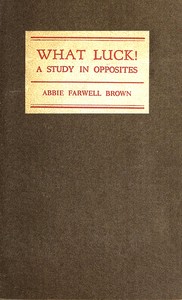
What luck! A study in opposites
Language: en368 downloads on Project Gutenberg
Subjects
In: Children & Young Adult Reading·Novels
Public-domain ebook sourced from Project Gutenberg #69532.
Public-domain ebook
Language: en368 downloads on Project Gutenberg
Subjects
In: Children & Young Adult Reading·Novels
Public-domain ebook sourced from Project Gutenberg #69532.
The opening · free to read
WHAT LUCK!
Side by side on the crowded waiting bench of the Infirmary sat two women, each with a child at her elbow, who had been eyeing one another furtively. They were silently criticizing in different languages.
“Her mourning must have cost much money!” thought Mrs. Rogazrovitch, enviously, looking down at her own painful saffron coat.
“Cielo! What a terrible hat!” mused the other woman, considering the purple velvet creation that crowned the frowzy locks of her neighbor. “She can have no care to hold the love of her husband!” And she wiped a tear with her black-bordered handkerchief.
The eyes of little Stephanie, who stood at the knee of Mrs. Rogazrovitch, were red and swollen; but not with weeping. Even the subdued light of the waiting-room made her squint horribly, and she kept her eyes turned from the window. This brought in direct line her neighbor, the pale, emaciated little boy at the other woman’s side. Stephanie was five; the boy seemed older. He hung his head and never looked up. Stephanie was ready to make friends, for she had grown tired of the long wait, but Paolo’s mother was in the way. She was continually bending over the boy, smoothing his hair or kissing his forehead, in what seemed to Stephanie a very silly fashion. Stephanie’s mother never kissed her at all.
Gradually Stephanie edged nearer. “Hello!” she said in a stage whisper suited to the solemn occasion. “Is your eyes sick, too?”
The boy stared, gave a blinking glance from big, brown eyes, and nodded.
“They look red, like mine,—only worse,” commented Stephanie, after this revealing look. “But they will fix them all right, if we’re lucky. The lady said so.” Again the boy glanced at her pitifully, but said nothing.
“Do you go to Kindergarten?” asked Stephanie. The boy shook his head. “I don’t go nowhere,” he said.
“I guess you are too big for Kindergarten. Oh, it’s the grandest place!” went on Stephanie ecstatically. “But I had to stop when my eyes got sick.—What makes your mother wear those black clothes? I hate black clothes.”
“My father died,” said Paolo solemnly.
“My father ran off,” volunteered Stephanie. “I think he went to be a soldier. Mrs. Raftery says it was because—”
“Stephanie! You shut up!” Mrs. Rogazrovitch jerked her by the arm. The attendant was saying something.
“Eighty-six!” he repeated. It was the number on the red ticket that Mrs. Rogazrovitch clutched in not over-clean fingers.
“Come on, you Stephanie!” snapped the mother. And the slatternly woman with the curly-haired child stepped forward to the table.
Yes; there was no doubt about it. Stephanie was a case of that tubercular eye trouble which affects so many children of the poor; a trouble caused by constitutional weakness, lack of care and of wholesome food. Unless properly treated Stephanie would become partially or wholly blind some day. And the pretty blue eyes would never play their part in a world where all the eyes are needed. But Stephanie was in one respect luckier than Paolo, who still waited, encircled by his affectionate mother’s arm. Strange negative “luck” that consisted in not being too-much loved by any one!
“You’d better leave her here,” said the Doctor, after he had examined the poor little eyes.
The woman blinked. “How long must she to stay?” she asked cautiously.
“Well, maybe three weeks; it’s an average case, I should say. We’ll take the best care of her,” he added kindly. But Mrs. Rogazrovitch was not worrying as he surmised.
“I don’ care. But will she grow well forever?” she asked. “She not be blind, eh?”
“She can be cured if you keep up the treatment as we tell you, after she goes home. You must bring her back for examination; give her milk and wholesome food, well cooked,—no doughnuts and candy; and,”—the doctor referred to Stephanie’s card,—“clean up your house and keep it in better condition. We shall keep an eye on Stephanie. And if you can’t do all this, we must find a better home for her.”
The woman looked sulky. “How much it costs to keep in the Hospital?” she asked. She was told that the usual charge was seventeen dollars and a half for a week, but that if she could not afford so much, the Superintendent would probably arrange to let her pay what she could.
“I can’t to pay anything for sick child!” exclaimed the woman. “I can just to pay rent and get some food. Two years ago my man goes off. I don’ know. Maybe he’s fighting; but I don’ get nothing.”
“That’s all right,” said the Doctor. “You go see the Superintendent. We’ll look after Stephanie anyway.—By the way, will you sign this paper giving us permission to fix her adenoids and tonsils while she is here? I daresay you don’t care?”
“No; I don’ care,” said the woman casually, with the air of one conferring a favor.
Of course she did not realize how great a privilege Stephanie was getting. Few citizens know that the Massachusetts Eye and Ear Infirmary is the only Hospital in the city where a child with a trouble like Stephanie’s would be so taken in and cared for. All such cases are referred to the Infirmary. How should Mrs. Rogazrovitch guess that the kind hands which were to care for the child and the kind faces surrounding her belonged to the best specialists and the best nurses anywhere to be found? She only knew that for the time being a burden was lifted. And this was Stephanie’s advantage over Paolo, whose mother loved him too fatuously to give him his only chance.
“Eighty-seven!” called the attendant, after Stephanie and her mother had passed on. It was Paolo’s turn.
“She says,—she could not spare me; she loves me too much. And besides, my father would not let her,” the boy answered a question in a hollow voice. “He was very sick, and last week he died. He would not let me be in a Hospital.” Helplessly he raised to the doctor eyes which should have been very beautiful; the eyes of a poet or painter.
“But why then did not your mother bring you back for treatment, as I told her?” asked the doctor again. The woman began to weep. “She says she could not leave my father,” interpreted the boy. “She loved him very much. Once she did try to come here with me, after the Visitor called. But she could not find the way. She says her head is sick. And she lost her ring. That made her very sad indeed.”
“Did she give you the medicine regularly?”
The boy hesitated. “Sometimes,” he said; “when the Visitor came. I think my mother forgot; she was so sad about my father. She sat in a chair and rocked all day. She is very kind and loving. She held me on her lap and cried, and cried.”
The Doctor frowned. “Is there any one here who can speak Italian?” he called out to the waiting crowd. A man stepped forward, while the Doctor sent Paolo aside. “Tell her, please, that unless she brings Paolo here regularly, and gives him the medicine every day, I will not answer for the consequences.—Do you see that boy over there?” The Doctor indicated a tiny fellow with fine Greek features, whose mother was crying over him in the corner. “Well; that woman would not leave him in our care, because she was too obstinate. And although she lives close by, she would not take the time and trouble to bring him in for treatment. So now he will lose the sight of one eye at least. Tell Mrs. Valentino that Paolo’s eyes are very bad, and he will fare worse than that boy, unless she does as I say.”
The woman burst into hysterical grief, and clasped Paolo passionately, mumbling endearing syllables in her musical tongue. The boy’s brown eyes filled too, and he tried to comfort her. Pitying herself for her many troubles, the mother led Paolo away.
“She will not come back,” thought the Doctor. “I see it in her face. The Social Service Department will have to get busy.”
The Social Service Department of the Infirmary did get busy, as in all such cases. When Paolo did not reappear, they went to look him up. The Visitor coaxed and re-urged the dazed, inefficient mother. But it was hopeless. Finally the case was reported to the proper authorities. But already Paolo’s mother had loved him to death. Stephanie was not to see her little neighbor again.
Meanwhile, for Stephanie herself there had begun what was—apart from a little discomfort at the beginning—the happiest three weeks she had ever known. To begin with, her poor ragged clothes were taken away, and she had a lovely warm bath in a tub; in itself a novel experience. With her yellow curls nicely brushed, sweet and clean from top to toe, she was then tucked away in a little white cot all by herself,—this also was an unheard-of luxury!—in a sunny, airy room where other clean children were playing about like a happy family. At first poor little Stephanie was too miserable to do more than snuggle into the soft, sweet pillow, and allow herself sulkily to be fed with easily swallowed things. A kind Voice, associated with strong and gentle hands, attended to her wants. But Stephanie slept most of the time; dreaming of happy faces, merry laughter, and feet running about a Kindergarten.
After two days of existing as a mere little mollusc, one morning Stephanie sat up and began to take notice. A beautiful white-clad Being put her into a neat cotton frock and pinafore. Only Stephanie’s scarred shoes were left to remind her of the home that seemed mercifully far away. They tied a shade over her eyes, to help the squint, and for the first time she looked around with interest at the nursery.
What a pleasant place it was! Stephanie had never seen anything nearly so beautiful; except the Kindergarten. Poor little Stephanie! It had been hard luck to give up the Kindergarten, just when she was growing so happy there. The school nurse had seen that she must stop. But—there was a rose on the table here, too! A red rose! And children playing games, just like a real kindergarten! But these children were not all of Stephanie’s age. Some were bigger; some much littler. Why, in the very next cot to her lay a wee baby, sucking a bottle. Nurse said its mother was sick in another room. Stephanie thought this baby would be nicer than a doll to play with. And oh, oh! Over there was a little black live doll, with eyes that rolled and blinked, and real hair standing up all over her head; and a big red bow! Stephanie grinned at the doll; and oh, oh! The doll grinned back! Stephanie waved her arms up and down. And the funny doll stretched her mouth in white-toothed glee, and did just what Stephanie did. This was better even than Kindergarten!
What else was there in the lovely room? Stephanie looked around. There were nine little beds against the walls, and as many more in the next ward, as she soon learned when she began to investigate. Most of the beds were empty in the daytime. Across the room from Stephanie a big boy sat up among pillows, reading. He laughed when Nurse told him a funny story, but could only whisper in reply, holding on to his throat. Stephanie understood perfectly, and was very sorry for poor Tom. She was sorrier still when dinner-time came; when she and the other dressed children gathered about little low tables, with bibs on. Soup was all that poor Tom could swallow. But Stephanie could eat fish, and potato; and there was a nice pudding, too! Poor Tom! Stephanie ate ravenously, after her two days’ fast. No puddings ever happened in the home she had left.
The book keeps going
Reading is free forever. Sign up and watch scenes appear while you read.



Scenes Storieta drew for other classics.
New illustrated classics
Once or twice a month: the latest books to get full character casts, scene art, and free comic editions. No account needed.