Public-domain ebook
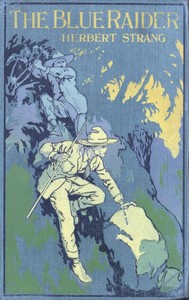
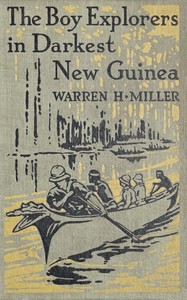
The boy explorers in darkest New Guinea
Language: en481 downloads on Project Gutenberg
Subjects
Public-domain ebook sourced from Project Gutenberg #69554.
Public-domain ebook
Language: en481 downloads on Project Gutenberg
Subjects
Public-domain ebook sourced from Project Gutenberg #69554.
The opening · free to read
“Land ho! fellows--yonder to the east. Can you make it out?”
The two youths beside the tall man who had spoken shaded their eyes from the tropical glare and searched the cloud banks on the horizon of the blue Banda Sea.
“I think I see it, sir,” said Dwight. “Part of those clouds seem to have faint white lines in them.”
“I see it!” exclaimed Nicky, peering through his glasses. “It’s developing out like a camera plate--high, jungly mountains that seem to be floating in the clouds. I see dark spaces now, with streaks of sunlight edging the outlines of the hills. Hurrah for Aru!”
“That’s not Aru; that’s Ke’,” returned the man. “Aru is too low and flat to be seen yet. It lies to the east of Ke’. Our bungalow is on Kobror, the southernmost of the Aru Islands; we ought to pass the port of Dobbo in a few hours.”
The three white men were standing before a small palm-thatched deck house which was their home on the Malay proa Kuching. Curator Baldwin of the National Museum was their leader. He was a tall, rangy giant of a man, his sinewy frame clad in tropical khaki, with the inevitable puttees of the East accentuating the muscular leanness of his long legs. One placed him easily--mining engineer or leader of a scientific field party, captain of his team in college days, most likely, that commanding sort of man to whom exploration in dangerous out-of-the-way places is all in the day’s work.
And the choleric blue eyes that looked a man in the eye from under his pith helmet, the sunburnt face with its gray mustache and firm chin, warned the casual stranger that here was the last man in the world to trifle with.
The two youths beside him were scarcely less noteworthy. Their resolute, weather-tanned young faces bespoke the hardy outdoorsmen, of the same breed, but younger, as the curator. Dwight was tall and spare, with a keen hatchet face and merry gray-green eyes that twinkled at one when he talked, yet they could grow hard and cold as ice in time of peril. Nicky was stout; habitually good-humored, habitually chuckling over the least joke, and always finding one and making himself the butt of it on every occasion. They were a great team; always “joshing” each other, always differing on every conceivable subject, yet devoted to each other and to the curator, whom they adored as an athlete and admired as a scientist. For two years they had been his assistants on expeditions in Africa and in British Guiana. He had picked them for this trip because of their tried and proven resourcefulness in facing conditions as they found them in wild lands. As unlike, physically, as two boys could be, they were alike in one thing--their sturdy independence of character. Original in everything they did, they copied no one, neither in their outdoor equipment nor in their ways of living when in the jungle.
The Malay proa on which the party was sailing bore the house flag of the museum floating from the end of her seventy-foot foreyard. In these days of interisland steamers you will not see so many of her type, once the most common craft of the Banda Sea. Her sails were huge mats of palm-fiber; her masts tripods of bamboo; and her body, built on Ke’ by the greatest boat builders of the Malay Archipelago, was of hewn logs, doweled together along their edges and secured by ribs of teak bent in and lashed with rattan to projections on her planks. There was not an iron nail or a spike in her anywhere, but the curator had chartered her for the museum’s field expeditions among the islands as the best ship for the purpose, for her crew of Javanese and Bugis cost but their rations of rice and fish, with a small wage, and she could sail anywhere and be repaired at any island with native palm and rattan.
Over the smooth rollers of the Banda Sea she bowled southward on the east monsoon, steadily rising the low hills of Aru to the east. By midafternoon she had come off Dobbo, the principal pearl port of the Aru Islands, and the captain altered her course slightly, heading for the coast of Kobror, the wildest of the two great mainlands of Aru.
Out of the coral reefs that surround the harbor of Dobbo put forth a long, black canoe. Her crew of naked blacks foamed up the water in spats of spray with their paddles, singing and shouting as they came. Up in her high carved prow sat a white man, dressed in the cottons of the equatorial tropics, with a Japanese-bowl hat sheltering his head from the sun. He rose and waved them a greeting as his canoe drew near.
“Proa ahoy! I say, are you there, Baldwin?” he shouted. “I’m going on to Kobror with you.”
“Hello, Bentham! That’s fine, old man! Come right aboard and we’ll have tiffin.... Did you get my letter? These mail steamers only touch Aru about once in a dog’s age, they tell me. How are you, old new-chum?” greeted the curator, grasping Bentham’s hand as the canoe shot alongside and her crew of mop-haired Papuans leaped aboard to mingle with their own crew.
“How am I, dea-rr man? My word! Rippin’! Yes, I got your letter, doncherknow. Have a bungalow for you; I fancy it’s more or less done in, but it’s out in the jungle, as you wanted,” he replied, shaking hands heartily.
“It was mighty good of you, Bentham!” thanked the curator. “We’ll fix it up and make it our headquarters while down here. We’re stopping on Kobror a day or so after paradise birds.”
He turned to introduce Dwight and Nicky, who had been studying Bentham curiously. The bold, independent swagger of the Australian was written in every line of his sunburnt face. He was the representative of the Aru pearl company, the curator had told them, sole white man in a whole group of islands peopled by native black savages.
They led the pearl trader to their house on deck, where the Javanese cook served tiffin. It was a cozy little retreat, about ten feet square by perhaps six high, and was built of bamboo arches thatched with palm-leaf attap. Its floor was raised some six inches above the wet deck by springy bamboo poles laid side by side, and the thatch walls were lined with fragrant sandalwood boxes, which also served for bunks.
Bentham was pathetically glad to see them, eager to talk and talk of the war and the world’s doings, with all the pensive loneliness of a white man condemned to months and months of existence with no other associates than Papuan natives and Chinese traders. The curator and the boys filled him up with news to his heart’s content. Just to hear their voices in the good old mother tongue once more, to feel their keen minds sympathetic with his own, was pleasure enough, and Bentham basked luxuriantly in it.
“Where to next, after Kobror, Baldwin?” he asked, after a pause in the flow of news.
“Dutch New Guinea,” puffed the curator. “That’s our main drive this time. Our proa sails for there in a day or so.”
“Dutch New Guinea!” The trader’s face grew suddenly grave. “My word, man! Have you read Captain Rawling’s report of the British expedition up the Mimika? Or about the Dutchman, Lorentz’s, dash to peak Wilhelmina in the Snow Mountains? He’s the only one who has got to them, so far.”
“Sure! We’re familiar with all that. But I can say this to you, Bentham, you being an Australian: the trouble with the British, and with the Dutch, too, is that they can’t get away from the safari idea. Get me? Every one of their expeditions failed because of it. Your Englishman must have his tub and his champagne, his big tents and heavy camp furniture, his tinned sweetmeats and what not, and it takes an army of porters to carry it all. He learned the safari idea in Africa; but it won’t work in New Guinea, because you can neither move a safari through the jungle nor live off the country with it. The British were a year and a half on the Mimika, and they never got within forty miles of the Snow Mountains. It took them five weeks to cut a safari trail three miles long. All that country, from the Great Precipice to the sea, is a flat, dense jungle, with the rivers running through it so swiftly that they are impossible to ascend. They contented themselves with plane-table surveys made from a clearing in the jungle, and before long their army of porters died like flies of beriberi.
“We are going to try the American idea,” he continued, “going light--‘pigging it,’ the British call it--but it gets you somewhere. We’ll take our own light, concentrated foods along, and live off the country on wallabys and wild pig for fresh meat. There’ll be plenty for us.”
“But, man dea-rr--the danger!” objected Bentham. “These Aru niggers, here, had the fear of God dynamited into them some forty years ago, and they’ll jolly well never touch a white man again! But it’s different in Dutch New Guinea. They’re cannibals and head hunters, and most of them have never even seen a white man. The English territory is somewhat policed, but, my word! the Dutch have only two small posts six hundred miles apart on the whole west coast! You’ve heard of the Tugeri head hunters? Many a time our soldiers have chased them over the border--where they stay, to raid us again whenever they feel like it--as jolly a bunch of cannibals as ever cut a throat. And the pygmies of the mountains! My word! Your little party would be massacred the first step ashore. What could you do against fifty of them, or a hundred?”
“Oh--we’ll manage!” twinkled the curator, mysteriously.
“Man dea-rr, it’s foolhardiness! Here, let me give you some dynamite sticks, anyway. It’s plain suicide to go ashore without it. Our expedition, with its army of porters, was all right--but you!”
“Say, Bentham, there’s been a war, you know!” laughed the curator, “and I was in it--lieutenant of a trench-bombing detail. Dynamite is old stuff, now. I’ve brought a few grenades along, if we have any trouble.”
“You’ll need ’em for those blighters!” exclaimed Bentham. “So you were in France, eh?” The regret in his own tones told how keenly it galled him to have been stuck down here out of it all. The talk went back to the war again, of which he could never get enough.
“Yes, we’re going to try a new tack in a new way,” said the curator, when they got back to the expedition again. “We’re going to land in that long lagoon at the head of Dorgo Bay. No white men have ever been in that way. The mountains come right close to shore there, and we can get on high ground right off and avoid that swampy jungle. Then, southward along the ridges above the Great Precipice for ours, and we’ll see what we’ll see.”
“Well!” said Bentham, shaking his head, “good luck to you! But the pygmies or the Outanatas will get you sure! You’ll have to wade through dynamite the whole way!”
“Oh, we’re not exactly unprepared, you know,” demurred the curator. He showed him a curious pistol that the boys had often speculated over. It looked like a foreign automatic, only its barrel was a mere shell of steel, like a shotgun, and it had no hammer or firing mechanism.
“I had this made. Sort of shell thrower, you know. It’s rather effective at moderate ranges--shoots T. N. T. shells. It pays to look ahead in these expeditions and try to meet conditions as you imagine them likely to turn out. Force, and plenty of it, is the only thing the savage really understands, so we’re fixed to defend ourselves if we have to.”
The book keeps going
Reading is free forever. Sign up and watch scenes appear while you read.



Scenes Storieta drew for other classics.
New illustrated classics
Once or twice a month: the latest books to get full character casts, scene art, and free comic editions. No account needed.