Public-domain ebook
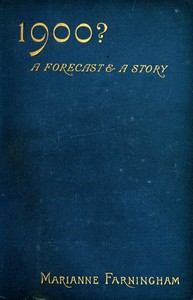
Nineteen hundred? A forecast and a story
Language: en443 downloads on Project Gutenberg
Subjects
Public-domain ebook sourced from Project Gutenberg #69638.
Public-domain ebook
Language: en443 downloads on Project Gutenberg
Subjects
Public-domain ebook sourced from Project Gutenberg #69638.
The opening · free to read
Author of “The Cathedral Shadow,” “The Clarence Family,” “Songs of Sunshine,” &c., &c.
London: JAMES CLARKE & CO., 13 & 14, FLEET STREET. 1892.
This little dream, of what, I hope, may be in the near future, was dreamed several years ago, and much of it written on paper, the rest having to wait for strength and opportunity. But, meanwhile, the spirit of progressive love has not had to wait, and already part of my dream has come true, for the genius of “applied Christianity” is at work, doing what I only saw in a vision. I take this fact as an earnest that the other good things will follow. But they will not unless it is realised that the hope of England is in her young. And I affectionately dedicate this forecast-story to all father-hearted men and mother-hearted women who see in every child a treasure of priceless value, a force of mightiest possibilities, to be redeemed for Christ at any cost.
CONTENTS.
CHAPTER PAGE I.— Old England for Ever 1 II.— A Sunday in the Country 8 III.— A Sunday in London 16 IV.— Cousin Tom 25 V.— The Duty that is Nearest 33 VI.— Arthur Knight’s Inheritance 45 VII.— Mary Wythburn’s Wedding 53 VIII.— Some Signs of the Times 63 IX.— In the Autumn 72 X.— In Paradise 84 XI.— Our Parish 95 XII.— A New Order 106 XIII.— The Course of True Love 117 XIV.— Defeat, or Victory? 127 XV.— A New Emigration 137 XVI.— Christmas Day 147 XVII.— A Report of Progress 156 XVIII.— Discovered 166 XIX.— A New Minister 175 XX.— A Tri-Coloured Crusader 179 XXI.— A Happy Exodus 186 XXII.— “Get On, Get Honour, Get Honest” 199 XXIII.— A City of Homes 207 XXIV.— A Church in Conference 216 XXV.— Thistles or Grapes? 221 XXVI.— His Own Way 229 XXVII.— A Visit of Inquiry 237 XXVIII.— “For Christ and the People!” 244 XXIX.— Young England 252 XXX.— Peace! 259 XXXI.— From Darentdale to High Seathorpe 266 XXXII.— A Letter 276 XXXIII.— All’s Well that Ends Well 283 XXXIV.— Was it a Dream? 292 XXXV.— Was it Expedient? 300 XXXVI.— For Ever After? 307
NINETEEN HUNDRED?
A FORECAST AND A STORY.
CHAPTER I. OLD ENGLAND FOR EVER.
The good ship Kenwick Castle lay off Madeira. Few of her passengers cared to land, for they were homeward bound, and desired nothing so much as to get away speedily. Neither were they as much impressed as on the outward journey, by the soft brilliancy of the atmosphere and the picturesque loveliness of the crimped coast of the island. The towering peaks, the rainbow-spanned gorges and ravines, the dense foliage of the forests, the vineyards and the plantations—made up a picture worthy of admiration; but the eyes that looked across the waters to the white houses of Funchal were wearying for the quiet beauty of English meadows.
The scene between the ship and the shore was a lively one. Boats flashed in the sun, and a clamorous company of Portuguese, Moorish, and negro salesmen offered fruits, baskets, chairs, and ornaments of all sorts, so that those who had forgotten to bring presents for their friends might easily purchase them now. Swimming boys—black-skinned and coffee-coloured—were shouting for money to be thrown into the sea to test their diving powers, and boatmen were eager for customers. But the captain and the crew looked only for fresh passengers, and did but wait with dogged patience until they should arrive.
Two young men were leaning over the side of the vessel, and watching the boats and the shore.
“There are passengers coming,” said one. “It would indeed be strange if Miss Wentworth were among them.”
“Too strange to be true, I imagine. She is probably in England.”
“Yes. But she usually leaves Madeira about this time. I wish she might happen to be going with us.”
“So do I, heartily. And, look—look at the lady in the second boat. She is very like her.”
“How curious. It is really she. Let us see if we can help her.”
They hurried to the gangway and welcomed with great cordiality a lady whom everybody seemed glad to see, not a young lady, however, but a placid, kindly-looking woman, tall and matronly, who was between fifty and sixty years of age. She thanked the young men who had eagerly offered their services, but she evidently did not recognise them nor quite understand their manifest pleasure.
“How are you, Miss Wentworth? It is good to meet you again. You have forgotten us, I see. We came out with you six years ago in the Drummond Castle. My friend is John Dallington, and I am Arthur Knight.”
“Oh, yes, I remember! You were both sent from England to be out of the way; because your presence at home was embarrassing.”
“Exactly; and we have been together ever since. We have travelled nearly all over the world; but they cannot do without us any longer in England, so we are homeward bound, as you are. Don’t you want to know how we have been getting along since we parted from you at the hotel yonder?”
“I shall like to hear anything you have to tell me. You are both so altered that I should not have known you. You have grown, I think, and passed from youth into manhood. Six years make a great difference when you are young. What has become of the gentleman who went to take care of you? Is he with you still?”
“No, he is not. We must tell you of him presently.”
They made a pleasant-looking trio, frequently, during the three days that sufficed to carry them to England, as, with chairs drawn together on the deck, they talked of the past and the future. Miss Wentworth was an interested listener. Her fifty years had made her very kindly and sympathetic, and the motherliness of her nature rendered her the friend of every one who came within her reach, and especially of the young. She had been kind to the two youths, when, a little sore-hearted and rebellious, they were outward bound, and among the things which she had said to “hearten them up” had been one which they had not forgotten. They were therefore the more glad to see her now that their banishment was ended, and they were about to begin life in earnest.
Of the two young men, though Dallington was the more handsome, Knight was by far the more attractive. Rather taller than the average Englishman, strong and graceful in figure, with a broad forehead, masculine nose, firm lips, and wide chin, he was the personification of strength and manliness; but there was something about him which told also of great tenderness, refinement, and self-mastery. There was not a particle of self-assertion in him, and yet he was one who would never be overlooked, even in a crowd. When he entered a room people naturally observed him, when he spoke everybody listened; for he had the rare gift of magnetic influence, which seems to be possessed by only a few in a century.
Miss Wentworth had recognised this on her first meeting with him. She felt sure that if he lived the world would hear of Arthur Knight, and she was full of desire that the life so vigorous and forceful might be altogether on the side of righteousness and truth. So wistful was she that she could not let him go without one or two earnest words. She believed that “the Christian is the highest type of man,” and her faith in the power of the living Christ to draw and train disciples was great. She had doubts of the presumption which talks to people about “their souls,” yet she did summon courage to say to those young men, who glibly informed her that they did not believe in the Founder of the Christian religion, “No, for you do not need Him now; but when you do, you will find that He is both able and willing to help you.”
These words neither of the three had forgotten; and Knight referred to them in one of their conversations.
“I proved the truth of what you said, Miss Wentworth, in a very extraordinary manner. I had not the slightest sympathy with religion in any form. My mother died when I was about three, I can scarcely remember her; but my father, who was a Dissenter, took me to chapel with him always; though I never really entered into the service. I did not join in the prayer, for I did not want the things for which the minister asked, and the sermons never concerned me. They were for the most part disquisitions on texts, for which I did not care, and they seemed to me to have nothing whatever to do with the ordinary lives of the people. I cannot remember ever hearing anything to make a false or selfish man uncomfortable, and I could not see that those who were church members were at all better than those who were not. And I really believed that the whole thing was a farce.”
“I never went as far as that,” said Dallington. “But I did not have as much of it as my friend. We were Church people; and we had no prayer-meetings in the vestry, nor psalm-singing at home.”
“I had enough of it, and it was really irksome; and when I began to read books that were opposed to Christianity I agreed with every word that was said, and decided that as for religion there was absolutely nothing in it.”
“Yes?”
“But I know now that there is. You were asking me about my old tutor. He is dead; and it was at his death that I put your words to the test. It was very painful. We were alone, with none but Arabs near us. He was awfully ill; and when the thought came to him that he would probably die, he was altogether unnerved. The fact is that he was really afraid of what might be after death. He said to me, ‘Arthur, if there is a hereafter I am not prepared for it.’ Then I told him what you had said.”
At this point of the conversation John Dallington arose and walked to the side of the vessel.
“Mr. Knight, if you would rather not talk about it, do not tell me,” said Miss Wentworth, in a low voice.
“But I want you to know,” said Knight. “One cannot talk much about it; but I ought to tell you, and I will. I had never prayed before, but then with all my heart I called upon Jesus Christ. I asked Him, if it were true, as so many people believed, that He was really the living Saviour, to reveal Himself now. And He did.”
“But your friend did not live.”
“No; we did not ask for that. That was not what we most wanted. What we needed was the assurance that there is SOME ONE who sees us in our weakness and cares for our pain, and hears us when we cry. The assurance came so certainly that I have never doubted since. Hutton grew first calm, and then radiantly happy—as I had never seen him before. He looked up with a wonderful light upon his face, as if he could really see what is beyond, and he died with the name of Jesus upon his lips.”
“I am very glad. And what of yourself?”
“Of course, I cannot explain things. Dallington and I have received pretty regularly from England all the books and journals which we could get; and I know that this is a time of great doubt. I cannot answer the questions that are asked. But”—and the young man bowed his head reverently—“I believe in the Son of God, and I rest in His salvation.”
Such a conversation could not be a protracted one. Miss Wentworth could only look the sympathy and joy which she felt; and Arthur Knight walked the length of the deck twice, and then joined his friend. When the three met again on the following day the talk was of a less serious character.
The book keeps going
Reading is free forever. Sign up and watch scenes appear while you read.



Scenes Storieta drew for other classics.
New illustrated classics
Once or twice a month: the latest books to get full character casts, scene art, and free comic editions. No account needed.