Public-domain ebook
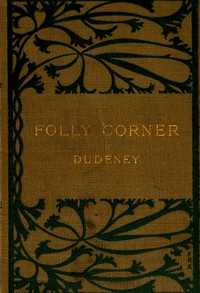
Folly Corner
Language: en499 downloads on Project Gutenberg
Subjects
In: Romance·Novels·British Literature
Public-domain ebook sourced from Project Gutenberg #69758.
Public-domain ebook
Language: en499 downloads on Project Gutenberg
Subjects
In: Romance·Novels·British Literature
Public-domain ebook sourced from Project Gutenberg #69758.
The opening · free to read
PROLOGUE.
THE steam of that stifling London day rose up in a choking, enervating haze from the hot grass. The shrill cries of children, loose from the Board School, cut the thick air. A train rushed across the bridge. Two or three cyclists tinkled their bells irritably as they spun down Wood Lane to the Uxbridge Road, leaving a cloud of gray grit behind them. Omnibuses pulled up at the corner of the short street near the few newly-built shops. From Portobello Road came the heavy rumble of more traffic, mixed with the nearer shout of costers vending dried fish and over-ripe fruit.
She was a young woman. She stood still, in a limp, hopeless attitude, her face turned on Wormwood Scrubbs, her strained eyes vacantly fastened on the buildings, spires, and chimneys in the distance.
Some simple sound from the frowning prison on her left made her turn her head with the swift, watching movement of a cat. But there was nothing to see; no hint, no hope. Behind those walls! Her throat, rising white and firm from the tumbled collar of the cotton blouse, contracted. Those walls! those impenetrable walls! those relentless walls!
She put out two hands in baggy gloves; she held them up, flat palms upward, toward the speechless prison. Her attitude was one of strong appeal, of hope, almost--as if she half expected that despair would work a miracle. They stretched out, big, strong, shapeless in the old gloves--those quivering, appealing hands of hers.
With a sharp agonized movement of the wrists she let her hands drop nervelessly to her side. A sob was strangled in her throat; she turned her head abruptly, so that her eyes no longer rested on the walls. With a sudden impulse she started running across the grass; ran across the road and under the bridge to the spot where an omnibus was waiting.
It grew dusk as she rattled back on the garden-seat to London. One by one the lights of night gleamed out. The life of night began. She looked down and saw the interior of smoothly rolling carriages, with women in evening dress lying idly back inside. Women on foot, smartly clad and with happy faces, flitted along the white pavements. Women clambered to the top of the omnibus, chattering and tittering. The one who sat next her glanced curiously at her grim mouth and shadowed eyes.
The lights grew thicker; fantastic chains of light--red and yellow. London glittered like some fairy mine of jewels: jewels already cut and polished, every facet gleaming. Words winked out letter by letter, then vanished. She saw them come and go on the fronts of the houses. OX FORCE--NINON SOAP--DUNN’S NOSTRUM. To her strained senses they lost all common meaning and symbolized the weird, the threatening, the unknown.
It was blinding hot in the market town that Wednesday. Sheep straggled into the pens; the drovers choked and cursed as the dust dried in their throats. A smart trap, driven by a girl, with a groom behind, bowled down the High Street, leaving behind an impression of coolness and smartness. Now and again a sharp, imperious cycle-bell cut the air, and as some female cyclist darted by pedestrians heard the soft flutter of sleeves, like the flapping sails of a yacht.
A man came, with a slightly rolling walk, down the street. He made an imperial progress, nodding his head bluffly to deferential shopkeepers who stood at their doors, exchanging a jovial word or so with other substantial yeomen. Everyone knew and respected Jethro Jayne--“Young Jethro” of Folly Corner. Everyone in and around Liddleshorn knew that there had been Jaynes at Folly in unbroken succession since before the days of Cromwell.
He was a picturesque figure, with his open, weather-tanned face, his clean-shaven lip, his buff breeches, and brown gaiters. He wore a linen coat and a flapping white linen hat. His eyes were lazily merry and roguish under the starched brim.
He turned in at the door of the inn, with the low-pitched, paneled dining-room, where most of the farmers dined on market-day.
A round-faced, pretty girl brought him his plate of beef and his two vegetables. Bread and cheese, and a jug of sweet cider, completed the meal.
He looked at her thoughtfully whenever she approached: so very blue-eyed and round; such a plump, neat figure in a black gown! He looked at her through a strong cloud of smoke as he puffed at his pipe and drank a last glass of the cider. She had suggested something. He was thoughtfully asking himself, Why not?
Presently he took a pencil and a letter from his breeches pocket. He began to write on the back of the envelope, making many erasions, knitting his brows and pouting his lips like an anxious child.
The girl came softly to the table and took away the mustard for another customer. Jethro never looked up at her. She had done her part. She had suggested.
He paid the bill and emerged into High Street. He looked a trifle more bluff and lurching than before. His face was red--with cider, with the excitement of his daring plan.
For the first time in his life he was yielding to impulse. Already he half regretted yielding. He was afraid of himself; he was more afraid of Gainah.
Yet he bent his head and went down two steps into the editorial offices of the Liddleshorn Herald. The place was empty save for a sharp-featured youth who was lounging at the side of the counter. He sharply asked the visitor what he wanted. He was a new importation, an embryo journalist, with a London journal as his goal. He touched the town side of things only. He had a smoldering contempt for farmers, and knew nothing of the master of Folly Corner.
Jethro pushed his envelope across the counter with a sheepish gesture.
“How many insertions?” asked the youth laconically, yet throwing an amused, curious glance at the big figure which stood near the door--an unconscious, unappreciated color scheme--in white and russet, buff and brown.
“How many times in?” The gentleman-farmer’s big, embarrassed laugh seemed to shake the silent place. “Well--once.”
As he went slowly out of the town the tinkle of a piano came out clearly from the front room of a little buff villa. There were rows of these buff villas on the outskirts of the town. Some navvies were putting down new drain-pipes. The notes of the piano and the reedy voice of a girl came out slowly, each note isolated and mingled with the nervous tap of the pickax. Jethro stood still and listened. It was a song of Purcell’s:
“To make us seek ruin, to make us seek ruin and love those that hate.”
He walked on, a queer stirring at his heart. The thin voice of the girl in the villa had touched the romantic spot in him. He thought of that other girl at the inn--plump, blue-eyed, smiling. He thought of his carefully-worded advertisement which, by to-morrow, would be worming its way through Sussex, through Surrey and Hampshire to London perhaps.
It was a joke; he began to regret, to blame the cider, or the demure little rings of light hair on the waitress’ unlined brow.
And yet he could still hear the piano. He still felt the slow, wondering work of his heart.
FOLLY CORNER.
THE story begins with the emotions of two women--the two women principally concerned--on a morning ten days after Jethro Jayne had imprudently indulged in sweet cider at the market dinner in Liddleshorn.
One woman was young--twenty-five or less. She was a big, fair girl; a handsome girl, in the elementary way that satisfies most men. She looked well able to take care of herself; an up-to-date girl, accustomed to fight her way alone, to meet men on their own ground, to jealously look after her own interests. There was, however, an occasional haggard line at her mouth, and in her well-opened, rather prominent gray eyes was a hunted, hopeless look.
She wore a coat and skirt, with sleeves of last year’s cut. Her hat was trimmed with strict attention to fashion, and yet bore the brand “home-made.” There was a crisp new veil tied about the brim.
She smacked so of cities that the few people she met turned round to slowly gape at her, and a couple of small girls coming home from the village shop laughed aloud in her angry face.
She walked slowly along the white road, stopping now and then to lift her veil and wipe her burning cheeks.
The scenery was beautiful--with the characteristic beauty of the Sussex Weald. But she did not notice: she was too preoccupied. Her own affairs were in a critical state, and when one is anxious there is small consolation in undulating hills, long stretches of pasture, and red-roofed farmhouses. Her attitude was quite cockney--prim regard for her shoes and half-contemptuous admiration of her surroundings predominated.
Once she stopped to rest. A thatched and plastered cottage stood empty under the shadow of huge oaks. Wide green glades wound into the very heart of a little wood. The turf, inch-deep in moss, yielded like down. It was irresistible. She threw herself flat on her back, settling her skirt smoothly under her, and looked lazily through the wide mesh of the veil at the sky. The heat and the perfect silence almost made her sleep. A trap went by full of gayly-dressed country girls; a young man, hideous in his Sunday clothes, was driving. They were all off to some festivity, and they looked curiously at the prone figure on the turf. At first they thought it was some tramp, but the thin-soled morocco shoes stuck out from the dusty skirt contradicted that assumption. Such vagrant ways these town folk had! They laughed derisively, and the sound roused her. She sat up and stared a trifle vaguely at the watchful hills, the glades of the wood, the white, winding ribbon of highroad. Then she rose and whisked her skirt and went on again.
Only once more was she tempted to stop--at a bramble bush where the blackberries were loose and juicy. She drew up her veil to her nose and drew them off the stalks with widely parted lips, because she was anxious not to soil the fingers of her gloves. It was so necessary to make a good impression: the woman who could always make a good impression had the world at her feet.
She crossed a common; fowls were scratching and shaking their wings in the mounds of dust; a long string of geese waddled by, conversing volubly, and with evident arrogance. A man with a timber wagon came toward her, and she stopped him to ask the way. He told her that she had a mile or more to go.
She went on, her feet dragging at every step. At every step she grew more nervous, more undecided. She took a letter from her pocket and read it over twice. She stopped, half turned back. Her face was violent red and chalk-white in turn. Still she went on, with lagging, heavy feet and a queer, terrified shame and excitement at her heart: went on over that open common which was just beginning to flush with heather. Another man came by, driving a black pig. It grunted, and seemed to run in every direction but the right one. He looked a stupid man; but, then, they were all half-witted in the country. She said--very slowly and deliberately, as if she were speaking to a small child--that she wanted Folly Corner. He gave a vacillating grin, keeping one eye on the pig, and pointed to a substantial stack of chimneys on the left.
The book keeps going
Reading is free forever. Sign up and watch scenes appear while you read.



Scenes Storieta drew for other classics.
New illustrated classics
Once or twice a month: the latest books to get full character casts, scene art, and free comic editions. No account needed.