About this book
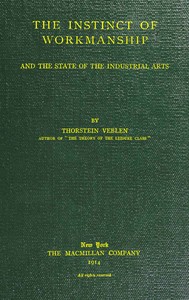
Thorstein Veblen’s “The Instinct of Workmanship, and the State of Industrial Arts” is a scholarly essay that treats the history of technology, industry, and craftsmanship as a series of loosely connected investigations rather than a tightly documented study. The opening pages make clear that the work is a “cursory survey,” offering general citations and selective references while reserving detailed footnotes for illustrative points. Its contents are organized into seven chapters that move from primitive technology through the “savage state” of industrial arts, the rise of hand‑craft, and finally the machine industry, all framed by an overarching discussion of human instincts and their role in shaping institutions. Veblen begins by arguing that human conduct is guided by innate proclivities, what he calls “instincts”, and that these drive the development of habits, conventions, and ultimately the structures of industrial society.
The book reads like a late‑19th‑century social‑science treatise, dense with philosophical argument, biological analogies, and a formal, almost lecture‑like tone. Veblen’s prose is meticulous, occasionally digressive, and steeped in the language of his era, making it a rewarding encounter for readers interested in the intellectual history of economics, the evolution of labor, or the cultural analysis of technology. Scholars of economic history, sociology of work, and anyone fascinated by the roots of modern industry will find Veblen’s blend of biology, psychology, and institutional critique both challenging and illuminating.