Public-domain ebook
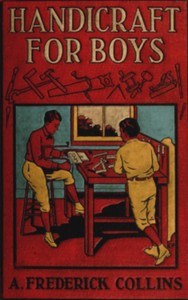
Handicraft for boys
Language: en1,571 downloads on Project Gutenberg
Subjects
Public-domain ebook sourced from Project Gutenberg #69989.
Public-domain ebook
Language: en1,571 downloads on Project Gutenberg
Subjects
Public-domain ebook sourced from Project Gutenberg #69989.
Handicraft for Boys is a practical manual written by A. Frederick Collins, the inventor of the wireless telephone, and first published in 1918. The book opens with a direct address to its youthful audience, framing a boy’s day into four parts, eating, sleeping, working, and playing, and urging the reader to devote the “playing” portion to constructive hobbies. From that point it launches into a systematic catalogue of projects, beginning with carpentry tools and techniques, then moving through scroll‑sawing, wood turning, metalwork, drawing, photography, printing, glasswork, toy making, and even homemade musical instruments. Each chapter is densely packed with step‑by‑step instructions, tool lists, and diagrams, promising a hands‑on experience that blends mental planning with physical creation.
The voice is that of an early‑twentieth‑century educator who combines earnest encouragement with detailed, almost encyclopedic instruction. Its prose is straightforward, occasionally peppered with the period’s moral tone, and the layout reflects the era’s penchant for exhaustive illustration and numbered sections. Readers who enjoy meticulous do‑it‑yourself guides, historical craft techniques, or a glimpse into the maker culture of the 1910s will find this volume both informative and inspiring.
The opening · free to read
Your life, if you live it like the average boy, is split up into four parts and these are (1) eating, (2) sleeping, (3) working and (4) playing.
Now I haven’t a word to say about the first three phases of your existence for you will attend pretty well to the eating and sleeping ends, and your elders will quite likely see to it that you get enough work to do in and out of school.
But when it comes to playing I want to edge in, for this is a very important and often a sadly neglected part of your daily routine. There are three kinds of playing, namely (a) where your mind only is engaged as for instance at dominoes, checkers or chess, (b) where your body is chiefly in action as in gymnastics and outdoor games, and (c) where your mind and body are doing something more or less constructive.
This book which I have written for you deals with playing of the latter kind and while I don’t want you to get so interested in any of the various arts and crafts described to the extent of using all your spare hours doing it, still it is a great mistake not to have a hobby such as jig-sawing, printing, die-sinking or the like. There is something tremendously fascinating about visualizing things in your brain and then fashioning them with your hands and you ought to do it.
Different from other kinds of playing the by-products of these arts and crafts last a long time after your efforts have been spent upon them and it is a source of great pleasure to look at them once in a while and know that you made them with your own hands.
Not only is there the fun of planning and doing the things I have described, but you will at the same time pick up a lot of information and, what is of far more value, your brain and eyes and hands will learn to work together like a dynamo direct connected to an engine, and then you can depend on them to serve you well whenever the occasion may arise.
A. FREDERICK COLLINS.
“The Antlers,” Congers, N. Y.
The book keeps going
Reading is free forever. Sign up and watch scenes appear while you read.



Scenes Storieta drew for other classics.
New illustrated classics
Once or twice a month: the latest books to get full character casts, scene art, and free comic editions. No account needed.