Public-domain ebook
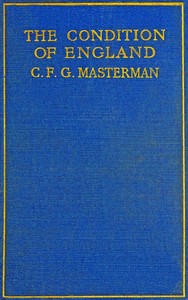
The condition of England
Language: en781 downloads on Project Gutenberg
Subjects
In: History - British·History - Modern (1750+)·Sociology
Public-domain ebook sourced from Project Gutenberg #70267.
Public-domain ebook
Language: en781 downloads on Project Gutenberg
Subjects
In: History - British·History - Modern (1750+)·Sociology
Public-domain ebook sourced from Project Gutenberg #70267.
The opening · free to read
What will the future make of the present? That is a question which opens a wide field for speculation, but secures no certain reply. There is difficulty from two causes. The one is the imperfection of contemporary record, with its distortions or exaggerations of the life of to-day. The other is the inability of the life of to-day to picture its own appearance, even if accurately delineated, when set in historic background. So much of the future becomes then read into the present that (for example) altogether divergent elements in national life will be emphasised if that life be on the highway toward success, or hovering on the brink of calamity, or a cross section only of progress towards a national decay. The reconstruction of the past has been largely effected from the testimony of contemporary documents, each author setting out to write of his own personal experience. Yet with all the material at our disposal, the vision of it is still fluctuating and changing; varying in the estimate of individuals, and from decade to decade. To some the days of declining Rome represent a period of tranquillity and human enjoyment; to others they appear as a tremendous warning of the triumph of the deadly sins. The Middle Age stands for one set of historians as a period of gold and innocence; with stately purposes, solemn processions, and widely diffused, if frugal, comfort; the whole illuminated by great dreams of adventure and aspiration. To another it presents itself as a prolonged delirium in which men wrestled in the darkness with fear and torment. To-day, perhaps too complacently, we assume that history will sharply distinguish our particular period of security from such troublous upheavals of Birth or of Death. We see ourselves painted as a civilisation in the vigour of early manhood, possessing contentment still charged with ambition; a race in England and Europe full of energy and of purpose, in which life, for the general, has become more tolerable than ever before. We would confess that we had not been able to “still the old sob of the sea,” or compel Time to stand still in his courses, or abolish altogether those “two black birds of night,” sighing and sorrow. But we would exhibit a people labouring and enjoying, more secure from plague, pestilence, and famine than in former ages, so accustomed to carry out unimpeded the labours of the day as almost to have forgotten the experience of a time when life itself was precarious and hazardous, and every morning an adventure into the unknown. We would defend our Literature, our Art, our Architecture, as, if not indubitably inspired, yet respectable if judged by any but the highest standard; with an intelligence ever more widely diffused, much reading, some thought, even an original, or, at least, a courageous outlook towards the bigger problems of human existence and human destiny. Condemn our poverty, we confront it with our charity. Reveal the ravages of disease, cancer, appendicitis, complaints of the brain, nerves, and stomach, we retort with the revelation of our warfare against disease, maintained with a devotion and a determination unparalleled in all the past. If we have Atheisms, here are all our Churches; if Social Maladies, our Social Reformers. That any future estimate should associate us even in thought with the dying days of Rome or the delirium of the medieval twilight seems to us a proposition obviously incredible.
We have to remember, however, in such an estimate, that each generation stands in the roll-book of the centuries, not as it appears to itself, but as it appears to observers gazing, as from a distance, over a gulf of time. What records will survive, what evidence of existence, when all the pleasantness and amenity of little, comfortable, satisfied people have vanished over the limits of the world? Imagine, for example, the twentieth century interpreted to the twenty-fifth by its popular newspapers: to-day, more certainly than its popular drama, the abstract and chronicle of the time. England seen through the medium of its Sunday Press--the Press which to seven out of ten of its present inhabitants represents the sole picture they possess of the world outside their local lives--takes upon itself an appearance of violence and madness. Men and women knife each other in the dark. Children are foully butchered by unknown assailants. Suicides sprinkle every page:--now that a girl may die with another woman’s husband; now that a family may escape the hell of unemployment; now simply for weariness, because the whole effort of life has lost significance and crumbled into dust and ashes. The most insistent noise which reverberates through their pages is the clicking of the huge machine of English justice, as couples once married in affection are torn apart, or a long procession of murderers, thieves, absconding solicitors, fraudulent company promoters, are swept away into the cold silence of the penal prison. The supply seems never to run short. The various Courts are in continuous sitting, and yet never overtake the work so bountifully provided. Itinerant justices are even compelled to journey round the countryside, arresting their courses at the principal towns, in order more speedily to deal with the continuous parade of brutality, outrage, and unnatural crime. Is it possible, one can imagine the future historian demanding, that any one could have been in those days altogether sane? as he pictures the decent wayfarer stealing furtively through labyrinthine ways lest ruffians should spring upon him in the dark, clutching his difficult savings for fear that they should be snatched from him; with the terror of poverty yawning before him, against which no prudence can guard, in cities visibly given up to the dominion of lust and greed. All this is in England: with a Sunday Press, if liberally providing the salt and flavour which so many colourless lives demand, yet on the whole committed to some standard of accuracy, some reflection of the fact in the record. In America, where such limitations are voted tiresome, the vision becomes gigantic, monstrous, like the Gargantuan architecture of its distorted cities. The observer who, in any future civilisation which may arise there, should attempt reconstruction of the barbaric past from a file of the New York Sunday editions, would find himself plunged into a region grotesque and hideous, like evil dreams.
But the survival of this peculiar literature is too impossible--perhaps too dreadful--an assumption. Let us believe that the great works will endure--the poetry, the fiction, the social studies and declamations of the representative people of the age. Are we in any better plight? Select ten, say, of the greatest writers of the Victorian era, and attempt from the picture which they present to effect a reconstruction of the Victorian age. The product is a human society so remote from all benignant ways as to demand nothing less than the advent of a kindly comet which will sweep the whole affair into nothingness. Our fathers led their decent, austere lives in that Victorian age which now seems so remote from us, making their money, carrying out their business and boisterous pleasure, inspired by their vigorous, if limited, creeds. They wrangled about politics and theology; they feasted at Christmas, and in the summer visited the seaside; they gave alms to the poor, and rejoiced that they lived in nineteenth-century England. But to the prophets of their age they were unclean from crown of head to sole of foot, a people who had visibly exhausted the patience of God. You may choose your verdict where you please--in Carlyle’s “torpid, gluttonous, sooty, swollen, and squalid England,” given up to the “deaf stupidities and to the fatalities that follow, likewise deaf”; or, in Ruskin’s interpretation of the “storm cloud” as “a symbol of the moral darkness of a nation that has blasphemed the name of God deliberately and openly, and has done iniquity by proclamation, every man doing as much injustice to his brother as it was in his power to do.” You may accept the condemnation kindly, as in Meredith’s “folly perpetually sliding into new shapes in a society possessed of wealth and leisure, with many whims, many strange ailments, and strange fancies”; the condemnation plaintive, as in Arnold’s “brazen prison,” in which most men, with “heads bent o’er their toil,” languidly “their lives to some unmeaning task-work give”; the condemnation defiant and rejoicing, as in Morris: “Civilisation which I know now is destined to perish; what a joy to think of.” You may find it rising to a rather shrill shriek in the later Tennyson, with his protest against the city children--who “soak and blacken soul and sense in city slime”--with his calling upon vastness and silence to swallow up the noises of his clamorous, intolerable day. You may hear it sinking to a deep note of strong repudiation, in that vision of a city, “perchance of Death but certainly of Night,” from the heart of which, in the pulpit of a great cathedral, a strange preacher proclaims the triumph of night and its despairs. One observer looking to the future will see “the whole life of the immense majority of its inhabitants, from infancy to the grave, a dreary routine of soulless, mechanical labor.” Another will call for a cosmic cataclysm to quickly make an end. Another in a more chilling indifference will turn away from the unlovely sight as from a spectacle irrelevant, impossible. Literature has no tolerance for the existence of comfort and security which to so many people seems the last word of human welfare. And no reconstruction, from the works of genius, the great novelists, artists, critics, of the vanishing present, can provide any judgment much more satisfying to our pride than the judgment of summarised theft and fraud and violence which is the weekly enjoyment of many million readers.
We know--at once--that this is a one-sided verdict. Of ten thousand citizens, all but three or four will pass their lives unchronicled; and these three or four--a murderer, an adulterer, an adventurer, a saint--will come to stand alone as lives whose existence is recorded. The remainder pursue their brave and patient labours, not too exacting in ideal, not too clamorous in pleasure, not at the end having very much to complain of, or being very eager to complain. So--in every civilisation, in every century, have passed the lives of the multitude of mankind. Yet it is change--obscure change in economic conditions, in aspirations, in faiths, in energies or lassitudes--which is responsible for the rise and fall of nations, for the variegated panorama of an ever-changing world. We have enjoyed in England security and settled society since the period of the great Civil War. For two hundred and fifty years ten generations have flourished and faded in a universe where regular government and an ordered apparatus of justice have guaranteed that life shall be reasonably safe, and that foresight shall attain reward. We are coming to believe that no circumstance will ever arise in which an insurance policy will not be honoured on presentation, and contracts entered into by the parents be fulfilled by the children. Yet during the whole of this period there have been cataclysms of change in the intimate life and convictions of the people which are more instinctive than opinions. So that the nineteenth-century civilisation is far removed from the eighteenth, and the twentieth from the nineteenth, in the estimate of the kingdom of the Soul. A study of those changes--a revelation and diagnosis of the hidden life of England--would be a study exceedingly worth attempting to-day. It would be a study which, passing from the external organisation, the condition of trade, the variation in fortune, would endeavour to tear out the inner secret of the life of this people: to exhibit the temper, mettle, response, character of an island race at a particular period of its supremacy. Changes in such temper and character are usually only revealed in times of national crisis: just as an individual only comes to “know himself” when confronted with the challenge of some overwhelming choice or anxiety. And as at that moment he reaps the fruit of the long obscure processes of sowing and ripening, so a nation in social upheavals, foreign perils, or some similar intrusion of reality, discovers in a moment also that it no longer possesses adequate forces of resistance, or that its religion, its boast of power, its patriotism, have been meaningless phrases.
The book keeps going
Reading is free forever. Sign up and watch scenes appear while you read.



Scenes Storieta drew for other classics.
New illustrated classics
Once or twice a month: the latest books to get full character casts, scene art, and free comic editions. No account needed.