In April 1949, judgment was rendered in the last of the series of 12 Nuernberg war crimes trials which had begun in October 1946, and were held pursuant to Allied Control Council Law No. 10. Far from being of concern solely to lawyers, these trials are of especial interest to soldiers, historians, students of international affairs, and others. The defendants in these proceedings, charged with war crimes and other offenses against international penal law, were prominent figures in Hitler’s Germany and included such outstanding diplomats and politicians as the State Secretary of the Foreign Office, von Weizsaecker, and cabinet ministers von Krosigk and Lammers; military leaders such as Field Marshals von Leeb, List, and von Kuechler; SS leaders such as Ohlendorf, Pohl, and Hildebrandt; industrialists such as Flick, Alfried Krupp, and the directors of I. G. Farben; and leading professional men such as the famous physician Gerhard Rose, and the jurist and Acting Minister of Justice, Schlegelberger.
In view of the weight of the accusations and the far-flung activities of the defendants, and the extraordinary amount of official contemporaneous German documents introduced in evidence, the records of these trials constitute a major source of historical material covering many events of the fateful years 1933 (and even earlier) to 1945, in Germany and elsewhere in Europe.
The Nuernberg trials under Law No. 10 were carried out under the direct authority of the Allied Control Council, as manifested in that law, which authorized the establishment of the Tribunals. The judicial machinery for the trials, including the Military Tribunals and the Office, Chief of Counsel for War Crimes, was prescribed by Military Government Ordinance No. 7 and was part of the occupation administration for the American zone, the Office of Military Government (OMGUS). Law No. 10, Ordinance No. 7, and other basic jurisdictional or administrative documents are printed in full hereinafter.
The proceedings in these trials were conducted throughout in the German and English languages, and were recorded in full by stenographic notes, and by electrical sound recording of all oral proceedings. The 12 cases required over 1,200 days of court proceedings and the transcript of these proceedings exceeds 330,000 pages, exclusive of hundreds of documents, books, briefs, etc. Publication of all of this material, accordingly, was quite unfeasible. This series, however, contains the indictments, judgments, and other important portions of the record of the 12 cases, and it is believed that these materials give a fair picture of the trials, and as full and illuminating a picture as is possible within the space available. Copies of the entire record of the trials are available in the Library of Congress, the National Archives, and elsewhere.
In some cases, due to time limitations, errors of one sort or another have crept into the translations which were available to the Tribunal. In other cases the same document appears in different trials, or even at different parts of the same trial, with variations in translation. For the most part these inconsistencies have been allowed to remain and only such errors as might cause misunderstanding have been corrected.
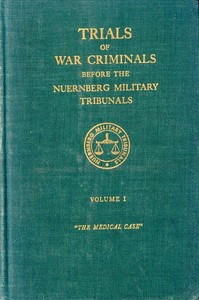
Volume III of this series is dedicated to the case United States of America vs. Josef Altstoetter, et al. (Case 3). This trial has become known as the Justice Case, because all of the defendants held positions in the Reich system of justice, as officials of the Reich Ministry of Justice or as judges or prosecutors of the Special Courts and the People’s Courts.
The book keeps going
Keep reading, and see it illustrated
Reading is free forever. Sign up and watch scenes appear while you read.
Scenes Storieta drew for other classics.