Public-domain ebook
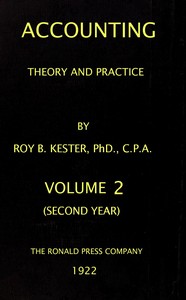
Accounting theory and practice, Volume 2 (of 3): A Textbook for Colleges and Schools of Business Administration
Language: en3,127 downloads on Project Gutenberg
Subjects
Public-domain ebook sourced from Project Gutenberg #70556.
Public-domain ebook
Language: en3,127 downloads on Project Gutenberg
Subjects
Public-domain ebook sourced from Project Gutenberg #70556.
This work is a second‑year textbook in a three‑year accounting course, written by Roy B. Kester, a professor of accounting at Columbia University. The opening pages make clear that it follows a Volume I that covered the fundamentals of debit and credit, ledger structures, and basic bookkeeping, and that this volume turns its focus to corporations and the valuation problems that arise in balance‑sheet preparation. The preface outlines a systematic plan: the first twenty‑seven chapters form the semester‑one text, while later chapters and three appendices supply practice problems intended for the second semester. Kester stresses a balanced approach, insisting that theory without application quickly fades and that practice must be grounded in solid principles. The book’s structure, with detailed chapters on stock, voucher systems, factory costs, depreciation, and various asset categories, reflects a comprehensive curriculum designed for rigorous professional training.
The voice is that of an early‑20th‑century academic, formal yet didactic, employing the conventions of its time, italic and bold markers noted for the original typesetting, careful definitions, and extensive enumeration of topics. Its style is methodical, dense with terminology, and rooted in the pedagogical ideals of a post‑World‑I era that demanded three years of professional study for accountants. Readers who appreciate a disciplined, historically grounded treatment of accounting, students of business history, scholars of accounting education, or practitioners interested in the evolution of corporate financial theory, will find this volume a valuable, if demanding, resource.
Underscores “_” before and after a word or phrase indicate italics in the original text. Equal signs “=” before and after a word or phrase indicate =bold= in the original text. Small capitals have been converted to SOLID capitals. Illustrations have been moved so they do not break up paragraphs. Typographical and punctuation errors have been silently corrected. …
Keep reading free · chapter 1 needs no account
![Cover of Business Administration: Theory, Practice and Application. [Vol. 1] Business Economics](/covers/56018.jpg)