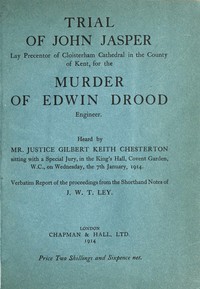
The accused, JOHN JASPER, aged 26, is Choirmaster at Cloisterham Cathedral, otherwise known as “lay precentor.” He lodges over the Gateway of the Cathedral. For some years he admits he has been in the habit of taking opium, and has resorted to an Opium Den in the East End of London kept by an elderly woman known as “Princess Puffer.”
The man of whose murder he stands accused was his nephew, EDWIN DROOD, in his 21st year, and by profession an Engineer. The Prisoner, who was likewise Trustee and Guardian of the said Edwin Drood, professed the greatest affection for him, and on the occasion of his visits to Cloisterham manifested every appearance of joy and satisfaction.
The said Edwin Drood was betrothed to one Rosa Bud, this being in fulfillment of a contract made by their respective parents (now deceased). Certain formalities in connection with the confirmation of this engagement, notably the handing of a ring by Mr. Grewgious, solicitor, Staple Inn, legal adviser to Edwin Drood, were witnessed by Mr. Grewgious’s clerk, Bazzard. There is evidence to show that they had grown weary of each other, and wished the Contract to be annulled. On the other hand, Jasper, the Accused, was admittedly in love with Rosa Bud, and it is alleged was secretly jealous of his nephew. Miss Bud, on her part, deposes that she not only disliked but “feared” Jasper and avoided his attentions as much as possible. Eventually the engagement between Edwin Drood and Rosa Bud was rescinded by mutual consent; but the said John Jasper, for sufficient reasons, was not at the time warned of this fact. The circumstance, however, was revealed to Mr. Grewgious.
WITNESSES will be called to prove that in the early part of the year, the Accused, Jasper, accompanied a stonemason named Durdles to the Cathedral and made particular enquiry into the destructive qualities of quicklime. It is also alleged that Jasper applied a drug to this same Durdles, causing sleep, and that he then appropriated his keys, and therefrom made a close investigation of the vaults, especially of the Sapsea vault, which was partly hollow.
There were also residing in Cloisterham an orphan brother and sister, twins, by name Neville and Helena Landless. They came from Ceylon, where they had been subjected to personal ill-treatment, and after staying with Mr. Honeythunder, their guardian, Neville was lodged with Canon Crisparkle, and Helena was sent to Miss Twinkleton’s school. Neville Landless is described as “fierce” and hot-blooded, Helena Landless is “almost of the gipsy type.” Between her and her brother is a strong bond of affection. In her girlhood she had escaped at times from her cruel step-father by disguising herself as a boy. She is a woman of much daring.
Soon after their arrival in Cloisterham, they met Drood, Jasper and Miss Bud at a party. It will be given in evidence that there was a contention between Drood and Neville, and that Jasper afterwards fomented the ill-feeling and charged Neville Landless with being “murderous.” At the same time, Miss Landless was seized with an instinctive hostility towards Jasper, who, she thought, was unduly menacing Rosa Bud. Matters between the two young men were smoothed over to some extent, and on the following Christmas Eve, John Jasper decided to bring them together at a convivial gathering in his own house.
On December 23rd Jasper visited the Opium Den in London. Next day he returned to Cloisterham, and was followed thither by the Opium Woman, who had heard him use threatening language in his sleep towards someone called “Ned” (Jasper’s nickname for Edwin Drood).
At night (Christmas Eve) the three men met and dined. It was a night of wild storm. The next morning Jasper hastened to Canon Crisparkle’s house shouting excitedly that his dear nephew had disappeared, and that he was convinced he had been murdered.
He plainly indicated that he believed the murderer was Neville Landless, in whose company Drood had left Jasper’s house at midnight; and Neville Landless was apprehended, but subsequently released for want of evidence.
On December 26th Mr. Grewgious visited Jasper and informed him that the engagement between Drood and Miss Bud had been broken off. It is in evidence that on hearing this news for the first time, Jasper “gasped, tore his hair, shrieked” and finally swooned away.
Shortly afterwards Canon Crisparkle visiting the Weir on the river, discovered Edwin Drood’s watch and chain, which had been placed in the timbers; and in a pool below he found Drood’s scarf-pin.
It is in evidence that the accused, Jasper, after a short interval, renewed his attentions to Miss Rosa Bud, and exercised so great a terror upon her that she deemed it advisable to take refuge in London under the supervision of Mr. Grewgious and her friend Miss Twinkleton. Neville Landless also removed to London, where he was visited by his sister Helena.
Meanwhile, a careful watch was kept upon John Jasper by a “stranger,” known as Dick Datchery. This person took lodgings opposite Jasper’s house and had him under close observation. “Datchery” (which is admittedly an assumed name) interviewed several persons, including Durdles and “Princess Puffer,” and kept a private record in chalk marks of all facts thus ascertained. In consequence of the suspicions excited by these circumstances, a warrant was applied for and John Jasper was arrested on a charge of Wilful Murder.
To this he pleads “NOT GUILTY,” and this is the issue to be tried.
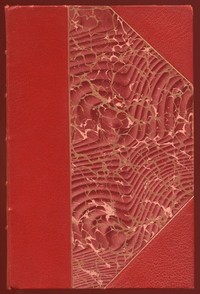
The design on the front page of this Indictment is a reproduction of that on the wrapper of the monthly parts of “The Mystery of Edwin Drood” as originally issued in 1870. It was drawn by Charles Allston Collins, and has been the cause of much controversy and speculation.
Conditions Agreed Upon Between the Prosecution and Defence
The three formal witnesses (that is to say, Crisparkle and Durdles for the Prosecution and the Opium Woman for the Defence) shall not in their evidence-in-chief go beyond the book or make any statements not expressly made therein, but in cross-examination they may, in response to specific questions, give explanations not expressly contained in the book.
The two chief witnesses (that is to say, Helena Landless for the Prosecution and Bazzard for the Defence) shall be free both in examination-in-chief and in cross-examination to make statements not made in the book, provided that they are not contradicted therein.
All statements made in the book shall be taken to be true and admitted by both sides, and any statement by a witness contradicting such statements shall be considered thereby proved to be false.
The said two chief witnesses (and no others) shall be allowed to give hear-say evidence.
The Defence having agreed not to call Edwin Drood, the Prosecution agree not to comment upon his absence from the witness-box either in speech or cross-examination, but the Prosecution reserve the right to comment upon the silence of Edwin Drood subsequent to the murder.
Both sides having agreed not to call Grewgious, it is agreed that neither side shall comment upon the fact that the other has not called him.
The Defence agree that the legal point that no conviction can take place since no body has been found, shall be raised only after the retirement of the jury, but the Defence reserves the right to comment upon the absence of a body as part of the general absence of direct evidence of the commission of a murder.
John Jasper, the charge against you is that you did feloniously, wilfully, and with malice aforethought, kill your nephew, Edwin Drood, in the City of Cloisterham, on the night of the 24th of December, 1860. Are you guilty, or not guilty?
THE PRISONER: Not guilty.
THE CLERK OF ARRAIGNS: Will the gentlemen of the Jury please rise, and sit down as I call their names? Mr. George Bernard Shaw, Sir Edward Russell, Dr. W. L. Courtney, Mr. W. W. Jacobs, Mr. Pett Ridge, Mr. Tom Gallon, Mr. Max Pemberton, Mr. Coulson Kernahan, Mr. Edwin Pugh, Mr. William de Morgan, Mr. Arthur Morrison, Mr. Francesco Berger, Mr. Ridgwell Cullum, Mr. Justin Huntly McCarthy, Mr. William Archer, Mr. Thomas Seccombe—you shall well and truly try the Prisoner at the Bar, John Jasper, for the murder of Edwin Drood, and a true verdict give according to the evidence.
Mr. George Bernard Shaw was elected Foreman.
MR. WALTERS: I appear for the prosecution, my Lord.
JUDGE: Mr. Cuming Walters, I think, for the prosecution. Is there anyone with you?
MR. MATZ: I am with him, my Lord.
MR. CECIL CHESTERTON: I appear for the defence, my Lord.
JUDGE: Mr. Chesterton, I think, for the defence. One s, I think. Is anyone with you?
MR. CROTCH: I am, my Lord.
[THE CASE FOR THE PROSECUTION.]
Mr. Matz then proceeded to open the case for the prosecution in the following speech:
My Lord and Gentlemen of the Jury—
The case to be tried is one of murder—murder which we shall contend was premeditated, pre-arranged and carried out in a methodical and determined manner.
The Prisoner is John Jasper, Lay Precentor at Cloisterham Cathedral. The Prosecution will set itself to prove that on the night of the 24th December he murdered in that city his nephew Edwin Drood, an Engineer.
The said Edwin Drood was 21 years of age, and for some years was betrothed to Miss Rosa Bud in fulfilment of a dying wish of their respective parents (now deceased).
To this young lady the Prisoner acted as music master, and admittedly was enamoured of her, although he kept this fact secret from Edwin Drood.
On the evening in question—the 24th December—Edwin Drood and Neville Landless—a pupil of the Revd. Septimus Crisparkle—dined together with the Prisoner in his rooms in the Gate House adjoining the Cathedral.
The night was a terribly stormy one. After leaving the Prisoner, some time about midnight, the two young men took a walk to the river to see the effect of the storm on the water, and returned to the house of the Revd. Septimus Crisparkle in Minor Canon Corner. Here Edwin Drood left his companion, intending to return to his Uncle’s lodgings.