Public-domain ebook
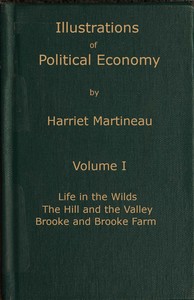
Illustrations of political economy, Volume 1 (of 9)
Language: en1,139 downloads on Project Gutenberg
Subjects
In: Novels·British Literature·Economics
Public-domain ebook sourced from Project Gutenberg #70716.
Public-domain ebook
Language: en1,139 downloads on Project Gutenberg
Subjects
In: Novels·British Literature·Economics
Public-domain ebook sourced from Project Gutenberg #70716.
Harriet Martineau’s Illustrations of Political Economy is a didactic work that frames the study of wealth, production and distribution as a moral and social imperative. The opening passage surveys every branch of human knowledge, from theology to chemistry, only to argue that the discipline of political economy, concerned with how societies procure and share their necessities, is oddly neglected by the very people it most affects. Martineau likens the nation to a household, describing the stark contrasts between abundance and want within a single roof, and then expands the metaphor to the whole country, suggesting that the same principles that smooth domestic life could, if understood, remedy national inequities. She sets out to replace abstract theory with vivid, comparative illustrations that reveal the practical consequences of economic rules.
Written in the mid‑ninteenth‑century prose of a socially engaged Victorian reformer, the book combines earnest argument with a conversational, almost sermon‑like tone. Its blend of moral philosophy, social observation and accessible storytelling will appeal to readers interested in the history of economic thought, social reform, or gender‑aware critiques of 19th‑century society, as well as to anyone who enjoys a persuasive essay that seeks to make complex ideas concrete through everyday examples.
The opening · free to read
In an enlightened nation like our own, there are followers of every science which has been marked out for human pursuit. There is no study which has met with entire neglect from all classes of our countrymen. There are men of all ranks and every shade of opinion, who study the laws of Divine Providence and human duty. There are many more who inquire how the universe was formed and under what rules its movements proceed. Others look back to the records of society and study the history of their race. Others examine and compare the languages of many nations. Others study the principles on which civil laws are founded, and try to discover what there has been of good as well as of evil in the governments under which men have lived from the time of the patriarchs till now. Others—but they are very few—inquire into the principles which regulate the production and distribution of the necessaries and comforts of life in society.
It is a common and true observation that every man is apt to think his own principal pursuit the most important in the world. It is a persuasion which we all smile at in one another and justify in ourselves. This is one of the least mischievous of human weaknesses; since, as nobody questions that some pursuits are really more important than others, there will always be a majority of testimonies in favour of those which are so, only subject to a reservation which acts equally upon all. If, for instance, votes were taken as to the comparative value of the study of medicine, the divine would say that nothing could be more important except theology; the lawyer the same, excepting law; the mathematician the same, excepting mathematics; the chemist the same, excepting chemistry; and so on. As long as every man can split his vote, and all are agreed to give half to themselves, the amount of the poll will be the same as if all gave whole votes. There is encouragement, therefore, to canvass, as we are about to do, in favour of a candidate whom we would fain see more popular than at present.
Can anything more nearly concern all the members of any society than the way in which the necessaries and comforts of life may be best procured and enjoyed by all? Is there anything in any other study (which does not involve this) that can be compared with it in interest and importance? And yet Political Economy has been less studied than perhaps any other science whatever, and not at all by those whom it most concerns,—the mass of the people. This must be because its nature and its relation to other studies are not understood. It would not else be put away as dull, abstract and disagreeable. It would be too absurd to complain of its being difficult in an age when the difficulties of science appear to operate as they should do, in stimulating to enterprise and improving patience.
Political Economy treats of the Production, Distribution and Consumption of Wealth; by which term is meant whatever material objects contribute to the support and enjoyment of life. Domestic economy is an interesting subject to those who view it as a whole; who observe how, by good management in every department, all the members of a family have their proper business appointed them, their portion of leisure secured to them, their wants supplied, their comforts promoted, their pleasures cared for; how harmony is preserved within doors by the absence of all causes of jealousy; how good will prevail towards all abroad through the absence of all causes of quarrel. It is interesting to observe by what regulations all are temperately fed with wholesome food, instead of some being pampered above-stairs while others are starving below; how all are clad as becomes their several stations, instead of some being brilliant in jewels and purple and fine linen, while others are shivering in nakedness; how all have something, be it much or little, in their purses, instead of some having more than they can use, while others are tempted to snatch from them in the day-time or purloin by night. Such extremes as these are seldom or never to be met with under the same roof in the present day, when domestic economy is so much better understood than in the times when such sights were actually seen in rich men’s castles: but in that larger family,—the nation,—every one of these abuses still exists, and many more. If it has been interesting to watch and assist the improvement of domestic economy from the days of feudal chiefs till now, can it be uninteresting to observe the corresponding changes of a state? If it has been an important service to equalize the lot of the hundred members of a great man’s family, it must be incalculably more so to achieve the same benefit for the many millions of our population, and for other nations through them. This benefit cannot, of course, be achieved till the errors of our national management are traced to their source, and the principles of a better economy are established. It is the duty of the people to do this.
If a stranger had entered the castle of a nobleman, eight hundred years ago, and, grieved at what he saw, had endeavoured to put matters on a better footing, how ought he to set about it, and in what temper should he be listened to? If he had the opportunity of addressing the entire household at once, he would say, “I have been in your splendid halls, and I saw vast sums squandered in gaming, while hungry creditors were looking on from without with rage in their countenances. I have been in your banqueting-room, and I saw riot and drunkenness to-day where there will be disease and remorse to-morrow. I have been in your kitchens, and I saw as much waste below as there had been excess above, while the under servants were driven into a cold corner to eat the broken food which was not good enough for their masters’ dogs. I have been in your dungeons, and I saw prisoners who would fain have labored for themselves or their fellow-captives, condemned to converse in idleness with their own melancholy thoughts, or with companions more criminal and miserable than themselves. I have been among the abodes of those who hew your wood and draw your water, and till your fields, and weave your garments; and I find that they are not allowed to exchange the produce of their labor as they will, but that artificial prices are set upon it, and that gifts are added to the profits of some which are taken out of the earnings of others. I hear complaints from all in turn, from the highest to the lowest; complaints which I cannot call unreasonable, since it is equally true that the poor among you are oppressed, and that the rich are troubled; that the rulers are perplexed and the governed discontented. These things need not be. There are methods of governing a family which will secure the good of all. I invite you to join me in discovering what these methods are.” What would be thought of the good sense of such a household if they should reject the invitation,—if the rulers should say, “We are much perplexed, it is true, to know how to govern; but it is very difficult to change the customs of a family, and so we will go on as we are;” if the sons and daughters of the house should reply, “It is true the servants threaten us with vengeance, and we have more trouble than enough with their complaints; but we should find the inquiry you propose very dull and disagreeable, so do not let us hear any more about it,” if the servants should say, “We have many grievances certainly, and we can easily tell what ought to be remedied; but as to what the remedies are, we are told we cannot understand the subject; so instead of trying to learn, we shall redress our troubles in our own way?” If this is folly, if this is neglect, if this is madness, it is no more than as many people are guilty of as refuse to hear anything of Political Economy, because it is new, or because it is dull, or because it is difficult. No one could make any of these objections, if he knew the nature, or saw anything of the utility and beauty of the science.
Half-civilized states were like the half-civilized household we have described, eight centuries ago. We wish we could go on to say that civilized states are managed like civilized households, that Political Economy was nearly as well understood by governments as domestic economy is by the heads of families. That it is far otherwise, our national distresses too plainly show. The fault lies, however, quite as much with the governed as with their rulers. Unless the people will take the pains to learn what it is that goes wrong, and how it should be rectified, they cannot petition intelligently or effectually, and government will regard their complaints as unreasonable and their afflictions as past help. However true it may be that governments ought to look over the world at large for the purpose of profiting by universal experience and improving their measures in proportion as knowledge advances, it is equally true that the people should look abroad also, and observe and compare and reflect and take to heart whatever concerns the common interests of the millions of their countrymen. If many of them occupy such a position as that they cannot do this, is it not at least their duty, should it not be their pleasure, to listen to those who have observed and compared and reflected and come to a certain knowledge of a few grand principles, which, if generally understood, would gradually remove all the obstructions, and remedy the distresses, and equalize the lot of the population? Such ought to be the disposition of the people.
But the people complain, and justly, that no assistance has been offered them which they could make use of. They complain that all they can do is to pick up bits and scraps of knowledge of Political Economy, because the works which profess to teach it have been written for the learned, and can interest only the learned. This is very true, and it is the consequence of the science being new. All new sciences are for some time engrossed by the learned, both because preparation is required before they can be generally understood, and because it is some time before men perceive how close an interest the bulk of society has in every new truth. It is certain, however, that sciences are only valuable in as far as they involve the interests of mankind at large, and that nothing can prevent their sooner or later influencing general happiness. This is true with respect to the knowledge of the stars; to that of the formation and changes of the structure of the globe; to that of chemical elements and their combinations; and, above all, to that of the social condition of men. It is natural that the first eminent book on this new science should be very long, in some parts exceedingly difficult, and, however wonderful and beautiful as a whole, not so clear and precise in its arrangement as it might be. This is the case with Smith’s Wealth of Nations,—a book whose excellence is marvelous when all the circumstances are considered, but which is not fitted nor designed to teach the science to the great mass of the people. It has discharged and is discharging its proper office in engaging the learned to pursue the study, and in enabling them to place it in new lights according to the various needs of various learners. It is natural, again, that the first followers of the science should differ among themselves, and that some should think certain points important which others think trifling; and it is a matter of course that their disputes must be tiresome to those who know little of the grounds of them. It is perfectly natural that the science should be supposed obscure and the study of it fruitless which could thus cause contradictions and perplexities at the very outset. It is perfectly natural that when certainty began to be obtained and regularity to come out of the confusion, formality should be the order of the day; that truths should be offered in a cold dry form, and should be left bare of illustration, and made as abstract and unattractive as possible. This is a very hopeful state of things, however: for when truth is once laid hold of, it is easy to discover and display its beauty; and this, the last and easiest process, is what remains to be done for Political Economy. When it is done, nobody must again excuse himself from learning, out of discontent at the way in which it is taught.
The book keeps going
Reading is free forever. Sign up and watch scenes appear while you read.



Scenes Storieta drew for other classics.
New illustrated classics
Once or twice a month: the latest books to get full character casts, scene art, and free comic editions. No account needed.