Public-domain ebook
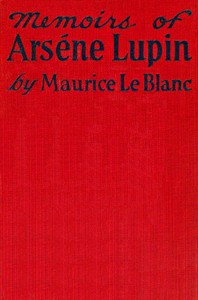
Memoirs of Arsène Lupin
Language: en566 downloads on Project Gutenberg
Subjects
In: Crime, Thrillers and Mystery·Adventure·Novels
Public-domain ebook sourced from Project Gutenberg #70719.
Public-domain ebook
Language: en566 downloads on Project Gutenberg
Subjects
In: Crime, Thrillers and Mystery·Adventure·Novels
Public-domain ebook sourced from Project Gutenberg #70719.
The opening · free to read
Ralph d’Andresy extinguished the lamp, and thrust his bicycle behind a bank. At that moment the clock of Benouville struck three.
In the deep shadow of the night he followed the lane which led to the estate of La Haie d’Etigues and so came to the wall which ran round it. He waited a little--the sound of horses pawing the ground, of wheels which rang on the pavement of the court-yard, the sound of harness bells. Then the two leaves of the big door were thrown open and a carriage passed out. It passed so quickly that Ralph barely caught the sound of men’s voices and perceived the barrel of a gun before the vehicle reached the high road and took the way to Etretat.
“Come,” said he. “Shooting gulls is an attractive sport and the rock where they shoot them is a long way off. At last I’m going to know the meaning of this improvised shooting-party and of all these odd comings and goings.”
He took his way along the boundary wall to the left, turned a corner and then another, and stopped forty yards along the wall. In his hand he held two keys. The first of them opened a small, low door. He went through it up a staircase hollowed out of the wall, half fallen to ruin, which, running along its left wing, had formed one of the old defences of the château. The second key opened for him a secret door in the first floor of the château itself.
He lit a small bull’s-eye lantern and without taking any special precautions, since he knew that the staff of servants lived in the other wing and that Clarice d’Etigues, the only daughter of the Baron, had her rooms on the second floor, went down a passage which brought him to a large study. In that very room some weeks previously he had asked the Baron for his daughter’s hand in marriage. His proposal had been received with an explosion of indignant anger of which he retained a most disagreeable recollection.
A mirror showed him the pale face of a young man, even paler than usual. However, inured to emotion, he remained master of himself and coolly addressed himself to his task.
He was not long about it. In the course of his interview with the Baron he had observed that that gentleman now and then cast a glance at a large mahogany roll-top desk of which the top had not been drawn down. Ralph knew all the places in which it is possible to put a secret drawer and all the mechanical devices that work such secret drawers. In a very short time he discovered in a cranny of the desk a tiny drawer which held a letter written on very thin paper and rolled up into the shape of a cigarette. No signature. No address.
He studied this letter, which at first appeared to him too commonplace for anyone to have taken so much trouble to hide it, and after working on it with the most minute care, giving the most earnest consideration to certain words which seemed significant and ignoring certain phrases evidently intended to fill the gaps between them, he was able to disentangle the following:
I found at Rouen traces of our enemy and I have had published in the local newspapers a story that a peasant in the vicinity of Etretat has dug up in his field an old copper candlestick with seven branches. At once she telegraphed to the livery stable at Etretat to send, at three o’clock in the afternoon on the twelfth, a brougham to meet her at Fécamp station.
On the morning of that day I will see that the livery stable receives another telegram, countermanding this order. Therefore it will be your brougham that she will find at Fécamp station and which will bring her to us, under a sufficient escort, at the very moment at which we are holding our meeting. We shall be able to constitute ourselves a tribunal and pronounce upon her a relentless sentence.
In those days in which the greatness of the end justified the means, the punishment would have been immediate. Dead men tell no tales. Choose what end you please; but remember the conclusions to which we came during our last interview and bear in mind that the success of our enterprises and our very existence itself depends on this infernal creature.
Be prudent. Arrange a shooting-party to divert suspicion. I will arrive by way of le Havre at four o’clock exactly, with two of our friends. Do not destroy this letter. You will give it back to me.
“An excess of precaution is a mistake,” thought Ralph. “If the Baron’s correspondent had not been so distrustful, the Baron would have burnt this letter and I should not have known about this scheme of abduction, this scheme of an illegal tribunal and even, heaven help us! this scheme of assassination.... Hang it! My future father-in-law, devout Catholic though he may be, seems to me to be entangled in combinations that are not Catholic at all.... Will he go as far as murder?... All this is devilishly serious and may very well give me a hold on him.”
He rubbed his hands. The business gave him considerable satisfaction and excited in him no great astonishment, since for several days he had been noticing some queer facts. He resolved then to return to his inn and sleep there and then to come back in good time to learn what the Baron and his guests were plotting and who this “infernal creature” was whom they desired to suppress.
He rerolled the letter, cigarette-wise, carefully, and put it back in the drawer, but, instead of departing, he sat down in front of a small round table on which there was a photograph of Clarice, and drawing it directly in front of him contemplated it with a profound tenderness. Clarice d’Etigues, very little younger than he was himself ... eighteen. Voluptuous lips ... eyes full of dreams ... a clear-skinned, pink, and delicate fair face, crowned by a mass of fair hair such as the hair of those little girls who run about the roads in the neighborhood of Caux ... and such a sweet expression and such charm!
Ralph’s eyes grew fonder and fonder as he gazed. Thus, naturally, the desire came to him to be with the object of his adoration. Why not? Clarice was alone in her isolated suite of rooms above him. Twice already, making use of the keys which she had entrusted to him, he had made his way to them in the afternoon. What was there to hinder him now? No sound they would make could reach the servants. The Baron would not return till the afternoon. Why go away? Compromise her? Why should he compromise her? No one could possibly know that he had been with her.
Besides, it was such a delightful night. The moon, nearly at the full, was shining with all its brightness. On such a night, under an even brighter moon and clearer sky, Romeo had made love to Juliet. He went quickly, but quietly, up the stairs.
Before the closed door of her boudoir he hesitated. Suppose someone should learn that he had been with her? No one could. He knocked with a rather uncertain hand. He waited. He knocked again louder and again waited. There was a sound in the room. The door opened, revealing Clarice, candle in hand, dressed in a lace peignoir, her charming face enframed in the silken mass of fair hair loosely held together by a ribbon.
“Ralph?” she murmured softly. “It seemed impossible. But I knew it was you. But--you oughtn’t to have come.”
“I couldn’t keep away. I wanted so to be with you. It’s quite safe. No one saw me come. No one can know I’m here,” he said in pleasing accents.
She smiled at him adorably and stepped back. He entered and shut the door and turned the key. He took the candle from her, blew it out, and set it on the table. Then, gently, he put his arms around her, drew her to him, and kissed her eyes and her lips with long, lingering kisses.
Then he drew her to a couch in front of the long, low window, and they sank down on to it, his arm round her waist, and her arm round his neck; and in the intervals between their languorous, passionate kisses, they gazed down on the plain and across the sea bathed in the silver radiance of the queen of the night.
They sat, murmuring to one another the lovely thoughts which their nearness in the night evoked in their ardent souls, thrilling and intoxicated, till the moonlight faded in the golden dawn and the sun rose over the seat.
They had loved one another for three months--since the day of their meeting in the south, where Clarice was spending some time at the home of a school-girl friend. Forthwith they felt themselves united by a bond, which was for him the most delightful thing in the world, for her the symbol of slavery which she cherished more and more fondly. From the beginning he appeared to her to be an extraordinarily elusive creature, mysterious, one whom she would never understand. He grieved her by occasional moods of flippancy, of malicious irony, of deep gloom. But in spite of that, what a fascination he had! What a gaiety! What bursts of enthusiasm and youthful exaltation!
All his faults assumed the appearance of qualities in excess; and his vices had the air of virtues ignorant of themselves and about to expand.
After her return to Normandy she was surprised one morning to perceive the slender figure of the young man, perched on a wall in front of her windows. He had chosen an inn a few kilometers away, and from there, almost every day, he came on his bicycle to find her in the neighborhood of La Haie d’Etigues.
A motherless girl, Clarice was not fortunate in her father, a hard man, gloomy in character, a fanatic in religion, inordinately proud of his title, greedy of gain to the point that the farmers who rented his land looked upon him as an enemy.
When Ralph, who had not even been introduced to him, had the audacity to ask his daughter’s hand in marriage, the Baron fell into such a fury with this beardless suitor, without a career and without relations, that he would have horse-whipped him if the young man had not quietly held him with something of the gaze of a tamer of wild beasts.
It was in consequence of this interview and to efface the memory of it from Ralph’s spirit that Clarice had entrusted to him the two keys which gave him secret access to her suite.
Later in the morning, pretending that she was not feeling well, she had her mid-day déjeuner brought up to her boudoir while Ralph hid himself in a room at the end of the corridor. After the meal they returned to the couch in front of the window and renewed the transports of the magical night.
A fresh breeze, rising from the sea and blowing across the high ground, caressed their faces. In front of them, beyond the great park enclosed by the wall, and among the plains all golden with the blossom of the colza, a depression allowed them to see, on the right, the white line of the high cliffs as far as Fécamp, on the left Etretat Bay, Aval Harbor, and the point of the enormous Needle.
A cloud fell on Clarice’s spirit. The tears welled up into her eyes.
“Don’t be sad, my dearest darling. Life is so sweet at our age; and it will be sweeter still for us when we shall have swept away all the obstacles. Don’t be sad.”
She dried her tears and, gazing at him, tried to smile. He was slender as was she, but broad-shouldered, of a build at once elegant and solid. His face, full of character, displayed a mischievous mouth and eyes shining with gaiety. Wearing knickerbockers and an open jacket over a white woollen sweater, he had an air of incredible suppleness.
The book keeps going
Reading is free forever. Sign up and watch scenes appear while you read.



Scenes Storieta drew for other classics.
New illustrated classics
Once or twice a month: the latest books to get full character casts, scene art, and free comic editions. No account needed.