Public-domain ebook
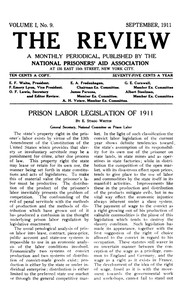
The Review, Vol. 1, No. 12, December, 1911
by Various
Language: en440 downloads on Project Gutenberg
Subjects
In: History - American·Law & Criminology·Politics
Public-domain ebook sourced from Project Gutenberg #70750.
Public-domain ebook
by Various
Language: en440 downloads on Project Gutenberg
Subjects
In: History - American·Law & Criminology·Politics
Public-domain ebook sourced from Project Gutenberg #70750.
The opening · free to read
[This address, which we print in large part, was read by Mr. Sonsteby at the recent Rhode Island state conference of charities and correction. It seems an excellent statement from the standpoint of organized labor.
The Review will be glad to print authoritative statements from other persons holding other views on the prison labor problem.--EDITOR.]
In speaking to the subject of labor’s attitude toward convict labor, I speak from the standpoint of organized union labor, and through it to the free labor of our country.
I speak particularly for the United Garment Workers of America, a union whose membership is largely composed of women and girls, and which is subjected to more competition with convict labor than almost any other union or trade.
Organized labor has taken a positive stand and has an attitude toward convict labor. That attitude is practically no different from the attitude of other citizens who have given the subject careful thought and who are not financially interested, directly or indirectly, in the labor of convicts.
I have found whenever labor men, manufacturers, sociologists and other financially disinterested people have discussed the question there has been an almost unanimity of opinion.
The attitude of free labor toward convict labor finds expression only through the means afforded by the labor unions. Unorganized free labor is what the name implies, and has no authorized person to speak for it. Organized labor’s attitude toward convict labor is, therefore, the only one capable of being crystalized and expressed.
Free labor is unalterably opposed to convict labor as it is commonly understood to-day, viz.: The competition of the products of convict labor with that of free labor on the open market. Free labor favors prison labor for the purpose of keeping prisoners employed, training them for their duties as citizens when they are released, and making products for the state and the state institutions.
Speaking before a subcommittee of the committee on labor, in the house of representatives, in March, 1910, Mr. Thomas F. Tracey, representing the American federation of labor, said, in part: “The labor organizations of this country, as typified by the American federation of labor, have not, are not, and should never help in the advocacy of anything that would put prisoners in idleness. We want those who are the outcasts of society, and who are confined in prisons to be allowed to do work--such work as will be beneficial to them; but we do not believe that, when these men are confined in prisons, instead of their labor being put in the direction of either grinding out dividends for stockholders of concerns of this kind (prison contractors), or making profits for the state, their efforts should be rather in the direction of educating them and reforming them to lead better lives.”
The foregoing sentiment represents the altruistic attitude of the American labor movement.
What reason is there for an expression of labor’s attitude? People who have a selfish purpose to serve have directly and by innuendo charged labor unions with selfishly endeavoring to keep all prisoners in idleness, so that no products from convict labor would be manufactured. Organized labor has never been guilty of such an endeavor, and its attitude has been intentionally and insistently misrepresented by those who knew better.
That the inmates of penal and reformatory institutions must have employment if the object of their confinement is to be attained, is admitted by all. That this employment will, in some degree, compete with free labor, is also true. That at the present time this employment of convict labor does compete with free labor, and compete in a demoralizing way with it, is recognized by all who are informed. People who do not come in contact with prison labor or the products of prison labor, do not realize what the competition of the convict labor means. Organized labor believes that the employment of convict labor should be so diversified that the burden will be equally distributed among all free labor, and reduced to such a minimum that the members of no trade or occupation can justly complain.
The two dominant ideas in prison management heretofore have been simply retribution and economy. The possibility of reforming convicts who are within prison walls--reforming them by useful, educative labor--is a comparatively new idea, and not accepted by all those in charge of convicts. Organized labor believes in reforming the convicts and returning them as soon as possible to society, mentally and morally sound and willing and able to take their places in the rank of wage earners. It costs money to train morals or to do educational or reformatory work. It takes effort, time, money, and interest to diversify employment among convicts so as to render such employment educative and beneficial to the convicts, and, at the same time, not unfair to free labor.
The desire on the part of many managers and prison officials to make penal and reformatory institutions self supporting is one of the causes for their failure up to the present time to arrive at a successful solution of the convict labor question. Another reason for the failure to successfully solve the question has been the fast disappearing but still remaining spoils system in politics, which gives to the local merchants contracts to supply the needs of the state and state institutions. The usual form of prison labor is not reformative.
The problems to which all right thinking people should apply themselves is to adopt or evolve some system of employment that is fair to free labor, and then endeavor to have such a system uniform throughout the United States. Until some uniform system of disposing of the products of convicts is adopted, there should be a federal law enacted providing that each state shall have the right to regulate the sale of prison-made goods within its own borders. Such a bill, has been pending for a number of years in the congress of the United States. Each state should dispose of, within its own borders, the products of its own penal institutions.
The systems in vogue in our penal institutions at the present time are commonly known as:
1. Contract labor (indoors). 2. Contract labor (outdoors). 3. Piece-price plan. 4. Lease system (outdoors). 5. State account: products sold on open market. 6. State account: for state use.
Of these, the contract labor and lease systems have been universally condemned. At the present time, each state has its own system, or lack of system of handling the convict labor question. Each state endeavors to avoid competition with free labor in its own particular state. To do this, many contracts provide that the product shall not be sold within the state where it is made, and as a result the free labor in all the states is subject to about the same competition because of this interstate commerce in prison-made goods.
The farming out and disposing of the labor of convicts by contracts to private persons or corporations, is the most pernicious form of competition to which free labor is subjected. The piece-price plan and state-account, when the product is disposed of on the open market, either to favored persons or corporations, or without regard to market conditions or prevailing market price, is not much better. All of these systems except the state account plan, where the product is used by the state or state institutions, tend toward the concentrating of the productions into a few trades. The concentrating of prison-made goods into a few trades is bitterly opposed by free labor. Such products are sold in the open market at less than the market prices, and this unfair, cruel competition drives free manufacturers out of business, free workmen out of employment, and puts a penalty on the wage-earner who keeps out of prison.
The old systems of labor have been tried, have been weighed in the balance and found wanting. The story of graft and corruption of prison officials who have had anything to do with contracts for prison labor under any system, except the state account plan, where the products are used by the state, or in the state institutions, has aroused almost every state in our Union. The reports of state investigating committees and of committees appointed by civic organizations, are such as to be almost unbelievable. The abuses, the atrocities, the crimes that are committed in the use of convict labor, have brought down the condemnation of all right thinking citizens, and created a demand for a system of labor that will not be subject to those conditions.
In the movement for better conditions, organized labor takes a stand in the front rank. Of all of the systems of work that have been used in the various penal institutions the one most successful is the state account system by which the labor of the convicts is used for the state, and the products for the state institutions. This system eliminates nearly all incentive to bribery of prison officials, the exploitation of convict labor and the opposition to the parole laws. Under it the whole people get whatever benefits may be derived from the labor of the prisoners of the state.
Organized labor is on record as favoring this system. When the prison officials recognize that the profits of the prisoners’ labor belongs to the state, that the state is more interested in reforming the prisoner than making a profit on him, such officials thereupon become much better officials for the state as a whole.
The efforts of the prison officials are thereafter directed toward curing our morally sick men and women, and new and various methods are tried. In this connection I might mention the experiment as reported in the press of September 30, of this year, of Ray Baker, warden of the Nevada state penitentiary, who, in company with three unarmed assistants, took fifty-two convicts, many of them life termers, to attend a theatrical performance. Every convict was upon honor, and not one violated his word.
How many of our prison officials will hold up their hands in holy horror at such unconventional conduct on the part of the warden?
Slavery and involuntary servitude except as a punishment for crime is forbidden in the United States by the thirteenth amendment to the constitution. It is by this amendment that the state has any right in the labor of convicts. That right, I think, should only exist when the convict labors for the state or its institutions. Where the state through its courts has no power, as punishment for crime, to sentence a convict to labor for private persons, it should have no right to do so directly by contracts with private persons providing for the labor or the product of the labor of the convicts.
Under the plan organized labor favors, the convicts are always under the control of the state and its authorized officials. They may be shifted from one form of work to another as the needs of the state or the health and training of the convicts require.
Every convict who has no trade and is capable of learning one should be taught one most suitable for him. Not in a haphazard, spasmodic way, but in a way that will make him an efficient, intelligent mechanic, retaining skill, and able to follow the trade when he is released. In the arrangement of employment for the prisoners the state should endeavor to supply itself with everything necessary in its various institutions. Convicts should be employed as nearly as possible at the work they are accustomed to, especially if they are skilled mechanics, in order that they should not lose their skill. A large proportion of the convicts are men accustomed to outdoor life, either on farms or other outdoor labor; many of them are convicted of crimes in no way violent or due to vicious or violent dispositions.
The book keeps going
Reading is free forever. Sign up and watch scenes appear while you read.



Scenes Storieta drew for other classics.
New illustrated classics
Once or twice a month: the latest books to get full character casts, scene art, and free comic editions. No account needed.