Public-domain ebook
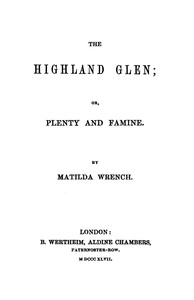
The Highland glen: Or, Plenty and Famine
Language: en361 downloads on Project Gutenberg
Subjects
In: Historical Novels·Novels·British Literature
Public-domain ebook sourced from Project Gutenberg #70779.
Public-domain ebook
Language: en361 downloads on Project Gutenberg
Subjects
In: Historical Novels·Novels·British Literature
Public-domain ebook sourced from Project Gutenberg #70779.
The opening · free to read
MACINTOSH, PRINTER, GREAT NEW-STREET LONDON.
THE HIGHLAND GLEN.
Reader, have you ever visited the western Highlands of Argyleshire? If you have, you will doubtless retain many a pleasant memory of the wild glens and the fair lakes, and the picturesque and magnificent mountains that make up the lovely scenery of these regions of the beautiful. If you have not, trust yourself for a few brief minutes to our guidance, while we strive to recal the impressions of one day, out of many happy days, passed in a Highland village there, not very long ago.
The traveller who visits this spot, seldom leaves it without exploring the upper shores and the Serpent’s Fall, at the head of Loch ——, nor did I and my companion; and, as we were slowly rowed up it against the tide, we gazed in admiration at the pyramidal and craggy mountains that towered majestically above the deep blue waters of the lake, shelving into them, and jutting out in little promontories that almost met on either side, damming up the current so as to make it discharge itself with tenfold impetuosity as it escaped from the narrowed channel. One of our guides was a student of St. Andrew’s, the son of one of the smaller tenantry on the Lochiel estates, and, during the vacation, he was endeavouring, by rowing visitors about the lake, to raise a small sum of money for the purchase of books to enable him to pursue his studies on his return to college. He was a fine athletic-looking lad, with a countenance of remarkable intelligence, and was perfectly well versed in all the legends of the locality. Indeed, his older and more staid fellow-labourer at the oar now and then allowed a half incredulous smile to steal over his weather-beaten face, as Mr. —— related how the shepherd of the glen, in ages past, had, after many warnings, been changed into a mountain on the Inverness side (where, alas! he was wont to stray), and how his faithful wife, who had many a time strained her eyes in vain in watching for his return, was rewarded for her fidelity and devotion, by finding herself and the stone, on which she used to sit in the dim twilight, gradually growing into the shapely mountain that still bears her name,[1] so that, while the world lasts, she shall never again lose sight of her gude man. It was truly an idle tale, and yet not, perhaps, altogether vain, for it might suggest a thought of sin and sorrow, that pair inseparably united by a decree which none may break. But we must not linger thus, lest minutes turn to hours, and patience be tired before her time.
After many a vigorous stroke, and many a long pull, that caused the beads of dew to stand thick upon the brows of our almost-exhausted boatmen, who with all their efforts could scarcely keep their course among the eddies of opposing currents, we at length saw the water of the fall, flowing into the lake, and gazing on it in admiration, like a silver line upon a field of ultramarine, soon after landed.
I will not stop to tell of sketching and climbing, and of boggy swamps that threatened to impede our way to the most desirable points of view. I will only say that we were thoroughly exhausted with fatigue and hunger, when, after some hours spent in exploring, we turned our steps towards a “house of refreshment” which our boatmen had pointed out. They had promised to announce our approach, and accordingly we found the table spread with freshly-made oat-cake, still hot and crisp, a large bowl of rich cream, fresh butter, a bottle of whisky, and a drinking-horn.
The “house of refreshment” was, however, nothing more than a rough Highland hut, situated at the foot of the old road up the glen, if road that could be called which was formed of a succession of vast ledges of rock from three to five feet high; such as it is, it is the only opening among the mountains that, bare and rugged, rise abruptly on all sides, and it is bordered by a narrow track, down which the drovers still conduct their flocks and herds, unless when it is flooded by the mountain torrents, that rush thundering through the glen, and discharge themselves through a chasm in the rock to the left of the hut, forming one of the small streams that feed the lake. A huge, shapeless mass of rock rises just opposite this rustic shelter, and must serve to break the violence of the blasts that sweep the glen, though it also hides the romantic beauties of its entrance.
A little group of three or four children were clambering over the rocks, and dragging huge branches of the bracken, which they had been out to get, as litter for the favourite cow that stood in a byre or shed at one end of the hut. At the sound of their ringing laughter as they drew near, a rough, wiry-headed tabby cat, that had been basking in the sun, put up her back, and after leisurely stretching herself and pawing, walked to meet the merry ones, and purred and rubbed herself against each in turn, turning up her green eyes as if she expected a caress in answer to her greeting. The bracken was dragged to the cow-shed, and then with a yell of self-gratulation, or of hunger, we cannot precisely say which, the whole number rushed into the room we occupied, and as suddenly disappeared through a side door.
Our meal despatched, and neither waiter nor hostess appearing, we had leisure to survey the apartment. The centre was supported on what was literally a roof tree, for a venerable beech, that had, perhaps, been the original attraction to the site, still upheld the simple framework of the roof, raised aloft on its double-twisted stem, selected, doubtless, for its promise of double strength. In one corner of the room stood a solid oaken chest, the receptacle of the meal that supplied the family with food; opposite was a bed, or rather shake-down, for it was on the floor, but looked very clean and comfortable; on the third side the peat was giving out its red heat from a spacious hearth, and indeed induced such a feeling of suffocation, that we would fain have opened the window for a little fresh air from the mountains. The massive framework, however, was not made to open; it seemed calculated rather to exclude light as well as air, for the proportion of glass was small indeed; so in despair I went to the side door, and, in opening it, nearly tumbled through, for the earth (there was no flooring) had sunk so much at the threshold as to have left a sort of trench. I recovered myself and stepped over, and there were the four barefooted urchins with their curly heads and their rosy cheeks, the very picture of health and glee, standing round a three-legged stool on which their mother had set a large bowl of smoking potatoes and milk. They were sipping and eating, and just as I entered the room, the elder boy having fished up a particularly attractive, flowery bit of potato between his finger and thumb, ran to the baby, a fine child of some ten or eleven months old, who was sitting on its mother’s knee, and began to cram its tiny mouth with the delicious morsel which broke and crumbled and fell into the infant’s lap; the petted baby smiled and laughed, and helped to pick up the crumbs, and put them, not into her own mouth, but her mother’s. “That’s a braw bairn,” exclaimed the mother, “a right Highland lassie, aye to gie the bit and sup afore you tak’ it yoursel;” and the child, at the sound of its mother’s voice, turned to her, and forgot the potato and nestled in her bosom, and she bent her head over the bonnie wee thing, and gave it a long fond kiss, as though it had been her first-born. She was seated on a low oaken bench, such as in England is called a settle, and a high screen behind her prevented her seeing our entrance.
We stood for a moment looking on the scene of simple domestic happiness before us, and then introducing ourselves by a few words of greeting to the group around the bowl, we thanked the hostess for our seasonable refreshment, and asked what we should pay. “Oh, naething, just naething,” was the reply; “ye’re wanderers and far frae hame, and ye’re welcome.” We remonstrated. She shook her head, saying, “God has gi’en us plenty, and he bids us use hospitality, and ye winna gainsay his bidding, so just gang in peace,” she added, laughing goodhumouredly, “for ye’re far frae ——, I guess, and ye’ll hae a long pull hame.”
It was indeed getting late, and the thought of four hours on the lake in the dark, had a hurrying tendency, so pointing to the Bible and hymn-book on the shelf above the children’s bed, we bade her remember us in their evening worship, and, slipping some silver into the children’s hands, we took our leave. We had not gone many yards before we met a Highlander with a net at his back, and a basket of fish before him, and the shout of delight which in another moment burst from the cot, proved him to be, as we had supposed, the father of the group within. Before we had gone far, we heard a sonorous voice raising the evening hymn, and anon the sound of shrill and infant voices mingling with it. We could not stop to listen, but we joined in heart, and as a fresh breeze from the mountain pass brought the sweet sounds once more to our ear, we fervently exclaimed (as again they died away), in the words of their native poet:—
“May He who stills the raven’s clamorous nest, And decks the lily fair in flow’ry pride, Yet, in the way his wisdom sees the best, For them and for their little ones provide, But chiefly in their hearts with grace divine preside.”
Such was the condition of a Highland family in the autumn of 1845. And now we are about to reverse the picture; to show our Highland family under other circumstances, and we would entreat the reader to remember that since the joyous and the grievous, the bright days and dark days, are alike of God’s appointment, it must be good for us to look upon both,—to look, to meditate, to minister, and it may be, in so doing, to learn a lesson that may be to our profit as well as theirs. May God of his infinite mercy grant it, to the glory of his holy name, through Jesus Christ!
Eighteen months had passed over the Highland cottage, and in their brief course had swept away almost all that it had once contained of the appliances of domestic usefulness and comfort; for the scarcity which had been felt on the partial failure of the potato crop in 1845, had, in consequence of the general failure of the following year, advanced through the successive stages of privation and destitution, till it might now truly be said in the simple, but emphatic language of Scripture, that “the famine was sore in the land,” for “_their food has been destroyed,_ and means of purchasing other food they have not.”[2]
It is about the second week in January, 1847, that we would again introduce our friends to the home of the M’Kenzies. An air of desolation now reigned around it,—all was still. There was no hum of children’s voices making glad the lonely glen; the fowls that had gathered round the cottage-door were no longer to be seen, the pig-stye was empty,[3] the stream was frost-bound.
The book keeps going
Reading is free forever. Sign up and watch scenes appear while you read.



Scenes Storieta drew for other classics.
New illustrated classics
Once or twice a month: the latest books to get full character casts, scene art, and free comic editions. No account needed.