Public-domain ebook
After world's end
English443 downloads on Project GutenbergDownload EPUB
Public-domain ebook sourced from Project Gutenberg #70814.
Public-domain ebook
English443 downloads on Project GutenbergDownload EPUB
Public-domain ebook sourced from Project Gutenberg #70814.
The opening · free to read
Could the Earthmen ever win against Malgarth, the Robot monster? Was their only hope Barry Horn, who had waked from the age-long amnesic sleep of the cosmic rays, and Dona Keradin, the wonder-girl in the carbon crystal?
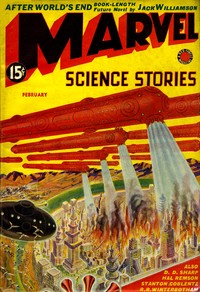
[Transcriber's Note: This etext was produced from Marvel Science Stories February 1939. Extensive research did not uncover any evidence that the U.S. copyright on this publication was renewed.]
We found the stranger, when we unlocked the bungalow after a week on the lakes, seated at my big desk in the study. His face was an enigma of youth and age. Lean beneath his long white hair, it was gray and drawn and hollowed as if with an infinite heartbreak--and yet it smiled. His emaciated hand, thrust out across the pile of loose yellow sheets he had written, gripped an incredible thing.
Queerly lifelike, he was yet more queerly still.
"Why, hello!" I said.
And then, when he remained stiffly staring at that scintillating glory in his rigid hand, we knew that he was dead.
His injuries, when we came to discover them, were dreadful as they were inexplicable. All his gaunt, shrunken body--torso, neck, and limbs--showed dark purple ridges. It looked as the body of Laocoön must have looked, when the serpents were done. But we found no snakes in the bungalow.
"The man was tortured," asserted the examining doctor. "By ropes, from the looks of it, drawn mercilessly tighter. Flesh pulped beneath the skin. Grave internal injuries. A miracle he lived as long as he did!"
For four or five days had passed, the doctors agreed, since the stranger received his injuries. He had been dead, by the coroner's estimate, about twenty hours when we found his body.
It is fortunate indeed for us all, by the way, that we had been together at the lakes and that friends there were able to substantiate our mutual alibi. Otherwise, in view of the incredible circumstances, ugly suspicion must have fallen upon us.
"Death," ran the oddly phrased verdict of the coroner's jury, after we all had been questioned, and the premises, the manuscript, and the stone examined, "resulting from injuries sustained through the act of persons or things unknown."
The stranger's life, as much as his death, remains a mystery. The sheriff and the aiding state police have failed to identify him. The manuscript is signed, "Barry Horn," but no record has been found that such a man is missing. The medical examiners agreed that he was of contemporary American stock; but they were mystified by the freaks of cell structure indicating extreme age in a man apparently young.
His clothing, even, is enigma. Textile experts have failed to name the fine rayon-like fibers of his odd gray tunic and the soiled, torn cloak we found on the couch. The hard shiny buttons and buckle, like the bright pliant stuff of his belt and sandals, have baffled the synthetic chemists.
The weapon we found in the yellow belt seems worth the study of science, but no scientist yet has made anything of it. It looks like a big, queer pistol, with a barrel of glass. Its mechanism is obviously broken, and my attempts to fire it have proved unsuccessful.
How he came into the bungalow--unless in the strange way his manuscript suggests--we have been unable to conjecture. For the house was securely locked before we started to the lakes, and no fastening shows to have been disturbed. A tramp, so the baffled sheriff argues, might break undetected into an empty house--but, if anything seems certain about Barry Horn, it is that he was not a common tramp.
The manuscript was written with my own pen, on paper he found in the desk. The task must have taken him three or four days. The doctors seem astonished that he was able to complete it. And it must have been a race with pain and death, for the script is continually more hurried and uneven, until, toward the end, it is barely legible.
The used dishes and empty cans on the kitchen table show that he found several meals for himself--the last of which, evidently, he was unable to eat, for the food was left untouched on the plate. A wrinkled rug lay with his cloak on the couch, where he slept and rested.
He must have rummaged for something in the medicine cabinet, for we found that open, and a bottle of mercurichrome smashed on the bathroom floor. He seems to have made no effort, however, to get medical assistance. For my telephone was sitting, dusty and untouched, on the desk where he wrote and died.
He surely perceived the end, for the page beneath his hand was the opening of a will. Had he lived to complete it, his instructions might have cleared up much of the monstrous riddle. He had written:
I, Barry Horn, being lately returned out of Space and Time to this my own beloved land and era, finding myself yet clear in mind but unregretfully aware of approaching death, do make this my last will and testament.
First I must offer belated apology to the Carridans, the relatives of my dead wife Dona, for the long bitterness I felt toward them because they took from me, I felt unjustly, my only son.
Second, to the unknown holder of this house, in repayment for his unwitting hospitality while it was being written, I bequeath this manuscript, with all rights thereto. I hope that it may be published, so that men may know something of the splendors and the dangers awaiting their race in the far-off future. So that others, perhaps, may share something of the love I feel for Kel Aran, the last man of Earth; and for those two great women, equally beauteous--Dondara Keradin, the Shadow of the Stone; and Verel Erin, the Stone's Custodian and Kel's brave beloved. For those three are more to me than any others I have known, save only Dona Carridan.
Third, to my sole son and child, Barry, upon his being released from the too-jealous guardianship of his mother's relatives, I bequeath my clothing and weapon and the large diamond block I have with me, requesting that he read the narrative I have written before making any disposition of the diamond, which was the Stone of Dondara.
Fourth, as Executor of this Will, I do hereby appoint my old friend and attorney, Peter--
At that point the last agony must have struck. The pen wandered away on an aimless track, dropped from dying fingers. The attorney's last name, and Barry Horn's instructions for finding his son, remain unknown.
Weird riddles enough! But the most astounding puzzle is the diamond block. An incredible brick of water-white crystalline fire, four inches long, it weighs eleven hundred carats--nearly half a pound! It is quite flawless, save for that singular shadow which certain lights show in its pellucid core--if that white ghost could be termed a flaw.
Such a stone is beyond price--but for the mutual support of jewel and manuscript, it would be beyond belief. For, while the famous Cullinan Diamond was far larger in the rough, there is no credible record of any cut stone weighing even half as much. Dealers, skeptical of its description and astonished by its reality, have been reluctant to set any valuation upon it.
"By the carat, millions!" cried one startled jeweler. "But I should cut up such a stone, like a cheese, never! Vait for some prince to giff his kingdom!"
We have hesitated, despite the request in the unfinished will, to publish this manuscript, especially since so large a part of the mystery is still unsolved. For it is sure to be received with skepticism in the scientific world, and its acceptance elsewhere may endanger the safety of the diamond.
But all other efforts to find Barry Horn's attorney and his son have failed. Publication holds the only remaining hope of clearing up the mystery and establishing the ownership of the jewel. Any person knowing the whereabouts of the younger Barry Horn, or the identity of his father's attorney, is requested to communicate immediately with the publishers.
WANTED: Vigorous man, with training and experience in scientific exploration, to undertake dangerous and unusual assignment. Apply in person, this evening, 6 to 10. Dr. Hilaire Crosno, Hotel Crichton.
That sounded good. I had been in New York just twice too long. Always, when I had come back from the long solitudes of desert or jungle, the first fortnight on Broadway was a promised paradise, and the second began to be hell.
I gave the grinning boy a dollar, stuffed an envelope with credentials, downed another stiff peg of whiskey, and walked into the glittering chromium lobby on the stroke of six. My inquiry for Dr. Crosno worked magic on the supercilious clerk.
Crosno proved to be a big man, with huge bald head and deep-sunken, dark, magnetic eyes. The tension of his mouth hinted of some hidden strain, and extreme pallor suggested that, physically, he was near the breaking point.
"Barry Horn?" His voice was deep and calm--yet somehow terrible with a haunting echo of panic. He was shuffling through my references. "Qualifications seem sound enough. Your doctorate?"
"Honorary," I told him. "For a pyramid I dug out of the jungle in Quintana Roo." I glanced at the room's austere luxury, still trying to size him up. "Just what, Doctor, is your 'unusual assignment--?'"
Majestically, he ignored my question. Gray eyes studied me.
"You look physically fit, but there must be an examination." He checked a card in his hand. "You know something of astronomy and navigation?"
"Once I sailed the hull of a smashed seaplane a thousand miles across the Indian Ocean."
The big head nodded, slowly.
The book keeps going
Reading is free forever. Sign up and watch scenes appear while you read.



Scenes Storieta drew for other classics.
New illustrated classics
Once or twice a month: the latest books to get full character casts, scene art, and free comic editions. No account needed.