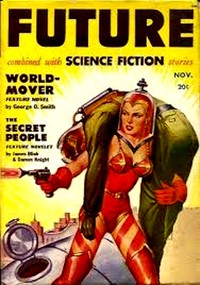
Les Ackerman, unbelievably alive after a nuclear explosion, finds himself sought after by the denizens of three possible worlds, all contending that Ackerman alone can adjust the incredible situation he has created. Only Les doesn't know what he's done!
[Transcriber's Note: This etext was produced from Future combined with Science Fiction Stories November 1950. Extensive research did not uncover any evidence that the U.S. copyright on this publication was renewed.]
To the present sitting, there were three hundred thousand words in the report on the new transuranic element that Les Ackerman was studying. This took months of painstaking work, but Ackerman viewed his results with satisfaction. To date, the report covered about all that was to be known regarding the physical and chemical properties of this new element; there remained only the nuclear properties to investigate.
Nuclear properties were always left to last. Nuclear bombardment defiled the element and rendered it unsuitable for the undestructive chemical analysis and physical investigations.
So Les Ackerman closed his notebook with a slam and checked the refrigerator. The deuterium-ice--frozen heavy water--for the cyclotron target was in fine shape. He could start at once.
He took both the ice-target and the sample to the big, enclosed room and inserted them in the proper places in the cyclotron set-up. Then he fired up the big cyclotron, and high-energy deuterons bombarded the deuterium-ice target, releasing free neutrons that in turn bombarded the sample.
That was to be his last job for the night; the registering counters would record the radioactivity while he slept, and in the morning the sample would probably be 'cold' enough to handle. He consulted his prospectus in the notebook and checked the bombardment-time for this first nuclear test. One half hour. At the end of one half hour, Ackerman could turn off the cyc and go to bed. The automatic counters would quietly record the diminishing activity of the 'hot' sample.
The click of the counting-rate meter sounded. The first atoms of the sample were being attacked properly. Ackerman nodded to himself, there in the operating chamber, separated from the real activity by solid yards of concrete, water, and paraffin.
Unluckily, Ackerman could not be in the cyc chamber itself to watch. As it was, it would have been no more dangerous for Les to stand in the radioactivity-laden cyclotron room than it was for him here in what all cyclotron mechanics considered more than safe from harm.
As the neutrons raced invisibly into the new element, a tiny, glistening sphere expanded, millimeter by millimeter. It was a strange field of energy, a true freak of Nature. Unpredicted and unknown, it hovered at nine centimeters radius as the sample swallowed neutrons by the uncounted million. It expanded again, slowly, slowly, slowly until the critical proportion of sample and transmuted nuclei was attained.
Then the glistening sphere of energy expanded with an acceleration that drove it to the ends of the infinite universe in a matter of microseconds. Too swift to be seen, to register--if there had been a means of detecting it--and too swift even to leave a trace of evidence on the physical universe.
Its effect, however, was evident to Ackerman. The others who came later saw only what they found remaining. Les was on the spot, and saw the dual effect of the bombardment of Element X by neutrons.
His notebook gave the first sight of unreality. Like a double exposure, or a photomontage, he saw page after page curl up in charred destruction--curling up wraithlike out of a complete and unharmed volume! He saw the solid concrete blocks rave into incandescence--flying in terrible fury out of the unharmed wall; each brick as it exploded separating ghostlike from its unharmed twin. The laboratory exploded in a mighty pillar of flame and fire--rising seventy thousand feet into the sky but mushrooming upward from the placidly unharmed ghostly replica of itself. The light from the explosion was all-blinding, yet the calm moonlight still cast its mellow shadow over the unharmed buildings. The explosion shocked fleecy clouds into falling rain--rain that fell from the serenely existing sky of the other--other--other what?
Ackerman found himself standing on the sterile land that surrounded the laboratory, simultaneously watching the boiling cloud above and the moonlit laboratory below. He was puzzled, somewhat afraid to go close to the possible effect of the nuclear explosion; yet there was the fact that at least in one existance the laboratory was unharmed.
He waited, wondering. The passage of time did not seem to bother him. Previously, Ackerman had been tired, and more than glad that this was the last job of the evening. Now he was far from weary, and the passage of time was difficult to estimate.
He was surprised to see, not too much later, that people were streaming towards the scene. He laughed at one group--a racing column of excellent fire-fighting equipment; the idea of tossing water or chemicals on a radioactive explosion was amusing in a sense. The fire had gone out a microsecond or so after it had started, and if anything were burning now, it was because the stuff had not time to cool down yet. Ackerman could think of nothing more dangerous, however, than to drive a fire truck--or anything else not shielded in lead, water, and concrete--across the scorched area.
He saw his colleagues walking wraithlike and arguing heatedly against the police and firemen. The latter wanted to go in; Ackerman's former mates were waving counters and personal ionization meters at them, trying to explain the danger. The officials were inclined to be skeptical of any danger that could not be seen, but were equally awed by the names of the men who barred their way. At long last a crude circle was drawn on the ground; as the curious folk continued to arrive, the circle was quickly filled and people were standing with their toes across the line.
Ed Waters shrugged sorrowfully. "I can't imagine; there was certainly nothing dangerous in what Les was intending to do."
"And we know Les," replied Tom. "He'd not take to doing something off the beam."
"There was certainly nothing off the beam about bombarding Element X with neutrons," agreed Ed Waters. "We've done it before."
"But not with as large a sample. We'll have to be careful in the future about it."
Waters grinned wolfishly. "We'll not toss another cyclotron to the breeze," he said. "We can get a neutron-emitting radioisotope from one of the uranium piles and shove the two together by remote control; it'll save both lives and materiel."
"Too damned bad," said Crowley. "We lost a good man."
"But I'm right here!" exploded Ackerman. He had been standing between them, waving his hands in their faces--and in more than one case through their faces. Strangely enough, the trees and the ground were quite solid to Les Ackerman, but his friends were not.
The crowds of the curious came and they went; newspapers, as the hours went on, told Ackerman that he was the victim of a terrible atomic blast, a totally deplorable situation.
Ackerman wondered more about it. Was this death?
It was many hours later, when daylight had come fully and the morning's work was to begin, that Les Ackerman got his next shock. The sterile area was still guarded by Ackerman's friends, making close watch with counters and ionization meters. Yet so far as Les was concerned, the shallow depression of greenish glaze fell in a concave bowl below the surface of a serene and untouched terrain upon which the wraithlike laboratory stood. He termed it "wraithlike" because he could see both the greenish depression and the laboratory, and the other side of the blast-bowl through the laboratory. He could not see through the laboratory to glimpse any of its insides.
Whatever this division was, Ackerman could see a dual possibility, could see either the world of the explosion or he could see the world of peace and quiet.
His shock came as the technicians began to arrive. Then, he blinked. As he was standing beside Ed Waters, he saw Waters' car drive up to the parking place beside the laboratory, saw Ed emerge and enter the building by the main door!
Before he could follow Waters, he saw Tom Crowley enter, too; Ackerman left their counterparts on the edge of the seared area and raced forward with a shout of alarm.
It occurred to him, then, that both men carried personal counters and warning gauges; they would have been warned away from the area if there were any radioactive danger. Ackerman found his hand passing through the door-handle and puzzled over how to get in until he understood that if his hand could pass through the door-handle, he himself might pass through the door. He did, and with some dismay knew that he was walking, not upon the floor of the building but about a foot or so below the floor. With an effort of his will alone Les raised himself; it was disconcerting to know that he was wading knee deep through a solid concrete floor.
He found Waters and Crowley in the cyclotron room. They were looking over the sample critically with heavy magnifiers and making notes. "Thought Les was going to flop here," said Waters.
"So did I. He must have decided to go home after he was finished."
"Don't blame him. I'd have been inclined to set the timers and leave then. Ackerman is a cautious fellow and would wait until the timers clicked off even though he had nothing to do but sit and watch unerring meters. I'd say that Les deserved a good night's sleep. Well, take a hunk off of the sample for the radioisotopists, and we'll carve a bit ourselves for later, then give the remaining piece another banging."
"You carve," said Crowley. "I'll get another heavy-ice target from the refrigerator."
Waters nodded, cut two infinitesimal slices from the sample with a diamond-edged wheel, dropped them into separate containers and labelled them both. Then he re-inserted the sample in the cyclotron set-up and both men went out to give the Element X sample a second shot--according to plan, a longer and more energetic blast.
Vainly Les Ackerman tried to reach them.
He screamed himself hoarse, trying to tell them not to do it--that he had been a one-time victim. Then, in fear and desperation, he saw them leave the cyclotron chamber; he fought and swore against his wraithlike fingers that passed through the sample of death. He clawed ineffectively at it, trying to take it from the coming blast of neutrons. Like the room, the walls, and the men, his hands passed through the cyclotron; through the sample; and through the containing shell. Instinctively he knew that the cyclotron was being fired up, yet his fumbling hands felt nothing of the fifty thousand volt driving power of the Dee plates. He knew instinctively when the storm of the deuterons came to bombard the heavy-water ice. He knew that the resulting neutrons were entering the sample of Element X.
He fumed and fretted; then as his mind cried out in vain, his will slipped and Les Ackerman went down through the floor of the room, he could not reach up high enough even to touch the imminent danger.