Transcriber’s Note: Biblical references in the sidenotes are not always possible to make out, due to the quality of the print. Where this is the case it has been noted with [unclear] or [unreadable], as appropriate.
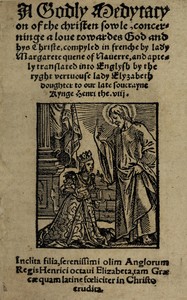
A Godly Medytacyon of the christen sowle, concerninge a loue towardes God and hys Christe, compyled in frenche by lady Margarete quene of Nauerre, and aptely translated into Englysh by the ryght vertuouse lady Elyzabeth doughter to our late souerayne Kynge Henri the .viij.
Inclita filia, serenissimi olim Anglorum Regis Henrici octaui Elizabeta, tam Græcæ quam latine fœliciter in Christo erudita.
To the ryght vertuouse and christenly lerned yonge lady Elizabeth, the noble doughter of our late souerayne Kynge Henry the .viij. Iohan Bale wysheth helth with dayly increace of Godly knowledge.
[Sidenote: Nobylyse.]
[Sidenote: Albion.]
Diuerse and many (most gracyouse lady) haue the opynyons bene amonge the prophane philosophers and christen dyuynes, concernynge ryght Nobylyte, and no fewar stryues and contencyons for the same. Some autours haue vaynely boasted it to take orygynall of the olde Goddes of the Gentyles, as euery lāde hath had hys peculyar Saturne, Iupiter, & Hercules, yea our Englāde here and all. Some hath fatt it from the foure generall monarchyes of the Assyrianes, Perseanes, Grekes, and Romanes. Some haue attrybuted it, to the bolde battayles and bloudshedynges, in Ninus of Babylon the first inuētour of polycyes in warre, in our great Albion the Chamesene, whych first in thys regyon suppressed the posterite of Iaphet, vsurpynge therin the first monarchy, in Brute that more than six hondred yeares after defaced of hym the tyrannouse yssue, in Ebrāck and Dunwallo, in Brenne and Belyne, in great Constantyne, Artoure, Cadwalader, Engist, Egbert, Alphrede wyllyam cōquerour & soch other, for lyke cōquestes of the Romanes, Grekes, Galles, pyctes, Brytaynes, Saxons, Danes, Iryshens and Englyshens.
[Sidenote: Brute.]
[Sidenote: Romani.]
[Sidenote: Gwalli.]
[Sidenote: Iaphet.]
[Sidenote: Kyndes of Nobylyte.]
The hawty Romanes set not yet a lyttle by themselues, that they haue rysē of Aeneas & Romulus, of whom the one most shamefully betrayed hys owne natyue kyndred and contraye, and the other most vnnaturally slewe hys owne brother for worldly domynyō. Lyke as our walshemen here in Englande, aduaūcynge their successyon or progeny aboue the Englysh wyll nedes come of Sardanus & Bute, a foūdacyō not all vnlyke to the other. These gloryouse champyons for thys farre fatched groūde of their Nobylyte, accoūte all other nacyons and peoples, ignoble, profane, and barbarouse, as is to be seane in the monumētes of their writers. But in the meaneseason, they are not aware that they wndyscretely prefarre cursed Cham to blessed Iaphet, by whose posteryte the Iles of the Gentyles were first sorted out in to speches, kyndredes, and nacyons, Gene. 10. and not by Chams ofsprynge, of whome the Troianes and Romanes had their noble begynnynge. That the Chamesenes had in those Iles, was by cruell vsurpacyon & tyrāny, as testyfyeth Berosus the Caldeane and therfor that groūde of Nobylyte is not all the best. Ouer and besydes all thys, some haue applyed it to renomed byrth or successyon of bloude, some to the habūdaūce of pleasures worldly some to the mayntenaūce of great famylyes, some to the sūptuousnesse of notable buyldynges, some to the hygh stomake & stature of persone, some to valeaūtnesse in marcyall feates, some to semely maners of courtesye, some to lyberalyte of rewardes and gyftes, some to the auncyentnesse of longe coūtynuaunce, some to wysdome lernynge & stody for a cōmēwelth with soch lyke. And these are not all to be dysalowed, for we fynde them in Abraham, & Dauid with other iust fathers.
[Sidenote: Clergy.]
[Sidenote: Stābery.]
[Sidenote: Hunte.]
[Sidenote: Fryres.]
But now foloweth, a monstruouse, or whether ye wyll, a prestygyouse nobylyte. The Romysh clergye ymagenynge to exalte themselues aboue the lewde layte (as they shame not yet to call the worldly powers) haue geuen it in a farre other kynde, to mytars, masses, Cardynall hattes, crosers, cappes, shauen crownes, oyled thombes, syde gownes, furred amyses, mōkes cowles, and fryres lowsy coates, becōmynge therby pōtyfycall lordes, spirytuall sirs, and ghostly fathers. Thys kynde of Nobylyte dygged out of the dongehyll, haue I seane gorgyously garnyshed with the retoryckes of Porphyry, Aristotle, Duns, and Raymundus decretals, in the bokes of Iohan Stanbery byshopp of herforde, De superioritate ecclesiastica, De discrimine iurisdictionum, and De potestate pōtificia. In the bokes also of Walter hūte an ordynary reader sūtyme in Oxforde, De precellētia Petri, & De autoritate ecclesie. Yea, and amōge thēselues they haue moch contended both by disputacyon & writynges, whych of their seeres myght other excell in the nobylnesse of christen perfection. The monkes in publyque scoles, by a dystynccyon of the actyue and contemplatyue lyfe, haue aduaunced their ydell mōkery aboue the offyce of a byshopp, and the fryres their scalde crauynge beggery, aboue the degrees of thē Both. As is largely seane in the brawlynge workes of Rycharde Maydeston, Thomas walden, Wyllyam Byntre & other whych haue written Contra wicleuistas, & Pro mēdicatione fratrū.
[Sidenote: Myluerton.]
[Sidenote: 4. orders.]
[Sidenote: Prestes.]
[Sidenote: O Deuils īcarnate.]
In the dayes of kynge Edwarde the fourt, Iohan Myluerton prouyncyall of the Carmelytes, was full thre yeares, a prysoner in the castell of Angell at Rome at the sute of the byshoppes of Englande for the same, and lost so the byshopryck of saynt Dauids, wherunto he was a lyttle afore elected. Thys matter haue I hearde, vndre the tyttle of Euangelyck perfeccyon, most depely reasoned in their ordynary dysputacions at their concourses cōuocacyons, and chapters (as they than called them) yea by those whome I knewe most corrupt lyuers, Berūto for fournyshynge out the same, the graye fryres added. S. frances paynted woūdes, the blacke fryres. S. Domynyckes bolde dysputynge with heretykes, the whyte fryres our ladyes fraternyte, and the Augustyne fryres the great doctryne of their patrone. In the vnyuersytees afte moch to and fro, hath it bene concluded, that the order of a prest haue farre excelled in dygnyte the order of a byshopp. And thys haue they left behynde them for a most graue and depe reason therupon. Marke their more than lucyferyne presumpcyon therin. Soch power hath a prest (saye they) as hath neyther Angell nor yet Man, be he of neuer so great autoryte, scyēce, or vertu. For a prest by worde maye make hym agayne, that by worde made heauen & earth. A prest maye euery daye both byget hym and beare hym, where as hys mother Marye bygate hym (beare hym they wolde saye) but ones. These are their very wordes in a boke entytled, De origine Nobilitatis. ca. 5. with moch more cyrcumstaunce of matter. O blasphemouse bellybeastes, & most ydell wytted sorcerers. How ydolatrously exalte they themselues aboue the eternall lyuynge God & hys Christ?
[Sidenote: Nobylyte.]
[Sidenote: Apostles.]
[Sidenote: Faythe.]
Iohan Chrisostome a man taught and brought up in the christen philosophy, defyneth the true Nobylyte after a farre other sort, than ded the prophane writers. He calleth it not with Aristotle, a worthynesse of progeny, neyther yet with Varro ā opulēcy of ryches, but a fameuse renome obtayned by lōge exercysed vertu. He is pusaunt, hygh, ād valeaunt (sayth he) and hath Nobylyte in right course, that dysdayneth to geue place to vyces and abhorreth to be ouercomen of them. Doctryne greatly adourneth a mā hyghly borne, but a godly endeuoure of christyanyte bewtyfyeth hym most of all. By nō other wayes haue the Apostles and Martyrs obtayned a noble report, than by the valeaunt force of pure doctryne and fayth. A gētyll hart (sayth Seneca) or a stomake that ys noble, moueth, prouoketh, and sturreth, only to thynges honest. No man whych hath a noble wytte, delyteth in thynges of small value, moch lesse in matters of fylthynesse or supperstycyon. Chefely apperteyneth it to men and women of syncere Nobylyte, to regarde the pure doctryne and faythe, vnto soch hath God promysed in the scriptures, habundaunce of tēporall thynges, longe lyfe, fortunate chyldren, a kyngedome durable, with soch other, Deut. 28.
[Sidenote: Gedeon.]
[Sidenote: Asa rex.]
[Sidenote: Iosaphat.]
[Sidenote: Iehu.]
[Sidenote: Ezechias.]
[Sidenote: Iosias.]
[Sidenote: Prestes.]
[Sidenote: Ecclesia. 49.]
A most worthy conquerour is Gedeon noted in the scriptures, for destroyenge false relygyō & renuynge the kyngedome of faythe. Iudi. vj. So is kynge Asa, for remouynge the male stues from the prelates abhorrynge marryage, & for puttynge downe ydolles whych hys forefathers maynteyned. 3. Reg. 15. So is kynge Iosaphat, for beynge couragyouse in the wayes of God, and for puttynge downe the hyll aulters & their sacrifices. 2. parali 17. So is kynge Iehu, for sleynge the ydolatrouse Prestes, and for breakynge and burnynge their great God Baal, and for makynge, a Iakes of their holy churche 4. Reg. 10. So is kynge Ezechias for clēsynge the house of the lorde from all fylthynesse, afore hys tyme therin occupyed. 2. Parali. 29. and for breakynge downe the brasen serpent and ydolatrouse ymages with their aulters and sanctuaryes. 4. Reg. 18. So is kynge Iosias, for suppressynge relygyouse persones and aulter prestes, for cōsumynge their iewels & ornamētes, & for ouerthrowynge their buggery chambers in the howse of the lorde 4. Reg. 23. Thys noble kīge also destroyed all theyr carued ymages, he strewed the dust of thē vpon their graues that had offered to them, and brent the prestes bones vpō their aulters, restorynge agayne the lawes of the lorde. 2. parali. 34. Iesus Syrach reporteth of hym fynally, that he whollye dyrected hys hart to the lorde, & toke awaye all abhomynacyons of the vngodly. Eccle. 49. Besydes that is spoken of kynge Dauid and kynge Salomon.
[Sidenote: Edwarde vj. rex.]
[Sidenote: Ignoble.]
Not I only, but many thousandes more whych wyll not from hens fourth bowe any more to Baal, are in full & perfyght hope, that all these most hyghly notable and pryncely actes, wyll reuyue & lyuely florysh in your most noble and worthy brother kynge Edwarde the sixt. Most excellent & godly are hys begynnynges reported of the very foren nacyōs callynge hym for hys vertuouse, lerned, and godly prudent youthes sake, the seconde Iosias. Those hys wonderfull pryncyples in the eyes of the worlde, and no lesse gloryouse afore God thus beynge to hys honoure, that eternall lyuynge God contynue and prospere to the ende, that he maye haue of them as had these vorthy kinges afore rehearced, a ryght noble and famouse report. Nobylyte sought by wycked enterpryses and obtayned by the same (as in many afore our dayes, and in some now of late) is not els but a publyque and notable infamye, and in the ende eternall dāpnacyon. Nobylyte wonne by the ernest sekynge of Gods hygh honour, is soch a precyouse crowne of glory as wyll neuer perysh here nor yet in the worlde to come.