About this book
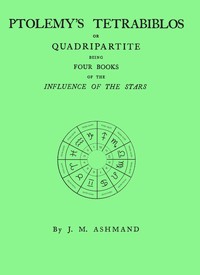
Ptolemy’s Tetrabiblos, presented here as a newly translated “Quadripartite” of four books, is a systematic treatise on the influence of the stars. The work opens with a formal title page that notes its Greek source, a preface by J. M. Ashmand, and an extensive table of contents that maps out topics ranging from planetary orbs and fixed‑star influences to the detailed mechanics of nativities, wealth, marriage and death. An introductory advertisement frames astrology as a once‑venerated science whose principles are now “neglected,” while the preface argues that contemporary curiosity, fueled by poetic references such as Byron’s, justifies a return to the “best accredited principles” of the discipline. The book proceeds methodically, each chapter enumerated and titled, promising a blend of astronomical observation, philosophical commentary, and practical prediction.
The language is formal and scholarly, reflecting early‑19th‑century English translation conventions, with preserved archaic spellings and occasional typographical corrections. Its tone is didactic, echoing the reverence of a period that still entertained the idea of celestial determinism. Readers with an interest in the history of astrology, Renaissance natural philosophy, or the transmission of ancient scientific thought will find the work’s exhaustive structure and its accompanying extracts from the Almagest and Centiloquy especially rewarding.