Public-domain ebook
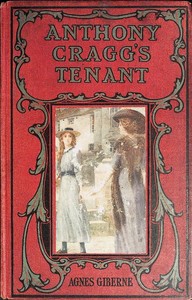
Anthony Cragg's tenant
Language: en383 downloads on Project Gutenberg
Subjects
Public-domain ebook sourced from Project Gutenberg #70873.
Public-domain ebook
Language: en383 downloads on Project Gutenberg
Subjects
Public-domain ebook sourced from Project Gutenberg #70873.
The opening · free to read
"ANTHONY! I say, Anthony! you're wanted. Make haste, will you? Folks can't dawdle round the whole day while you're pottering about upstairs. What are you doing? Do you mean to come, or not?"
"All right, my dear," a man's voice said in the distance, not exerting itself.
Mrs. Cragg tapped her smart parasol on the dusty floor. Although her words held a commanding sound, she was addressing her husband, and not a shop-boy. Mr. Cragg's better half had a reputation for smartness of tongue.
Generally she liked to make her exit at the private door, from which business was excluded; but for once she had gone round by the warehouse, and had travelled down by the uncarpeted wooden staircase at the back of the shop, to a door which led into a side street. At this door she had stumbled on two people, waiting patiently for attention—a tall man, wearing a shabby coat, and a girl.
Shabby people were objectionable in Mrs. Cragg's eyes. She counted herself a fine lady, and loved gay clothes, which she looked upon as a mark of gentility. Mrs. Cragg was not the first person in the world to fall into that mistake.
At this moment she wore a gown of bright blue, while a large scarlet wing stood forth aggressively in her green straw hat. She had a high colour, beady black eyes, a profuse fringe of yellowish hair, and marked features. Not everybody would admire this combination, but Mrs. Cragg was wont to feel satisfied on looking into her mirror.
Six years earlier, when she had figured as the only and hard-worked daughter of a third—rate and unsuccessful country attorney, with a sickly wife and several boys, she had been rather a pretty girl. But then she had worn no fuzzy fringe, nor had she dressed in blue and green and scarlet, nor had she rattled and laughed in self-important tones. These new developments had taken her husband by surprise, and he was not yet used to the change.
"You needn't expect me to stop here, if you mean to be a whole week getting from the top to the bottom of the stairs!" she cried. "I've got something else to see to."
"There's no need. If you'll just ask the gentleman to step inside—"
"We can wait where we are. You need not trouble yourself. Perhaps we have come to the wrong door?" suggested the tall man. "I daresay we ought to have gone to the front entrance in High Street."
"It don't matter. May as well stop, now you are here," said Mrs. Cragg. "He'll be down directly. He's always slow. That's his way."
She had meant to go out this side to save time, but, on second thoughts, she turned back and met her husband.
"Well, I hope you've been long enough," was her greeting. "It's somebody after that new house of yours; and if I was you I wouldn't have anything to do with him. He's as shabby as shabby. Got on a coat that shines like anything, and a pair of gloves that our cook wouldn't look at. And I should think his trousers was made at a slop-shop. If you let him have that house, you won't get any rent for it."
"It isn't always the finest-dressed folks that pay their bills the quickest," replied Cragg, with a wisdom born of experience.
"He won't. You see if I'm not right." Mrs. Cragg liked to be always in the right, and seldom admitted that she was not. Having once committed herself to this particular view of the question, she was certain not to regard the tall man in future with favourable eyes. Cragg knew this, but he said nothing.
"You see!" repeated Mrs. Cragg, "I know a man that can't be depended on when I come across him. He's as poor as a church-mouse, and he wants to get a house rent-free. If you take my advice, you'll pack him off in a hurry."
Cragg was not in the habit of taking a woman's advice in matters of business, though he obtained plenty of it, gratis, from his wife. Her opinion, given lavishly and unasked on all occasions, lost value from its abundance.
Mrs. Cragg passed on, and Mr. Cragg finished the descent of the stairs, with the air of a man who prided himself on being never in a hurry.
"Good morning. This way, please," he said, and he led the strangers to a room behind the warehouse.
Cragg was a vendor of new and secondhand furniture, and indeed of everything required in house-plenishing. The main warehouse, or shop, which opened on the High Street, was full of furniture of all kinds, piled together, with lanes amid the piles. This lesser room in its rear held rolls of carpets and heaps of rugs. One chair stood in the middle, and upon it the newcomer slowly lowered himself, with a sigh of relief, as if he had had enough walking. The girl leant against him, drooping her head, as she had done all along, so that the wide-brimmed hat hid her face. From her height Cragg supposed her to be about thirteen years old, but he did not pay much attention to that matter.
With a business-like air of expectancy he stood waiting. He was much older than his wife, nearer fifty than forty, while she was still under thirty. He had a sensible face, with horizontal lines of care on the forehead, and absent eyes. People talking to Mr. Cragg often fancied that his thoughts were elsewhere; yet he generally heard what was said.
"I am a stranger in Putworth," was the first remark. "My name is Dale; and I am told that you have a house to let."
"Yes. About the only vacant house just now in Putworth."
"So I hear. One that you have just built. I went to the postmaster, and he advised me to come to you. My daughter and I arrived yesterday afternoon. We want to find a quiet home, somewhere on this line of rail. Easier to move my furniture than if we go elsewhere. I may want one or two things from you—possibly"—glancing round—"though we have nearly enough; very nearly enough."
"Putworth is a healthy place. You have not seen the house yet, of course?"
"The outside of it. We walked round yesterday evening for a look. Too late to do anything. It seemed to be just what I want."
"Extremely well situated."
"Well, yes. That meadow in front looks damp, and the surroundings are not pretty. Still, one can't have everything."
"Not pretty!" Cragg bristled up in a mild fashion. "There's green grass and a stream of water. What more can you want? And the meadow's drained."
Mr. Dale did not enlarge on his desires. A faint smile worked its way to his lips. He merely said: "What rent?"
Cragg looked him over carefully. He wanted a good rent, but also he wanted not to lose a tenant. Not that he was by nature grasping; but business was slack in Putworth, and Cragg had an extravagant wife. Her extravagant ways had grown upon her gradually, and Cragg had hardly yet begun trying to check her. Yet he knew that there was need, for embarrassments were increasing upon him, unknown to his friends. At the same time he had a stronger motive to make money and to save than ever in past years.
This motive was consideration for his daughter rather than his wife. He had not ceased to feel affection for his wife, though he found her a growing trial; but his very heart-strings were wound around the child. Each moment that he could spare from business was devoted to Dot.
The building of a new house had been a sudden notion, no long time back, awakened by the sight of a slip of waste land, outside the town, put up for sale. The price asked had been merely nominal,— "dirt-cheap," he said to himself, though not to the seller,—and having a passion for bricks and mortar, he had been unable to resist the temptation; even though that passion had already landed him in difficulties. It was by no means the first speculation of the kind on which he had ventured.
Bricks and mortar are expensive, no matter how cheaply they may be put together. Now that the house was ready for an occupant, even to the extent of being painted and papered, which some said he should have delayed till he had found a tenant, he was naturally anxious to get it off his hands as early as might be.
"Depends on the length of lease," he made answer cautiously.
"I don't want a lease. I want a house by the year,—yours, if it suits. Not much doubt that it will. I have had a lot of trouble, and I want a quiet corner to rest in. May as well say at once that I can't give more than twenty pounds. That's enough for a poor man to pay. Will it do?"
Cragg knew that he was not likely to obtain a larger sum. The house had been run up very cheaply, and it lacked modern conveniences. He had recently let another house, of very much the same size, only in a prettier position, for eighteen pounds; but that was on a lease. Twenty pounds for this, taken by the year, would be as much as he had any right to demand. Yet, with the instincts of a business man, he hesitated. It would not do to snatch at the proposal.
"Perhaps you would like to come and see the place."
"Yes, I should. But I must know your terms first. We don't want a long trudge for nothing, do we, Pattie?"
The girl lifted her face in response, and a thrill of surprise shot through Cragg, seasoned though he was in varieties of faces. Hers was not a common countenance. It could hardly be called beautiful in the full sense, but it was full of goodness and purity; the features were small and colourless; the eyes were of a deep and wistful blue; the sensitive lips were sad. She looked older than Cragg had expected.
The book keeps going
Reading is free forever. Sign up and watch scenes appear while you read.



Scenes Storieta drew for other classics.
New illustrated classics
Once or twice a month: the latest books to get full character casts, scene art, and free comic editions. No account needed.