Public-domain ebook
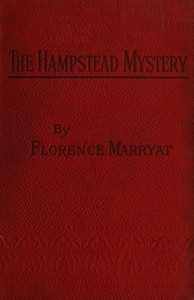
The Hampstead mystery: a novel. Volume 3 (of 3)
Language: en439 downloads on Project Gutenberg
Subjects
Public-domain ebook sourced from Project Gutenberg #71035.
Public-domain ebook
Language: en439 downloads on Project Gutenberg
Subjects
Public-domain ebook sourced from Project Gutenberg #71035.
The opening · free to read
Hannah Hindes did not know what answer to make to this direct appeal. She was an honest woman, to whom a lie was an abhorrence, but she was also a woman who held her husband’s reputation, perhaps his life, in her hands. She hesitated so visibly, that Captain Hindes began to think his brother’s disorder must be such as she found it impossible to speak to him upon.
‘Well, never mind,’ he said presently, ‘I see you are unwilling to mention it, but I shall soon get it out of old Hal. But you make me feel rather anxious, Hannah. If my brother has not consulted a doctor, I must make him do so. His health is too valuable to you and the children to be trifled with. By the way, talking of children, what induced you to send those two little fairies, Elsie and Laurie, away from home to be educated? I thought that was altogether against your principles, Hannah. Edith says she remembers your giving her a long lecture on the subject when Fanny was born, and cautioning her never to let a daughter be educated anywhere but at home. She has dinned it into my ears whenever I have hinted the young lady was old enough to go to school.’
‘Yes!’ replied Hannah, with a sigh. ‘Those have always been my sentiments, Arthur, and are so still. But Henry has grown so irritable of late, that the noise of the children playing about The Hall disturbed him, so I thought it best to let them go. They are with an old friend of mine, where I can see them almost every day. I daresay,’ she continued, timidly, ‘that you thought it very strange that we could not receive you at The Old Hall, as we did before. It cost me more than I can tell you to write and put off your coming here. But it was for the same reason. My husband cannot bear the least noise or confusion. I am afraid he has over-taxed his brain, and, when he returns home, he requires absolute rest.’
‘Don’t say anything more about it, Hannah,’ replied her sister-in-law. ‘Of course, Artie and I knew there was some unavoidable reason for the refusal. And, much as we should have liked to renew our former pleasant relations with you, everything must give way to Henry’s health.’
‘What are your plans?’ inquired Hannah.
‘We have hardly fixed them yet,’ said Captain Hindes. ‘We thought of staying in town for a while, just to see a few theatres and other amusements, while we look out for a country cottage to spend the summer in. But if my brother is seriously ill, I shall not dream of going far away from him.’
‘Oh, Arthur! he is not so ill as that!’ exclaimed Hannah; ‘it is his mind that is suffering, rather than his body. He works so hard at the business, and now, of course, everything falls on his shoulders. He seldom gets to the City before noon, and, when he comes home, he is so exhausted, he cares for nothing but to go to bed.’
‘But neuralgia is generally due to physical weakness, Hannah. The doctors always give Edie a tonic for it the first thing. Is Hal taking nothing to strengthen him?’
‘I don’t think he takes anything but morphia when the pain becomes intolerable,’ replied Hannah; ‘but, Arthur, don’t argue with him on the subject. Nothing makes Henry so irritable as to be talked to about his health. When you see him, treat him as if you saw no difference in his appearance. He won’t let even me mention the subject to him.’
‘He must be mightily changed,’ said Captain Hindes, sighing; ‘however, I will take your advice, and keep silence on the matter. I shall call at his office the first thing to-morrow. When do you think I shall find him there?’
‘Not before twelve, Arthur; if then. Will not you and Edith have some refreshment before you go back?’
‘No, thank you, Hannah. We are both tired, and should not have moved out except to see you. Tell old Hal all about us when he wakes up, and say I shall be in Sise Lane early to-morrow. Good-night, my dear. I’m awfully sorry about his illness. It’s quite spoilt my coming home, but I hope I may be able to cheer him up. If it is due, as you seem to imagine, to his over-working himself, I think I shall be able to persuade him to come out a little with me, and brush the cobwebs off his brain. What need has he to ruin his health by work? He has made plenty of money, to say nothing of the handsome legacy that Mr Crampton left the son and heir. By the way, how is the prodigy? I conclude he has not left home as well as the girls.’
‘No,’ said Hannah, with a wintry smile; he is not quite old enough for that yet. He will not be three till his next birthday. He is quite well, thank you, Arthur; but I have to keep him at the top of the house, for fear he should disturb his father.’
‘Why, Henry was always so devoted to Master Wally. Edie and I have often laughed together over his letters about his little son, and said, surely no man had ever had a boy before. At one time he could write of nothing else.’
‘Oh! yes, and he loves the child as much as ever, perhaps more, but he cannot stand his noise. It jars upon his nerves. Sometimes I long for the time when Wally shall be able to go too. It is a dull life for a young child to be confined to the company of his nurse.’
‘You grieve me more and more with each word you say, Hannah,’ replied her brother-in-law; ‘however, I shall see Henry for myself to-morrow. Come! Edie, we must make tracks for our hotel.’
‘Won’t you wait for the carriage to take you back,’ asked Hannah anxiously, for she was distressed at not being able to show them more hospitality.
‘No, thanks, dear. We shall get home quicker by the Metropolitan. We shall see you again soon. Good-night!’ and, with his wife’s arm snugly tucked under his own, Captain Hindes walked off again.
As soon as she was sure that they were gone, Hannah sat down and indulged in the luxury of ‘a good cry.’ It was seldom that she permitted her feelings to get the better of her, but this interview had upset her.
The semi-deceit she had been compelled to practise--the determination of Captain Hindes to find out what was the matter with his brother, and the evident suspicion with which he had received her statements, all combined to make her fear that a crisis of some sort was at hand. She dreaded what her husband might do or say if his brother pressed him too hard for an explanation of the alteration in his demeanour and appearance. His brain was at times so muddled, even in the day-time, that he spoke more like a madman than a sane person, and if Arthur took it upon himself to consult medical men on Henry’s behalf, or to have him privately watched, what terrible dénouement might not be the consequence. She wished heartily that her brother and sister-in-law had not returned home just at that particular moment, that they had given her time to coax her husband to leave England for a while, as he had seemed so well disposed to do, but wishing was futile. They were there, in their midst, and she must set all her wits to work to conceal the real state of affairs from them.
She visited her husband’s bed-chamber at once, to find him sunk into a slumber, from which she could only rouse him to a semi-torpid condition. So she wisely let him sleep until the morning, when he was able to listen to her story, and conceive a hazy idea that his brother and his wife had paid The Old Hall a visit whilst he was asleep.
When Captain Arthur Hindes walked into the office the following day, he found his brother had not yet arrived. Naturally he was well-known there, by Mr Bloxam and all the older employés of the firm, and he received a hearty welcome, for he was a general favourite. Arthur was taller and fairer than Henry--had a handsomer face and a neater figure--was possessed, moreover, of a bright, happy temperament, and had always a kind word or a jest on hand.
‘Not arrived yet?’ he exclaimed in answer to Bloxam’s intimation of the ‘governor’s’ absence, ‘and nearly half-past twelve! What makes him so late, Bloxam? He used to be called “the early bird” at one time.’
‘Ah! Master Arthur, things are changed since then,’ replied the old cashier. ‘Mr Henry’s not been nearly so active of late. I often think he’s not well. He seems so mopey and dull. Perhaps it will be different now you’ve come home, Mr Arthur. You’ll cheer him up a bit. He has felt Mr Crampton’s death terribly, and Miss Jenny’s too, for the matter of that, they came so quickly, one after the other, and he ought to have taken a change long ago. I’m very glad you’ve come back, sir. You’ll do him more good than anyone else could do.’
‘I am glad also, Bloxam, for Mrs Hindes’s account of him quite alarmed me. But do you think he is really ill?’
‘I think he is very, very ill, Mr Arthur,’ returned Bloxam, mysteriously; ‘but here he is, so I will leave you together.’
Saying thus, the cashier retreated by a side door into his particular sanctum, as the glass doors from the front swung slowly on their hinges, as though propelled by an enfeebled hand, to admit Henry Hindes. He entered, looking much as he had always done of late, slouching along with a bent figure and a shaking frame. He had made some attempt, at the instigation of his wife, to brighten up his general appearance by assuming a frock coat and a tall hat, but they only served to make the difference in him more apparent. Captain Hindes could not for a moment believe the evidence of his senses, but when he was convinced that it was his brother who stood before him, he started forward to greet him with a slight cry.
‘Good God! Hal, my dear old fellow!’ he exclaimed, ‘is this you?’
‘Who else?’ demanded Henry, with an attempt at jocularity, as he held out his hand and grasped that of Arthur.
The younger man looked him in the face for a few minutes without speaking. He could not trust himself to do so. He was too infinitely shocked. This Henry? Henry, whose devotion to his personal appearance had passed into a family proverb--who had always been the ‘nattiest’ youth, and the most perfectly-dressed young man, and the most faultless gentleman in the City--whose irreproachable garb and spotless linen and glossy hats had been cast in his teeth in bygone days, as witnesses that he was not fit for business or anything but a cavalier des dames. This limp, untidy, slovenly-looking man, with bloodshot eyes, and unhealthy complexion, his brother Henry, of whom he used to be so proud? Arthur felt a great lump rise in his throat, and could have sat down and cried to see the difference a few years had made in him. But he held his hand as in a vice instead, and replied in as hearty a voice as he could manage,--
‘Why, dear old chap, you’re not looking yourself at all. You took me quite by surprise, though Hannah did prepare Edie and me last night to see a change in you.’
‘Hannah, Hannah!’ cried his brother quickly; ‘what had she to say of me? What did she tell you? How dared she--I mean, why did she mention me at all?’
‘My dear Henry, it would have been very extraordinary, surely, if she had not mentioned you, considering that we went over to Hampstead to see you, and were much disappointed to find you had already retired to bed. You want shaking up, old fellow, that’s what it is. You’ve been worrying yourself over this big business too much. Your late partner’s death has thrown too much responsibility upon your shoulders. How I wish I were not such a fool, and could help you a little. But now that I have returned, you must come out more, Henry. It is quite time you came back to the world. It is--let me see!--quite nine months or more, surely, since that poor girl met with her death--’
The book keeps going
Reading is free forever. Sign up and watch scenes appear while you read.



Scenes Storieta drew for other classics.
New illustrated classics
Once or twice a month: the latest books to get full character casts, scene art, and free comic editions. No account needed.