Public-domain ebook
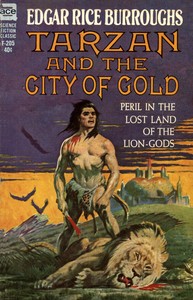
Tarzan and the city of gold
Language: en525 downloads on Project Gutenberg
Subjects
Public-domain ebook sourced from Project Gutenberg #71316.
Public-domain ebook
Language: en525 downloads on Project Gutenberg
Subjects
Public-domain ebook sourced from Project Gutenberg #71316.
The opening · free to read
When Tarzan ventured northward into the remote and trackless backlands of ancient Abyssinia, it may have been only the lure of mystery that drew him--or the secrets those unmapped valleys have guarded from time immemorial.
It was in one such unknown valley that a strange white warrior in ivory armor led Tarzan to the luxurious court of the most beautiful woman in the world, to the arena and the lion pit, and to the intrigues and perils of a forgotten barbarian kingdom.
If you are bored by the humdrum of the daily grind of civilization, lay aside the badges of your servitude, don a loin cloth of lion skin, seize bow and arrows and spear, and tread the silent trails of the mysterious jungle toward high adventure with Tarzan of the Apes.
Edgar Rice Burroughs is renowned for his many novels of fantastic adventure. Unquestionably his best known creation is that of the jungle hero, Tarzan the Ape Man, but almost as well known are his stories of other planets and of Pellucidar beneath the Earth's crust.
Born in Chicago in 1875, he tried his hand at many enterprises without notable success, until at the age of thirty-five, he turned to writing. With the publication of his first novels about Tarzan and Barsoomian Mars, his career was assured. The gratitude of a multitude of readers who found in his imagination exactly the kind of escape reading they loved assured him of a well-earned fortune.
By the time of his death, in 1950, at his home in a town bearing the name of his brain child, Tarzana, California, his name was a byword in literature. Well over 40,000,000 copies of his books have appeared in 58 different languages. New printings of his famous classics are now appearing regularly in Ace Books.
Down out of Tigre and Amhara upon Gojam and Shoa and Kaffa come the rains from June to September, carrying silt and prosperity from Abyssinia to the eastern Sudan and to Egypt, bringing muddy trails and swollen rivers and death and prosperity to Abyssinia.
Of these gifts of the rains, only the muddy trails and the swollen rivers and death interested a little band of shiftas that held out in the remote fastnesses of the mountains of Kaffa. Hard men were these mounted bandits, cruel criminals without even a vestige of culture such as occasionally leavens the activities of rogues, lessening their ruthlessness. Kaficho and Galla they were, the offscourings of their tribes, outlaws, men with prices upon their heads.
It was not raining now; and the rainy season was drawing to a close, for it was the middle of September; but there was still much water in the rivers, and the ground was soft after a recent rain.
The shiftas rode, seeking loot from wayfarer, caravan, or village; and as they rode, the unshod hoofs of their horses left a plain spoor that one might read upon the run; not that that caused the shiftas any concern, because no one was looking for them. All that anyone in the district wished of the shiftas was to keep out of their way.
A short distance ahead of them, in the direction toward which they were riding, a hunting beast stalked its prey. The wind was blowing from it toward the approaching horsemen; and for this reason their scent spoor was not borne to its sensitive nostrils, nor did the soft ground give forth any sound beneath the feet of their walking mounts that the keen ears of the hunter might detect during the period of concentration and mild excitement attendant upon the stalk.
Though the stalker did not resemble a beast of prey, such as the term connotes to the mind of man, he was one nevertheless; for in his natural haunts he filled his belly by the chase and by the chase alone; neither did he resemble the mental picture that one might hold of a typical British lord, yet he was that too--he was Tarzan of the Apes.
All beasts of prey find hunting poor during a rain, and Tarzan was no exception to the rule. It had rained for two days, and as a result Tarzan was hungry. A small buck was drinking in a stream fringed by bushes and tall reeds, and Tarzan was worming his way upon his belly through short grass to reach a position from which he might either charge or loose an arrow or cast a spear. He was not aware that a group of horsemen had reined in upon a gentle rise a short distance behind him where they sat in silence regarding him intently.
Usha, the wind, who carries scent, also carries sound. Today, Usha carried both the scent and the sound of the shiftas away from the keen nostrils and ears of the ape-man. Perhaps, endowed as he was with supersensitive perceptive faculties, Tarzan should have sensed the presence of an enemy; but "Even the worthy Homer sometimes nods."
However self-sufficient an animal may be it is endowed with caution, for there is none that has not its enemies. The weaker herbivora must be always on the alert for the lion, the leopard, and man; the elephant, the rhinoceros, and the lion may never relax their vigilance against man; and man must always be on guard against these and others. Yet one may not say that such caution connotes either fear or cowardice; for Tarzan, who was without fear, was the personification of caution, especially when he was far from his own stamping grounds as he was today and every creature a potential enemy.
The combination of ravenous hunger with the opportunity to satisfy it may have placed caution in abeyance as, oftentimes, a certain recklessness born of pride in his might did; but, be that as it may, the fact remains that Tarzan was wholly ignorant of the presence of that little knot of villainous bandits who were quite prepared to kill him, or anyone else, for a few poor weapons or for nothing at all.
The circumstances that brought Tarzan northward into Kaffa are not a part of this story. Perhaps they were not urgent, for the Lord of the Jungle loves to roam remote fastnesses still unspoiled by the devastating hand of civilization and needs but trifling incentive to do so. Still unsated with adventure, it may be that Abyssinia's three hundred fifty thousand square miles of semi-savagery held an irresistible lure for him in their suggestion of mysterious back country and in the ethnological secrets they have guarded from time immemorial.
Wanderer, adventurer, outcast, Greek phalanx, and Roman legion, all have entered Abyssinia within times chronicled in history or legend never to reappear; and it is even believed by some that she holds the secret of the lost tribes of Israel. What wonders, then, what adventures, might not her remote corners reveal!
At the moment, however, Tarzan's mind was not occupied by thoughts of adventure; he did not know that it loomed threateningly behind him; his concern and his interest were centered upon the buck which he intended should satisfy the craving of his ravenous hunger. He crept cautiously forward. Than he, not even Sheeta, the leopard, stalks more silently or more stealthily.
From behind, the white-robed shiftas moved from the little rise where they had been watching him in silence, moved down toward him with spear and long-barreled matchlock. They were puzzled. Never before had they seen a white man like this one; but if curiosity were in their minds, there was only murder in their hearts.
The buck raised his head occasionally to glance about him, wary, suspicious; and when he did so, Tarzan froze into immobility. Suddenly the animal's gaze centered for an instant upon something in the direction of the ape-man; then it wheeled and bounded away. Instantly Tarzan glanced behind him, for he knew that it had not been he who had frightened his quarry but something beyond and behind him that the alert eyes of Wappi had discovered; and that quick glance revealed a half dozen horsemen moving slowly toward him, told him what they were, and explained their purpose; for, knowing that they were shiftas, he knew that they came only to rob and kill--knew that here were enemies more ruthless than Numa.
When they saw that he had discovered them, the horsemen broke into a gallop and bore down upon him, waving their weapons and shouting. They did not fire, evidently holding in contempt this primitively armed victim, but seemed to purpose riding him down and trampling him beneath the hoofs of their horses or impaling him upon their spears. Perhaps they thought that he would seek safety in flight, thereby giving them the added thrill of the chase; and what quarry could give the hunter greater thrills than man.
But Tarzan did not turn and run. He knew every possible avenue of escape within the radius of his vision for every danger that might reasonably be expected to confront him here, for it is the business of the creatures of the wild to know these things if they are to survive, and so he knew that there was no escape from mounted men by flight. But this knowledge threw him into no panic. Could the requirements of self-preservation have been best achieved by flight, he would have fled; but as they could not, he adopted the alternative quite as a matter of course--he stood to fight, ready to seize upon any fortuitous circumstance that might offer a chance of escape.
Tall, magnificently proportioned, muscled more like Apollo than like Hercules, garbed only in a narrow G string of lion skin with a lion's tail depending before and behind, he presented a splendid figure of primitive manhood that suggested more, perhaps, the demigod of the forest than it did man. Across his back hung his quiver of arrows and a light, short spear; the loose coils of his grass rope lay across one bronzed shoulder; at his hip swung the hunting knife of his father, the knife that had given the boy-Tarzan the first suggestion of his coming supremacy over the other beasts of the jungle on that far gone day when his youthful hand drove it into the heart of Bolgani, the gorilla; in his left hand was his bow and between the fingers four extra arrows.
As Ara, the lightning, so is Tarzan for swiftness. The instant that he had discovered and recognized the menace creeping upon him from behind and known that he had been seen by the horsemen he had leaped to his feet, and in the same instant strung his bow. Now, perhaps even before the leading shiftas realized the danger that confronted them, the bow was bent, the shaft sped.
Short but powerful was the bow of the ape-man; short, that it might be easily carried through the forest and the jungle; powerful, that it might send its shafts through the toughest hide to a vital organ of its prey. Such a bow was this that no ordinary man might bend it.
Straight through the heart of the leading shifta drove the first arrow, and as the fellow threw his arms above his head and lunged from his saddle four more arrows sped with lightning-like rapidity from the bow of the ape-man, and every arrow found a target. Another shifta dropped to ride no more, and three were wounded.
Only seconds had elapsed since Tarzan had discovered his danger, and already the four remaining horsemen were upon him. The three who were wounded were more interested in the feathered shafts protruding from their bodies than in the quarry they had expected so easily to overcome; but the fourth was whole, and he thundered down upon the ape-man with his spear set for the great bronzed chest.
The book keeps going
Reading is free forever. Sign up and watch scenes appear while you read.



Scenes Storieta drew for other classics.
New illustrated classics
Once or twice a month: the latest books to get full character casts, scene art, and free comic editions. No account needed.