Public-domain ebook
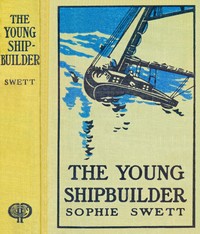
The young ship builder
by Sophie Swett
English424 downloads on Project GutenbergDownload EPUB
Public-domain ebook sourced from Project Gutenberg #71346.
Public-domain ebook
by Sophie Swett
English424 downloads on Project GutenbergDownload EPUB
Public-domain ebook sourced from Project Gutenberg #71346.
The opening · free to read
It might be thought that people who lived on Groundnut Hill, in Palmyra, would have no more story to tell than the needy knife-grinder, but as Hiram Nute, the essence-peddler, says, “Wherever there’s human nater and the Lord’s providence, there’s apt to be consid’able goin’ on.”
Perhaps there was more “goin’ on” in our family from the fact that the human nature is somewhat mixed. There is sure to be an astonishing variety in any large family, I have observed, even when there are not, as in ours, two sets of children. But the queer differences with us are all set down to the fact of mother’s second marriage. She was Deacon Partridge’s daughter, and she married the Rev. Cyrus Dill, who was the “stated supply” at Palmyra, the summer that she was nineteen. He received a call to a small church in a large city, and three children were born there, Cyrus, Octavia and I. I am Bathsheba. They named me after my Grandmother Dill, because she was a woman who feared the Lord. It was my father’s behest, and was so set down in his will--he died just after I was born. The will was pasted into the family Bible. Every one said it was a beautiful will, because, while he had scarcely any material possessions, he yet bequeathed so much.
Grandma Partridge and my mother always cried over it on rainy Sundays, and to my infant mind it was a scarcely less sacred thing than the scriptures themselves.
When I was sixteen, I was so light-minded as to wish that Grandma Dill could have been a woman who feared the Lord and had a pretty name, too.
Long before that time grandma had to weep alone over the will, for mother had married the young artist who had pitched his white umbrella tent all summer on the green slope of our orchard, and painted old “Blue” in its brooding stillness, and with its shifting shadows, and the beautiful vista of the river through our Norway pines.
An artist! The name savored of unconventionality to grandma, and of shiftlessness as well, to grandpa. But they gave in--to mother’s dimple--stern Uncle Horace said. He declared, furthermore, this severe relative of ours, that grandpa would never have been coerced by the dimple, if he had not been enfeebled in body and mind by his inveterate foe, asthma.
Grandma, we learned, as we grew up, was suspected of secretly favoring the match. She cried and feared that it was not marrying in the Lord, for the young artist had been reared in a different faith from ours; but,--dear grandma!--she loved a romance. Stories were not favored in those days, by the strictest of the sect to which we belonged, and grandpa was of the strictest. She read them privately, sometimes, with a deep sense of guilt. When, by great good fortune--and some one’s oversight--I found one in the Sunday-school library, she would ask me, with wistful eagerness, if it were “a pretty story.” And although I never saw her read it, she knew “how it ended” while I was still at the beginning.
I suppose it was a pretty story, a very pretty drama of human life, that was played before grandma’s eyes in that summer when Royce Dupont painted pictures on our orchard slope, and “leaf by leaf the rose of youth came back” to mother. And in spite of her religious misgivings--he had a bewildering veneration for the saints--and in spite of her loyalty to the dead, grandma had a furtive joy in it.
They were married in the autumn, and her artist husband took mother abroad with him, leaving the children, Cyrus and Octavia and me, to comfort and make things lively for grandpa and grandma. And our half-sister and half-brother were born in Paris. That is why Palmyra people will call them French children, although their father was an Englishman by birth and only from very remote ancestors was there a drop of French blood in his veins.
In less than five years mother came back widowed, to the Groundnut Hill farm, bringing with her Estelle and David, children of two and three. Cyrus was twelve by that time, and Octavia ten, and I was nine, a tall slip of a girl, loving my patchwork and my knitting, and to help Loveday stamp the butter, much better than I loved my book; and yet wrestling with many more problems than any one wot of under my sandy-thatched poll.
People said that I looked very much like my father, and perhaps that was why my mother clung to me with passionate, half-remorseful tenderness, and wished to take me with her when she married and went abroad.
Grandfather had set his face firmly against that. A vague impression remained with me, gathered, perhaps, from Loveday’s remarks, that he did not wish to give me over to my stepfather’s saints. I had seen his paintings of them, in strange robes of scarlet, violet and yellow; and Loveday had whispered darkly of idolatry, a phrase quite beyond my comprehension, but which made me cry in my bed at night for fear of the painted saints.
Loveday would read to me on Sunday afternoons about the homely fishermen who had left their nets upon the Galilean shores to follow in the footsteps of our Lord. She told me that these were the real saints, as they were on earth, and we could not hope to know how they looked in the blessed company beyond. I was comforted, but a horror of saints and of those who painted them remained with me for years.
I set down these childish vagaries because I think a story is only of value in so far as it is a transcript of real life, and I mean this to be as frank as if it were a diary, which no eyes but my own should ever see. And small things went far toward the shaping of character on Groundnut Hill--as they do everywhere in this dimly-apprehended scheme of things.
Something of my horror of those painted saints must have been in time swallowed up by curiosity, for I remember that when I was ten, a year after mother’s return with our new brother and sister, I attempted to transform one of the boys into a saint, according to my unfading recollection of my stepfather’s paintings, by draping his shoulders with some old yellow flannel that hung upon the clothes-line. It was out on the wide lawn, and Cyrus was deep in his Latin book, lying under the great butternut tree. Three-year-old Rob, Uncle Horace’s son, was there, for Uncle Horace had married late in life, when one would no more have expected tender emotions to develop in him than one would have expected one of our Druid-like old Norway pines to blossom with wild roses, and his young wife had died, leaving him an infant son.
I draped the folds of yellow flannel about them in as stately a fashion as I could, but I must confess that there was no semblance of sainthood about them, nor even anything cherubic, as one might have expected of their baby faces. They insisted upon thinking I meant them to play king, and strutted about with grotesque airs. Loveday came out and reproved me sharply for having vain imaginations, and for not having forgotten the heathenish pictures; for to my shamefaced astonishment, she understood just what I was doing.
Dear Loveday! our spiritual, as well as our temporal welfare lay very near her heart. Perhaps the relation she bore to us could scarcely be understood outside of New England, and at that time even it was a survival of the customs of an earlier date--to say nothing of the fact that Loveday was unique. She was ignorant, she was full of prejudices and crude notions, and yet there has sometimes come to me, in these later years, a doubt whether Loveday’s ignorance, with the intuitions with which love lighted it--love to God and man--were not better than all the wisdom of the schools.
She had been the “hired girl” when she was twenty; at forty she was the housekeeper, and the reins of domestic management, always held somewhat slackly in grandma’s gentle hands, had slipped, almost without any one’s consciousness, into hers.
And Hiram Nute still continued to woo her, as he had done twenty years before. “He hadn’t never slacked up a mite on his courtin’,” Loveday herself admitted. And our “hired man” was relieved of the tasks of churning, taking in the clothes and chopping wood, during Hiram’s periodical visits, for Loveday would never permit him to come unless he made himself useful.
She said matrimony was an ordinance of the Lord, but there ’peared to be consid’able many that was ready to serve him that way compared to them that was ready to do their duty just where he had sot ’em. And as for seein’ them blessed young ones brought up on saleratus bread and slim morals, she couldn’t do it. This was by no means intended as a reflection upon grandma, but upon the “back folks,” whom Palmyra was forced to depend upon for “help.”
Grandma’s hands were wholly filled now by the care of grandpa, whose feebleness increased year by year, and also, alas! by mother’s need of her constant attention, for a delicacy of the lungs had developed in our mother, and her strength failed rapidly. She took her illness lightly, declaring that it was only the result of the change from the sunny south of France to bleak New England air. But even on the healthful Palmyra hills we knew the meaning of that dread word, consumption, and we older children understood when the neighbors whispered it to each other with bated breath.
Perhaps it may have been vague thoughts of that country to which I knew my mother was going soon, that made my mind revert to the painted saints. In spite of the ill-success of my first experiments, and in spite of Loveday’s rebuke--for I was a wilful young person in those days--I took advantage of Cyrus’ absorption in his book to try to make for him a costume similar to that in the pictures.
The shadows of the butternut tree were heavy; one shaft of yellow sunset light pierced them and fell directly upon the boy. Finally, becoming aware that I was dressing him in some fantastic way, he arose with--not a scowl, even at thirteen Cyrus was too dignified to scowl--but a sternly rebuking expression upon his face.
The shadows were heavy, as I have said, and the shaft of light was dazzling. In the one moment that he stood there I saw, with a thrill of mingled triumph and dismay, that I had evolved one of the painted saints. But not one of them had such a face as this! Of course, my later understanding comes to my aid in interpreting its expression, but it struck my childish mind with a sense of awe.
A narrow, dark face, heavily browed, and the high forehead overhung by masses of black hair as straight as an Indian’s. Only our Cyrus, and we had always been obliged to admit that he was a homely boy! But it was an intense, ascetic, loftily spiritual face. Something in the absurd toggery, transfigured by the strange effect of light and shadow, and associated with my dim recollections of the saintly faces, had shown it to me vaguely as a child of ten could see it. Years afterward, when I saw a painting of St. John the Baptist on the wall of Estelle’s studio, in a flash Cyrus came back to me, as he had looked that night under the old butternut tree.
St. John the Baptist! “Prepare ye the way of the Lord, make his paths straight!” A prophet with a warning cry. And Cyrus, we used to think, was one who thought he knew exactly what the way of the Lord was.
The book keeps going
Reading is free forever. Sign up and watch scenes appear while you read.



Scenes Storieta drew for other classics.
New illustrated classics
Once or twice a month: the latest books to get full character casts, scene art, and free comic editions. No account needed.