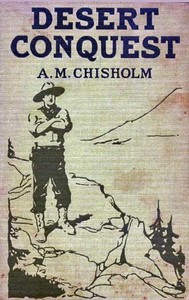
Public-domain ebook
Easy money
Language: en336 downloads on Project Gutenberg
Subjects
In: Adventure·Novels·American Literature
Public-domain ebook sourced from Project Gutenberg #71348.
Public-domain ebook
Language: en336 downloads on Project Gutenberg
Subjects
In: Adventure·Novels·American Literature
Public-domain ebook sourced from Project Gutenberg #71348.
The opening · free to read
Author of “Hands Off!” “The Land of Frozen Suns,” Etc.
When Charlie Shaw, the carefree cow-puncher, was accused of being a shallow josher, and therefore worthless for rounding up cow thieves, Charlie got angry and proved that even a “kidder” can get down to business.
The cool autumn wind riffled across Lonesome Prairie. It fluttered the manes and tails of a dozen saddled horses standing in a compact group, awaiting the pleasure of their riders, who stood and squatted in various postures, casting occasional glances at a number of flat, wrinkled objects in the grass of a tiny hollow. They had come upon these objects quite unexpectedly and had stopped to examine them. One rider had gone galloping back toward camp. The rest waited.
“Gosh, old Elmer’ll go straight in the air when he sees this,” one remarked.
Two miles distant a herd was stringing south. Heavy-loaded wagons, tooled respectively by a cook and a night herder, with a comet’s tail of saddle stock following behind, bore in the same direction. And from that direction three men were now riding full tilt toward the dismounted cow-punchers.
When they pulled up at the group, Elmer Duffy gave an immediate exhibition of what his rider had termed “going straight in the air.” Elmer was past forty, a sandy-haired Texan, with a capacity for irritable conduct that remained mostly hidden beneath a placid exterior. He had a long, solemn face. He took his position as the active head of a big cow outfit rather more seriously than range bosses usually did. This attitude, together with his slumbering crabbedness, did not make him popular with his men.
“What’s all this?” he demanded.
“Well,” one sunny-faced young fellow explained, “as near as we can see, it’s eight beef hides with the Seventy-seven brand, that’s been skinned off their rightful wearers and laid out to dry in the sun by some kind soul. We happened on ’em an’ sent Mike back to tell you, because we thought maybe you’d be interested.”
Mr. Duffy prowled from one hide to the other. The skulls and shin bones and hoofs of the defunct animals were scattered about for all and sundry to behold, where the coyotes had gnawed them. But they knew very well that neither wolf nor coyote had pulled down a bunch of mature cattle like that. And, as the foreman of the Seventy-seven gathered the import of these remains, he grew red in the face, and his language became eloquent but unprintable.
“Some dirty thieves has been butcherin’ beef an’ gettin’ away with it,” he stormed. “I’d give five hundred dollars cold cash to lay hands on ’em.”
“If you’d advertise that in the River Press,” the same youngster laughed, “maybe they’d come in and give themselves up for the reward.”
Elmer glared at him.
“Don’t get fresh,” he growled. “This here’s serious.”
“So it seems,” Charlie Shaw replied carelessly. “But there’s no law against joshin’.”
“This ain’t no josh,” Duffy declared, embellishing his statement with an earnest oath. “And I suppose all a man can expect when he finds that a bunch of thieves is loose on the range is for featherheads like you to make a joke of it. If it was your cattle that’d been killed, you’d sing a different tune.”
Charlie Shaw’s laughing mouth shut in a tight line.
“I would, Elmer,” he said quietly. “I’d keep my mouth shut and go after ’em. I wouldn’t waste my breath cussin’.”
“_You_ wouldn’t waste your breath cussin’!” Elmer exploded. “No! All you c’n waste is the outfit’s time an’ your money at poker. If I had to depend on boneheads like you to protect the outfit’s interests, the Seventy-seven would go to hell in two seasons. Josh--that’s all you know how to do.”
Charlie took a step toward him. He was tall and slim, older in years and experience than his boyish face told, and his merry blue eyes suddenly ceased to be merry.
“Don’t get too personal in your remarks, Elmer,” he warned. “I might get serious myself.”
“Personal! Personal!” Duffy bellowed. “Say, lemme tell you somethin’.”
As an offset to his unfortunate disposition, Elmer Duffy had a reasonable amount of common sense; otherwise, he could not have guided the destiny of the Seventy-seven. He realized that he had got too personal. And he couldn’t back down without losing face. He had no high opinion of Charlie Shaw’s intelligence. No serious-minded man ever has a high opinion of light-minded youth, and Charlie had been the play boy of the Seventy-seven all that summer--a competent enough range rider, with no proper sense of responsibility, according to Elmer. But Shaw had nerve. His record and his actions made even Elmer Duffy concede that. And Elmer didn’t hunger for war over a mere matter of levity.
“You go onto the wagon,” he said stiffly, refusing to pursue the contention farther. “Catch your horses, pack your bed, and we’ll part company. Here’s your time.”
He disregarded Charlie’s palpably belligerent attitude, sat himself on the grass, drew a check book and indelible pencil from his pocket, and proceeded to write out a check.
“You drew most all you had comin’ last trip,” he said, as he handed over the green slip. “There’s the balance.”
“So you think I’m a bonehead, do you?” Charlie inquired gravely. “I wonder if I couldn’t sort of change your mind about that.”
“I don’t want to have no fuss with you, Shaw,” Elmer said curtly. “I can’t have a man in the outfit I don’t hitch with. You’re young an’ careless an’ hot-headed an’----”
“An’ you’re middle-aged an’ staggerin’ under a tremendous weight of responsibility an’ cranky as a bull with the seven-year itch,” Shaw retorted. “I don’t give a damn about you firin’ me, Elmer. But nobody can talk to me----”
A couple of men horned in between them. Everybody in the crew liked Charlie Shaw. They respected Duffy, even if they didn’t love him. No one wanted to see a fuss over nothing. And they could see the making of a powder fog in that unexpected clash born of irritation and a loose tongue. They twisted Charlie Shaw about and spoke soothingly to him. While they strove with his outraged dignity, Elmer Duffy, exercising uncommonly good judgment, mounted his horse and issued orders.
Thereafter Charlie could only let it go as it stood, or make himself ridiculous by insisting on a ruction with a man who patently desired to avoid one. Duffy could indicate his distaste without having his nerve questioned.
But when the dozen riders were bobbing away in a row, Charlie sat on his horse, disconsolate, indignant and still resentful.
“Darn his hide,” he reflected. “I was just about to tangle with him, I guess. By gosh, I’ll make him sing a different tune yet. Bonehead? Huh! Thinks I don’t know enough to come in out of the rain. Just because I pushed him over some beefed steers. Gosh darn him, I will show him.”
Just how, Charlie hadn’t the remotest idea. The present occasion did not look particularly auspicious. The drama of an old range song flitted unpleasantly through Charlie’s mind:
Heaps of fun in the summertime, Pockets full of gold. But when you’re broke in the wintertime, Oh, mister, ain’t it cold!
A raw October wind whistled mournfully across Lonesome Prairie. Charlie thought regretfully of the celebrated poker game in which he had recently dropped practically a summer’s wages. Round-up was nearly over. The big outfits seldom took on men in the fall. Oh--well. But he would certainly show Elmer Duffy he could do something besides taking life as a perpetual joke.
Even a natural clown has his serious moments.
Darkness on the plains is like darkness on the sea. If the stars are hidden there is no guiding mark--nothing but an immensity of shrouded silence in which a rider is like a ship without a compass. Yet men cast away at sea in open boats win to a landfall by day or night. Men cross the plains when night spreads her ebony wings and do not miss their destination. Each has his own resources of location and direction; the mariner by dead reckoning, based on observation of wind and heaving swells at sundown, the plainsman by his knowledge of the roll of the ground and the directional trend of gently undulating slopes. The rider feels these under the feet of his horse, as the seaman feels the lift and fall of his vessel.
So Charlie, crossing alone a forty-mile stretch of Lonesome Prairie, was as sure of his course as if bright day had shown him the Sweet Grass in the north, the blue summit of the Bear Paws on the eastern sky line, and the dark broken line to the south, where Marias Valley cut the plains. He rode at a jog trot, bearing south, always south, toward a ranch he knew, although the cloud rack in the sky darkened the plains, so that the outstretched fingers of a hand were scarcely visible.
He had fifteen miles yet to go, if he had not miscalculated. Nowhere in the stretch he had covered was there any great difference in elevation. It was all flat, with scarcely perceptible hollows bearing away to the east, toward Lonesome Prairie Lake. But he approached now a terrain of less monotony, and he began to peer ahead for a well-known beacon, something akin to that which guided the Israelites on an historical occasion, a pillar of fire by night.
Scarcely exact to call it a pillar. It was no more than a flickering gleam--an uncanny momentary glow. It came from an exposed surface seam of lignite coal, mysteriously set on fire long ago and burning still in the bowels of the earth. In the dark, flame and ignited gas would regularly flare about the pit, a ghostly incandescence, flashing intermittently above the smoldering embers of the burning seam.
The book keeps going
Reading is free forever. Sign up and watch scenes appear while you read.



Scenes Storieta drew for other classics.
New illustrated classics
Once or twice a month: the latest books to get full character casts, scene art, and free comic editions. No account needed.