Public-domain ebook
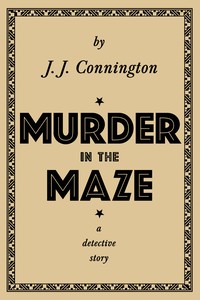
Murder in the maze
Language: en475 downloads on Project Gutenberg
Subjects
In: Crime, Thrillers and Mystery·Novels·British Literature
Public-domain ebook sourced from Project Gutenberg #71351.
Public-domain ebook
Language: en475 downloads on Project Gutenberg
Subjects
In: Crime, Thrillers and Mystery·Novels·British Literature
Public-domain ebook sourced from Project Gutenberg #71351.
The opening · free to read
Neville Shandon stood at the window of his brother’s study gazing contentedly out over the Whistlefield grounds. This was a good place to recuperate in, he reflected, especially when one could only snatch a couple of days at a time from the grinding pressure of a barrister’s practice. His eye travelled slowly over the prospect of greenery which lay before him, lawn beyond lawn, down to where a glint of silver showed where the river cut across the estate. Beyond that came the stretches of the Low Meadows, intersected here and there by the darker green of the hedges; then the long curve of the main road; and at last, closing the horizon, the gentle slope of Longshoot Hill surmounted by its church spire. A bee hummed lazily at the open window; then, startled by a movement, it shot away, the note of its wings growing higher and fainter as it receded in the sunlight. The King’s Counsel let his attention wander for a moment to the rooks sailing, in their effortless flight around the tree-crests by the river; then, with something more than apparent reluctance, he turned away from the landscape.
“You did pretty well when you bought Whistlefield, Roger,” he commented as he moved back into the room. “It’s as restful a place as I know. If it weren’t that I can get down here from time to time, I’d be hard put to it to keep fit for my work. Think of the Law Courts on a day like this! And that Hackleton case has been a bit of a strain, a bigger business than usual.”
His twin brother nodded a general assent, but made no audible reply. There was more than the normal family resemblance between the two men. In height and build they were much alike; both were grey-haired and clean-shaven; and even the hard lines at the corners of the barrister’s mouth found their counterparts in the deeply-chiselled curves which made Roger Shandon’s face a slightly forbidding one. Whether deliberately or not, the twins accentuated their physical resemblance by a similarity in their dress.
“We have the same tailor,” Roger once explained. “When I go to him, I say: ‘Make me a suit like my brother’s last one.’ I believe Neville says the same. The fellow has our measurements, so there’s no more needed on that visit. Neville and I have much the same taste in shades, so it generally comes out all right.”
The likeness between the twins went even deeper than the surface. Both owed their success in life to a certain hardness of character coupled with an abundance of energy. Neville, going to the Bar, had made himself feared from the first as a brutal and domineering cross-examiner; and his criminal practice had done little to soften his professional manners. Roger’s rise to prosperity had been more mysterious. It was vaguely known that he had made money in South Africa and South America; but the exact methods which had led to his fortune were never discussed by him. He had come home at the age of forty-five to find his brother one of the leading lights of the Bar. The purchase of the little Whistlefield estate had followed, and Roger had apparently been content to settle down in the countryside and make a clean break with the interests of his past.
The third brother, Ernest, seemed hardly to belong to the same family as the twins. Though five years younger, he had none of the vitality and energy which were so manifest in his elders; and the contrast was accentuated by the weakness of his eyes, which gazed incuriously at the world from behind the concave lenses of his pince-nez. Left to fend for himself by the time he was twenty, and with a couple of hundred a year of his own, he had simply vegetated without even attempting to go into any business; and when his brothers had made their fortunes, he had slipped into the role of parasite without a thought, had transferred himself to Whistlefield, and had continued to live there ever since. Roger had fallen into the habit of giving him a fluctuating allowance, which he eked out as best he could by betting on a small scale.
“What’s this Hackleton case that you were talking about?” he inquired with a certain dull interest.
Neville looked at his brother with an expression half quizzical and half contemptuous. For days the Hackleton case had extended in sordid detail over a good many columns of most daily newspapers, for its intricacy had been enlivened by frequent dramatic interchanges between witnesses and counsel. It had shown Neville Shandon at his best, relentlessly driving the defendants into one damaging admission after another.
“Do you never read newspapers, Ernest?” the barrister demanded, quite unnettled by his brother’s ignorance of one of the greatest cases in which he himself had taken a leading part. Ernest’s interests were limited, as Neville knew; and it was useless to expect him to go outside his normal range merely from family concern. Wide-ranging curiosity was the last quality one could expect from him.
Ernest blinked, took off his glasses and cleaned them, then replaced them carefully before replying.
“No. At least, not all of them. (Confound these glasses, they won’t grip my nose to-day, somehow. This is the fifth time they’ve fallen off.) I often look at the newspapers, Neville. I glance through the sporting news every day. I never read the law column, though. I can’t understand it, usually; and when I do understand it, it seems so damned dull. At least, it’s dull to me; so I don’t look at it, usually.”
The barrister shrugged his shoulders slightly. He was above petty vanity, and he felt no sting from his brother’s lack of interest in his work.
“Just as well you left the Hackleton case alone, then,” he said. “It’s an infernal tangle. It’s taken me months of work to see my way through it; and if I happened to break down before it comes to a finish, I doubt if a junior could take it on with anything like success. But I think this week will see the end of it.”
Roger had listened to the dialogue without moving a muscle. Ernest’s complete incuriosity was no surprise to him. He could almost have predicted it. The youngest brother had never had the slightest interest in anything which did not touch himself. Family triumphs meant nothing to him, except that indirectly they contributed to his welfare.
The barrister moved again to the window and looked out over the landscape. A cloud of rooks caught his eye, sailing together and then breaking up into a mass of wheeling individuals.
“After this sort of thing, the very thought of the air in the Law Courts makes one sick,” he said at last.
“Hackleton’s coming up for the rest of your cross-examination the day after to-morrow, isn’t he?” Roger asked.
“Yes. He’s a clever devil—sees a concealed point as well as I do myself, and generally manages to skate round it more or less. He’s just scraped through, so far; but I’ll have him yet. It’ll be a bad business for him if he makes a slip. This civil suit for breach of contract is only a preliminary canter, if things turn out as I expect. One single breach in his case, and the Public Prosecutor will be down on Hackleton instanter. There’s ever so much in the background which we can’t bring to light in this particular suit, but it would all come out if the thing were to be transferred to the Criminal Court. Then we could really get to the bottom of the business.”
“So I gathered, by reading the case. Anyone could see that there was a lot in the background that you couldn’t touch on.”
“Once it all comes out, it’ll be the end of Hackleton. Five years penal is the least he could look forward to. Pleasant prospect for a man who lives on champagne. He’s an amazing fellow: drinks like a fish and yet has almost as good a brain as I have.”
“And you think you’ll get him? Does he realise that?”
“I expect he does.”
“From all I’ve heard of him he hasn’t much to boast of in the way of scruples. He started his career by speculations in coffin ships, didn’t he? I seem to remember some trouble with the insurance companies in more than one case.”
“If he’s as hard a case as all that, I think I’d put on my considering-cap if I were in your shoes, Neville. It seems to me that you’re the weak joint in the harness.”
“I? How do you make that out? I’ve got this case at my finger-ends, I tell you. No one knows it inside out as I do.”
“That’s precisely what I mean. Suppose he loosed a gang of roughs on you before this cross-examination comes off? A good sand-bagging would put you out of action for just the time necessary to keep you out of the case; and that’s all he needs. You say yourself that you have all the strings in your hands, and I don’t suppose you’ve brought every card out of your sleeve even for the benefit of your junior. It wouldn’t be like you if you have. You were always one to keep a good deal in reserve.”
“That’s true enough,” Neville conceded with a grim smile. “No one could handle Hackleton in just the way that I shall this week. But I’m not particularly afraid of sand-bags or that sort of thing. No one could tackle me here, so far as I can see. One can’t do that kind of business in broad daylight on the Whistlefield lawns. And there won’t be much chance of getting at me on the way up to town or in London itself. I quite admit the possibility of the thing when one’s dealing with Hackleton. It’s quite on the cards; and because it’s never been done before, there’s no reason why it shouldn’t be done sometimes. I’m not nervous, of course; but I’m not likely to run any risks by going about much after dark until this affair is squared up.”
Roger Shandon’s face reflected the grimness of his brother’s smile.
“I quite understand what you feel about it. In fact, I’m in much the same boat myself. That’s what turned my mind to the possibility in your case.”
The barrister glanced at him keenly.
“Some more of your disreputable past cropping up, eh? I don’t care much for some of your old acquaintances. Who’s this fresh one?”
Roger grinned shamelessly. His brother knew something of the way in which he had made his money; for at times it had been useful to Roger to take legal advice without bringing an outsider into problems which came too near the edge of the law.
“It’s another gentleman with a grievance—from Cape Town this time,” he explained. “He says he acted as my agent in some I.D.B. business when I was out there. He says that I got the profit out of it and that the profit was big enough to split comfortably into two. According to him, I gave him away to the authorities later on; and he spent a period of retirement, on the Breakwater or some such health resort. The cure took some years in the sanatorium; and he hated the treatment. Too much open-air exercise with plain food; and too many uniforms about for his taste. That part’s true enough—he’s just out of gaol. As to the rest, he needn’t expect me to corroborate it on oath.”
“Blackmail, I suppose?” asked the barrister, perfunctorily. “I’ll have a talk with him, if you like. Perhaps my persuasive style”—the harsh lines about his mouth deepened—“would help to convert him to honesty. It’ll be no trouble.”
The book keeps going
Reading is free forever. Sign up and watch scenes appear while you read.



Scenes Storieta drew for other classics.
New illustrated classics
Once or twice a month: the latest books to get full character casts, scene art, and free comic editions. No account needed.