About this book
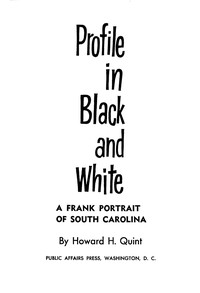
The work is a scholarly examination of race relations in South Carolina, written by Howard H. Quint, a former professor of American constitutional and intellectual history at the University of South Carolina. The opening pages explain Quint’s decision to resign before publishing, to avoid embarrassing his former employer, and outline his extensive academic credentials, Yale, Stanford, Johns Hopkins, wartime service in the OSS, and a prize‑winning article for the American Historical Association. The book positions South Carolina as a representative case of the Deep South, arguing that segregation, bigotry and prejudice have persisted despite the 1954 Supreme Court ruling outlawing school segregation. Drawing on newspaper editorials, legislative records, and personal testimonies, Quint documents the state’s resistance to federal mandates, the rhetoric of “nullification,” and the social climate that surrounds a black child’s attempt to enter a public school. The introduction frames the study as both a historical record and a moral appeal for patient, yet decisive, reform.
Quint’s voice is that of a mid‑century academic, marked by formal, often rhetorical prose and a tone that oscillates between detached analysis and impassioned condemnation. The style reflects the era’s scholarly conventions, extensive footnotes, dense paragraphing, and frequent citations of contemporary newspapers and political figures, while also invoking moral urgency. Readers interested in the history of segregation, civil‑rights scholars, and those who appreciate a rigorous, document‑driven account of Southern resistance to desegregation will find this book compelling. Its detailed focus on South Carolina’s press and political elite makes it especially valuable for researchers of regional media, legal history, and the social dynamics of the 1950s American South.