Public-domain ebook
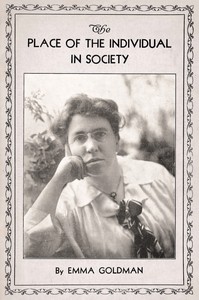
The place of the individual in society
by Emma Goldman
Language: en435 downloads on Project Gutenberg
Subjects
In: Philosophy & Ethics·Politics
Public-domain ebook sourced from Project Gutenberg #71418.
Public-domain ebook
by Emma Goldman
Language: en435 downloads on Project Gutenberg
Subjects
In: Philosophy & Ethics·Politics
Public-domain ebook sourced from Project Gutenberg #71418.
The opening · free to read
This profound work will revolutionize the intellectual world of thought by showing that the heretofore accepted notions as to the underlying causes of Social Phenomena are only partially true and therefore, inadequate to explain how social changes are affected.
Many great thinkers have sought to formulate a “Philosophy of History” which would enable us to analyze and explain, as well as predict social and historical events. Buckle, Hegel, Marx and Spengler are just a few among the great thinkers who have contributed to this great task, but Rocker with his profound understanding and in his illuminating style shows why the “Hegelian Dialectics”, “Marx’s Economic Determinism” and “The Spenglerian Philosophy of Destiny” have failed.
In this veritable encyclopedia of knowledge, we see before us, in a living procession, the great cultures of all ages. The thoughts and ideals of the Ancient Egyptians, Babylonians, Greeks and Romans become accessible to us with the same clarity and understanding as the thoughts and ideals of our contemporaries. No intelligent person regardless of his school of thought, can afford to miss reading this great work.
“Nationalism and Its Relation to Culture” will be published in two volumes and sold at $7.50 for both volumes. We offer You this great work at a price of $5.00, if you SUBSCRIBE IN ADVANCE.
This monumental work will soon be off the press. We urge you to send your subscriptions now--in advance. By so doing, you will help our committee complete the work and you will save $2.50.
SUBSCRIBE TODAY.
Subscriptions can be mailed to the following committees:
ADELAIDE SCHULKIND 104 Fifth Avenue New York, New York
B. YELENSKY 3332 Potomac Ave. Chicago, Illinois
C. V. COOK 1038 S. Alvarado St. Los Angeles, Calif.
The minds of men are in confusion, for the very foundations of our civilization seem to be tottering. People are losing faith in the existing institutions, and the more intelligent realize that capitalist industrialism is defeating the very purpose it is supposed to serve.
The world is at a loss for a way out. Parliamentarism and democracy are on the decline. Salvation is being sought in Fascism and other forms of “strong” government.
The struggle of opposing ideas now going on in the world involves social problems urgently demanding a solution. The welfare of the individual and the fate of human society depend on the right answer to those questions. The crisis, unemployment, war, disarmament, international relations, etc., are among those problems.
The State, government with its functions and powers, is now the subject of vital interest to every thinking man. Political developments in all civilized countries have brought the questions home. Shall we have a strong government? Are democracy and parliamentary government to be preferred, or is Fascism of one kind or another, dictatorship--monarchical, bourgeois or proletarian--the solution of the ills and difficulties that beset society today?
In other words, shall we cure the evils of democracy by more democracy, or shall we cut the Gordian knot of popular government with the sword of dictatorship?
My answer is neither the one nor the other. I am against dictatorship and Fascism as I am opposed to parliamentary regimes and so-called political democracy.
Nazism has been justly called an attack on civilization. This characterization applies with equal force to every form of dictatorship; indeed, to every kind of suppression and coercive authority. For what is civilization in the true sense? All progress has been essentially an enlargement of the liberties of the individual with a corresponding decrease of the authority wielded over him by external forces. This holds good in the realm of physical as well as of political and economic existence. In the physical world man has progressed to the extent in which he has subdued the forces of nature and made them useful to himself. Primitive man made a step on the road to progress when he first produced fire and thus triumphed over darkness, when he chained the wind or harnessed water.
What role did authority or government play in human endeavor for betterment, in invention and discovery? None whatever, or at least none that was helpful. It has always been the =individual= that has accomplished every miracle in that sphere, usually in spite of the prohibition, persecution and interference by authority, human and divine.
Similarly, in the political sphere, the road of progress lay in getting away more and more from the authority of the tribal chief or of the clan, of prince and king, of government, of the State. Economically, progress has meant greater well-being of ever larger numbers. Culturally, it has signified the result of all the other achievements--greater independence, political, mental and psychic.
Regarded from this angle, the problems of man’s relation to the State assumes an entirely different significance. It is no more a question of whether dictatorship is preferable to democracy, or Italian Fascism superior to Hitlerism. A larger and far more vital question poses itself: Is political government, is the State beneficial to mankind, and how does it affect the individual in the social scheme of things?
The individual is the true reality in life. A cosmos in himself, he does not exist for the State, nor for that abstraction called “society,” or the “nation,” which is only a collection of individuals. Man, the individual, has always been and, necessarily is the sole source and motive power of evolution and progress. Civilization has been a continuous struggle of the individual or of groups of individuals against the State and even against “society,” that is, against the majority subdued and hypnotized by the State and State worship. Man’s greatest battles have been waged against man-made obstacles and artificial handicaps imposed upon him to paralyze his growth and development. Human thought has always been falsified by tradition and custom, and perverted false education in the interests of those who held power and enjoyed privileges. In other words, by the State and the ruling classes. This constant incessant conflict has been the history of mankind.
Individuality may be described as the consciousness of the individual as to what he is and how he lives. It is inherent in every human being and is a thing of growth. The State and social institutions come and go, but individuality remains and persists. The very essence of individuality is expression; the sense of dignity and independence is the soil wherein it thrives. Individuality is not the impersonal and mechanistic thing that the State treats as an “individual”. The individual is not merely the result of heredity and environment, of cause and effect. He is that and a great deal more, a great deal else. The living man cannot be defined; he is the fountain-head of all life and all values; he is not a part of this or of that; he is a whole, an individual whole, a growing, changing, yet always constant whole.
Individuality is not to be confused with the various ideas and concepts of Individualism; much less with that “rugged individualism” which is only a masked attempt to repress and defeat the individual and his individuality. So-called Individualism is the social and economic =laissez faire=: the exploitation of the masses by the classes by means of legal trickery, spiritual debasement and systematic indoctrination of the servile spirit, which process is known as “education.” That corrupt and perverse “individualism” is the strait-jacket of individuality. It has converted life into a degrading race for externals, for possession, for social prestige and supremacy. Its highest wisdom is “the devil take the hindmost.”
This “rugged individualism” has inevitably resulted in the greatest modern slavery, the crassest class distinctions, driving millions to the breadline. “Rugged individualism” has meant all the “individualism” for the masters, while the people are regimented into a slave caste to serve a handful of self-seeking “supermen.” America is perhaps the best representative of this kind of individualism, in whose name political tyranny and social oppression are defended and held up as virtues; while every aspiration and attempt of man to gain freedom and social opportunity to live is denounced as “un-American” and evil in the name of that same individualism.
There was a time when the State was unknown. In his natural condition man existed without any State or organized government. People lived as families in small communities; They tilled the soil and practiced the arts and crafts. The individual, and later the family, was the unit of social life where each was free and the equal of his neighbor. Human society then was not a State but an =association=; a =voluntary= association for mutual protection and benefit. The elders and more experienced members were the guides and advisers of the people. They helped to manage the affairs of life, not to rule and dominate the individual.
Political government and the State were a much later development, growing out of the desire of the stronger to take advantage of the weaker, of the few against the many. The State, ecclesiastical and secular, served to give an appearance of legality and right to the wrong done by the few to the many. That =appearance= of right was necessary the =easier= to rule the people, because no government can exist without the =consent= of the people, consent open, tacit or assumed. Constitutionalism and democracy are the modern forms of that alleged consent; the consent being inoculated and indoctrinated by what is called “education,” at home, in the church, and in every other phase of life.
That consent is the belief in authority, in the necessity for it. At its base is the doctrine that man is evil, vicious, and too incompetent to know what is good for him. On this all government and oppression is built. God and the State exist and are supported by this dogma.
Yet the State is nothing but a =name=. It is an abstraction. Like other similar conceptions--nation, race, humanity--it has no organic reality. To call the State an organism shows a diseased tendency to make a fetish of words.
The State is a term for the legislative and administrative machinery whereby certain business of the people is transacted, and badly so. There is nothing sacred, holy or mysterious about it. The State has no more conscience or moral mission than a commercial company for working a coal mine or running a railroad.
The State has no more existence than gods and devils have. They are equally the reflex and creation of man, for man, the =individual=, is the only reality. The State is but the shadow of man, the shadow of his opaqueness of his ignorance and fear.
Life begins and ends with man, the individual. Without him there is no race, no humanity, no State. No, not even “society” is possible without man. It is the individual who lives, breathes and suffers. His development, his advance, has been a continuous struggle against the fetishes of his own creation and particularly so against the “State.”
The book keeps going
Reading is free forever. Sign up and watch scenes appear while you read.



Scenes Storieta drew for other classics.
New illustrated classics
Once or twice a month: the latest books to get full character casts, scene art, and free comic editions. No account needed.