There have been many writers of Negro dialect. Some stories that have come out of the North, feminine effusions chiefly, have been fearfully and wonderfully made; the thoughts of white people, and very common-place thoughts at that, issuing from Negro mouths in such phonetic antics as to make the aural angels weep!
In fact, no Northern writer has ever succeeded even indifferently well in putting Negro thought into Negro dialect. Even Poe, in “the Goldbug,” put into the mouth of a Charleston Negro such vocables as might have been used by a black sailor on an English ship a hundred years ago, or on the minstrel stage, but were never current on the South Carolina coast. To recent Southern writers, therefore, one must turn for intelligent understanding of the Negro character and the recording of his speech, which varies in the different sections of the South.
Thomas Nelson Page, recognized as the outstanding exponent of the Virginia Negro in literature, has yet touched his field lightly, considering chiefly the old family man servant and his relations with his master’s household. Very beautifully and tenderly, because very truthfully, Mr. Page has portrayed the ante-bellum Negro man servant; but as to the younger Negro, Negro life before and since the war, and the relations of Negroes to one another, it is to be regretted that he has contributed little or nothing.
The genius of Joel Chandler Harris, who, with Judge Longstreet and his “Georgia Scenes,” fixed Georgia firmly upon the literary map of the world, embalmed the Negro myths and folk-tales of the South so subtly in the amber of his understanding that “Uncle Remus” is known and loved by the children of half the civilized world. There was little creative work in “Uncle Remus.” Mr. Harris claimed to record the stories only “like hit wer’ gun ter me.” These myths were known and told by Negro nurses to the white children over all the Southern states, and in the West Indian Islands as well, but the artistry of Harris lay in the sympathetic understanding of children prompted by his kindly heart, and the human appeal of the tender relations of “the little boy” and the old Negro family servant was irresistible, not only to the children, but to those happy grown-ups who loved them.
It is interesting to know that in the low-country of South Carolina, instead of “Brer Rabbit and Brer Fox,” it is invariably “Buh Rabbit en’ Buh Wolf.” Strange, too, because wolves must have been found in upper Georgia and Carolina for more than a hundred years after they were exterminated along the coast, within whose forests still abound the grey foxes whose natural prey is the rabbit.
Encouraged by the success of the “Uncle Remus” stories, which greatly surprised this singularly modest man, Mr. Harris wrote novels and other stories of Georgia life among whites and blacks. While these were published successfully, it is upon the animal tales of “Uncle Remus” that his fame has been permanently established.
In the introduction to one of his volumes Mr. Harris has made a rather exhaustive study and analysis of the origin of these Negro myths. That they are of African origin none can doubt, but as on the West Coast of Africa, whence the slaves came to the American continent and the West Indian Islands, there are neither wolves, foxes, nor rabbits, it would be interesting to know what African animals were their legendary prototypes. In Jamaica many of the “Uncle Remus” tales are current and have been told to English children by their black nurses for generations, but there the Anancy Spider, a black, hairy tarantula-like creature, is substituted for the rabbit in the mythical triumph of mind over matter--cunning over physical strength--while the tiger does duty for the outwitted fox. Whence comes the Jamaican tiger? One can only surmise that tales of the strength and ferocity of the Jaguar (“el tigre” to the Spaniards) the great spotted cat of South and Central America, were brought from the mainland to the West Indies by the Indians of the Caribbean Coast or the earlier Negro slaves; but in Jamaica even the saddle-horse story is told complete in all its details, the spider, clapping spurs to the tiger’s flanks and riding him up to the house of the “nyung ladies” (Mis’ Meadows an de gals) hitching him to a post and walking boldly in to love’s conquest. For the “Tar Baby” story, instead of the violated spring, the drinking preserve of fox or wolf, a “tar pole” is set up in a banana grove, and to this sticky lure the pilfering spider is found stuck fast by the lord of the plantation when he makes his morning rounds.
Harry Stillwell Edwards, of Macon, is another Georgian whose charming stories in the up-country or cotton plantation dialect have given pleasure to thousands. With an unusual knowledge of the Negro character--the first consideration, if one would present truthful pictures of Negro life--he combines a charming literary style, and his writings deservedly rank high among Negro stories.
Harris touched the Gullah dialect very lightly and not with authority. In “Nights with Uncle Remus,” a later collection of Negro myths, he puts into the mouth of “Daddy Jack” certain variants of the Uncle Remus stories told in the dialect of the coast, and in his introduction to this volume he acknowledges his obligation to correspondents in Charleston and elsewhere on the Carolina and Georgia Coasts for the Gullah stories. It is almost certain that he lacked first-hand contact with the story-tellers, and thus missed some of the subtleties of their speech as well as the peculiar construction of their sentences, differing entirely, as they do, from those of the up-country Negroes. Mr. Harris also includes in his introduction a brief glossary of Gullah words, and expresses the opinion that this peculiar dialect is more easily read than the Georgia dialect of “Uncle Remus,” an opinion in which, unfortunately for the popularity of “Gullah,” few will concur.
In “Myths of the Georgia Coast,” Col. Charles Colcock Jones, of Georgia (and South Carolina, also, by the way) has given, in generally correct Gullah dialect, the stories current along the coast, many of them variants of those told in “Uncle Remus.” A careful lawyer, Col. Jones has set down, with most meticulous exactness, and without imagination or embellishment, the stories as they were told him on the plantation.
One familiar with Negro speech recognizes that these tales are recorded as they fell from Negro lips, and as such they must be regarded, as far as they go, as the most authentic record of Negro myths on the continent--probably the originals of many of the “Uncle Remus” stories, for the slaves first came from Africa to the coast, bringing with them their myths and legends which gradually infiltrated into the hinterland.
A comparison of Jones’s story of the rabbit and the tar baby with Uncle Remus’s version of the same tale will be interesting as showing, not only the richer and quainter dialect of the Gullah, but also his more direct and homely mode of thought.
The “Coteney” sermons of the Reverend John G. Williams, of Barnwell County, which appeared in the Charleston News & Courier about twenty-five years ago and were subsequently published in pamphlet form, purporting to be pulpit deliverances and consequently showing chiefly the Negro’s conception of his relation to religion, are full of homely wit, and, written in the language of the coast, constitute a noteworthy contribution to dialectal literature.
Mrs. A. M. H. Christensen, of Beaufort, although of Northern birth, enjoyed soon after the war unusual opportunities for acquiring folk-lore stories of the sea-islands and littoral, and she has set forth in a small volume certain of the tales that were told her, which are in the main variants of versions of those already related by Harris and Jones.
Another booklet, by the late J. Jenkins Hucks, of Georgetown, S. C., recording some of the cases that came before him as Magistrate, is, perhaps, the most humorous example extant of Gullah undefiled.
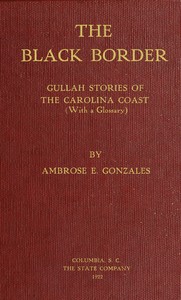
Following the Stories, will be found a fairly complete Glossary of the Gullah speech as used by the Negroes of the Carolina-Georgia Coast and sea-islands, perhaps the only extensive vocabulary of Gullah that has yet been compiled.
The words are, of course, not African, for the African brought over or retained only a few words of his jungle-tongue, and even these few are by no means authenticated as part of the original scant baggage of the Negro slaves.
What became of this jungle-speech? Why so few words should have survived is a mystery, for, even after freedom, a few native Africans of the later importations were still living on the Carolina Coast, and the old family servants often spoke, during and after the war, of native Africans they had known; but, while they repeated many tales that came by word of mouth from the Dark Continent--the story-tellers were almost invariably of royal blood, and did not hesitate to own it--they seem to have picked from the mouths of their African brothers not a single jungle-word for the enrichment of their own speech.
As the small vocabulary of the jungle atrophied through disuse and was soon forgotten, the contribution to language made by the Gullah Negro is insignificant, except through the transformation wrought upon a large body of borrowed English words. Adopting, as needed and immediately when needed, whatever they could assimilate, they have reshaped perhaps 1,700 words of our language by virtue of an unwritten but a very definite and vigorous law of their own tongue.
In connection with the Glossary, certain characteristic features of this strange tongue are noted. Their consideration will facilitate the reader’s exploration of “The Black Border.”
Of the stories included in this volume, the last fourteen were written and published in The State in the Spring of 1892. The remaining twenty-eight were written and published during the year 1918.
AMBROSE E. GONZALES.
Columbia, August, 1922.