Public-domain ebook
Age of anxiety
English438 downloads on Project GutenbergDownload EPUB
Public-domain ebook sourced from Project Gutenberg #71491.
Public-domain ebook
English438 downloads on Project GutenbergDownload EPUB
Public-domain ebook sourced from Project Gutenberg #71491.
The opening · free to read
"Choose!" said the robonurse. "Choose!" echoed his entire world. But either choice was impossible!
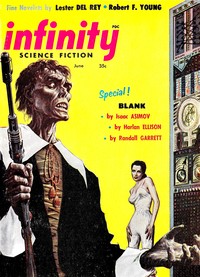
[Transcriber's Note: This etext was produced from Infinity June 1957. Extensive research did not uncover any evidence that the U.S. copyright on this publication was renewed.]
That morning, when Larry awoke, the robonurse was standing at the foot of his bed, smiling benignly. It made no attempt to help him into his housecoat and give him his morning unworry capsule. Instead it waited, poised delicately on its humming treads, making no motion toward him.
"I'm awake," Larry said sourly. "Why aren't you functioning?" He paused, frowning slightly, and added, "And where's my capsule?"
"This morning is different," said the robonurse. "This is your birthday, young man!" It clicked twice, hissed, and rolled forward at last, holding Larry's capsule-box in its grips. The box flew open as the robot approached Larry's bed, and the boy saw, within its gleaming interior, three capsules--one the usual light blue, the other two a harsh green and a bright yellow respectively.
"What's this?"
"_Choose_," the robonurse said inexorably.
The trigger-word echoed in the room for an instant. "_Choose_," the robot said again, and the repetition unlocked a chain of synapses, unleashed data hypnotically buried in Larry's mind years before, opened doors and brightened dark corridors.
Choose. The terrifying word held promise of conflict, pain, anxiety. Larry's fingers quivered with terror for a moment; his hand hovered over the capsule-box, wavered for a long second of indecision, while a glistening bead of sweat rolled down his smooth face.
His hand grazed the light-blue capsule, the capsule that could end the sudden nightmare forever. He fingered its glossy surface for a moment, then shook his head and touched the bright yellow one. A shudder of fear ran through him as he did so, and he swept up the green capsule hurriedly and swallowed it.
"Okay. I've chosen," he said weakly.
The robonurse, still smiling, closed the capsule-box and rolled away. It replaced the box on its shelf and said, "You've chosen, Larry--but all you've chosen is postponement of final decision."
"I know." His voice was dry. "I--I'm not ready yet. But at least I took a step forward. I didn't take the unworry drug."
"True enough," the robonurse said. "You can still go in either direction--back to the unworry of childhood, or on to the full anxiety of adult life."
"Let me think," Larry said. "That's why I took the middle capsule. To think this out."
"Yes, let him think!" Larry glanced up and saw the stooped figure of his father at the door of the bedroom. The robonurse scuttled away hummingly, and Larry swung around in bed. His father's face, wrinkle-etched, baggy-eyed, and despairing, stared intently at him.
The tired face broke into a feeble grin. "So you've arrived at the Age of Anxiety at last, Larry! Welcome--welcome to adulthood!"
Behind Larry lay an entire seventeen-year lifetime of unworrying--and behind that lay the three centuries since Koletsky's development of the unworry drug.
It was tasteless, easily manufactured, inexpensive, and--despite its marvelous properties--not permanently habit-forming. Adults under the influence of the unworry drug found themselves free from anxiety, from nagging doubts about the future, from any need to worry or grow ulcers or to plan and think ahead. Koletsky's drug made them completely irresponsible.
Naturally, the drug was highly popular among a certain group of adults with low psychic resistance to panaceas of this sort, and for a while the unworry drug was a considerable source of worry to those still clear-eyed enough to look ahead. Hundreds of thousands of people a year were yielding to the synthetic bliss of the unworry drug, returning to childhood's uninvolvement with the world.
Naturally, one of the remaining worriers invented an anti-unworry drug--and with that, a new social alignment came into being. The new tablet provided gradual weaning from the unworry drug; it took four years for the treatment to be completed, but once so treated a person could never bring himself to touch the Koletsky drug to his lips again. There was an inflexible guarantee against back-sliding built into the bonded hydrocarbons of the drug.
This second discovery left the world in possession of two remarkable phenomena: a soothing drug and its antidote, both of 100% efficiency. A new solution now presented itself--a solution whose details were simple and obvious.
Give the drug to children. Let them live in a carefree paradise of unworry until the age of seventeen--at which time, apply the four-year withdrawal treatment. At twenty-one, they were ready to step into the adult world, unmarked by the horrors of childhood and equipped to face maturity with a calm, if somewhat blank mind.
At the age of seventeen, then, a choice: forward or backward. One out of every ten elected to remain in the synthetic dream-world forever, thereby removing themselves from a world in which they probably would not have been fit to contend. It was an efficient screening process, eliminating those dreamers who would not have withstood the grind, who would have retreated from reality anyway, would have slipped into neurotic fancies. The remaining ninety per cent chose maturity and reality--and anxiety.
The light-blue capsule was the way back to dreamland; the bright yellow one, the first step in withdrawal. The third capsule was the one most frequently chosen. It was a delayer; its effect, neither positive nor negative, was to allow its taker's hormones to remain suspended during the period of choice.
"I've got three days, don't I, Dad?" The terms of the situation, implanted in each child's mind long before he could possibly understand the meanings of the words, now stood out sharply in Larry's mind.
Larry's father nodded. "You took the green one?"
"Yes. Was that wrong?"
"It's what I did when I was your age," the older man said. "It's the only sensible thing to do. Yes, you have three days to make up your mind. You can go on taking the unworry capsules for the rest of your life--or you can begin withdrawing. You'll have to decide that for yourself."
Something fluttery throbbed in the pit of Larry's stomach. It was the first sign of worry, the first agony of decision-making. He remained calm; despite his lifelong use of Koletsky's drug, its peculiar properties were such that he felt no need of it now.
Yet--how did he choose? In three days, how? Uneasily, he wiggled his feet against the cool, yielding surface of the floor for a moment, left the bed, crossed the room, threw open the door. Across the hall, the robonurse was ministering to his younger brother. The sleepy-eyed eight-year-old was sitting up in bed while the pseudomother washed and dressed him.
Larry smiled. His brother's face was calm, relaxed, confident-looking.
"The lucky devil," he said out loud. "He's got nine years of happiness left."
"You can have the rest of your lifetime, son."
Larry turned. His father's voice was flat, without any hint of emotion or any trace of value-judgment.
"I know," Larry said. "One way--or the other."
Later that first day, he dressed and left the house. He crossed the pedestrian-walk that led from his block to the next, feeling curiously impermanent in his between-status status.
The pedestrian-walk was empty except for a wandering vendor struggling along under a load of bubble-toys. Larry doubled his pace and caught up with the man, a short, long-nosed individual with worry-creases furrowing his thin face.
"Hello, son. Got your bubble-ship yet?" He held forth the inflatable vehicle and smiled--a forced, slick smile that faded when the vendor noticed the luminescent armband that told of Larry's status. "Oh--a Changer," the vendor said. "I guess you wouldn't be interested in a bubble-ship, then."
"I guess not." Larry took the toy from the vendor's hand anyway, and examined it. "You make these yourself?"
The book keeps going
Reading is free forever. Sign up and watch scenes appear while you read.



Scenes Storieta drew for other classics.
New illustrated classics
Once or twice a month: the latest books to get full character casts, scene art, and free comic editions. No account needed.