Public-domain ebook
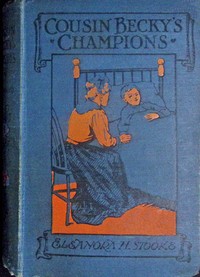
Cousin Becky's champions
English399 downloads on Project GutenbergDownload EPUB
Public-domain ebook sourced from Project Gutenberg #71566.
Public-domain ebook
English399 downloads on Project GutenbergDownload EPUB
Public-domain ebook sourced from Project Gutenberg #71566.
The opening · free to read
"TAKE that—and that—and that, and now go home and tell Aunt Janie I've smacked her dearie! I don't care if she calls and complains of me to mother—it would be like her to do that!" And the angry speaker—Roger Trent, a boy of about nine years of age—turned on his heel, and with head held high and flashing eyes, walked off, his heart beating fast with indignation as his mind dwelt wrathfully on the incident which had caused him to so far lose his temper as to cuff his companion in the open street.
A few minutes previously he had been walking amicably by the side of his cousin, Edgar Marsh, on their way home from school, when the latter had caught up a stone, which he had shied at a terrier with such true aim that it had hit the poor animal in the leg and sent it howling pitifully down the street; whereupon Roger had turned upon his cousin and dealt him several swift blows, for he hated anything like cruelty, and he possessed a fiery temper which often got him into trouble.
"I suppose there'll be no end of a row now," he reflected somewhat ruefully; "but Edgar's as old as I am and quite as big, so it wasn't cowardly to hit him, and he deserved what he got. I wish, though, I'd remembered what mother said, that she hoped I would try to keep the peace with Edgar. But I'm sure if she'd heard that poor little dog howling with pain, she'd have been angry herself; and Edgar could have hit me back if he'd liked—there is no fight in him! I wish he wasn't my cousin; and, oh, how I wish my father wasn't working for his father, then—"
He paused in his reflections, for he had turned down a side street, called Princess Street, and had reached home—a house in the midst of a long row of others, all exactly alike—and there at the sitting-room window were his mother and his sister Polly, watching for him. The angry cloud lifted from his countenance at the sight of the pair, and he smiled and nodded; but his mother had been quick to notice that something had gone wrong, and her first words, when her son entered the sitting-room, were:
"What is amiss, Roger? Have you been in mischief?"
"Why, mother, how sharp you are!" he exclaimed. Then he told her what had occurred, whilst she listened attentively, her face, which was pale and careworn, taking a decidedly anxious expression.
"Oh, Roger, you should not have struck your cousin!" she cried reprovingly when he had concluded his tale. "You really must try to keep your temper under better control, my dear boy."
"But, mother, it was cruel and wicked of Edgar to hit the poor dog," interposed Polly eagerly. "He had no right to throw a stone at it."
"Certainly not. Nevertheless, Roger had no right to hit Edgar. Two wrongs do not make one right."
Polly looked unconvinced. She was a pretty little girl, a year her brother's senior, with fair hair and honest grey eyes.
"I expect Aunt Janie will make a fuss," she observed, "for Edgar's sure to tell her—he's such a little tell-tale—and she always takes his part. That's so unfair. Oh, mother, I can't like Aunt Janie, I can't! I suppose she's kind—oh yes, I know she is, but sometimes I wish she wasn't, and then I shouldn't feel so bad about not liking her more."
And Polly looked down over herself and reflected that she really must be very ungrateful, seeing that she was clothed, at the present moment, in a frock which her mother had made for her from one of her aunt's cast-off gowns. "She isn't a bit like father," she proceeded; "no one would think they were brother and sister, like Roger and me. Oh, mother, if I was a rich lady and Roger had lost all his money and become quite poor, I know what I'd do!"
"Well?" said Mrs. Trent, inquiringly, amused at the little girl's earnestness. "What would you do, then?"
"I'd share my money with him," was the decisive reply.
"Of course you would, Polly," said Roger heartily. "And if I was rich and you were poor I'd go shares with you."
"You see, your aunt cannot do that, because her money is, a great part of it, her husband's," Mrs. Trent reminded them, "and your father would not like to take money from him—except what he earns."
"Did Uncle John ever want to give father some money?" Polly questioned inquisitively.
"N-o-o," her mother was obliged to admit. "But you must remember that your uncle has been very kind to us. When your father lost his money, it was your uncle who came forward and offered him employment in his office; but for that we should have come to want; and you know we often get fruit and vegetables from the Rookery gardens; and you and I, Polly, would have been very shabby before now but for your aunt's gifts of clothes. Don't let us be ungrateful, my dears!"
There was a brief silence. Mrs. Trent had spoken earnestly; and now she bent her head over the stocking she was in the midst of darning to hide the tears which glistened in her eyes. She was a very pretty woman; but though she was only a little over thirty years of age, her brown hair was streaked with white, and she had the appearance of one weighed down with many cares. When she had married, her husband had been a man in a good position as a clay merchant in the flourishing town of Beaworthy. The young couple had lived in a nice house in the suburbs, where the two children had been born; but, owing to heavy trade losses, and the failure of a bank in which Mr. Trent had had a considerable interest, the once prosperous man had been brought to the verge of ruin, and having failed in his business, he had been glad to accept a post as clerk in the office of Mr. Marsh, who had married his sister. Mr. Marsh was a clay merchant, too, but, unlike his brother-in-law, he was a successful trader, and it seemed as though everything he had touched had turned to gold.
Three years had now elapsed since the Trents had removed from their old home to their present abode in Princess Street, where they kept one servant instead of three, and dropped out of touch with many of their former acquaintances, as people do who have known better days. Sometimes Mrs. Marsh called upon her sister-in-law, and the inhabitants of Princess Street would flock to their windows to gaze at the carriage, with its pair of roan horses, drawn up before the Trents' door, and watch brown paper parcels and baskets carried into the house, and poor Mrs. Trent would blame herself for minding that everyone was aware she was indebted to her husband's sister for the clothes she wore and was really thankful to accept, and the surplus fruit and vegetables from her brother-in-law's gardens.
"If only Janie would walk when she comes to call, I should be so much better pleased," she had said to Mr. Trent on one occasion. "Her carriage is out of place in Princess Street." And then she had been sorry she had made the remark, because her husband had looked pained.
Mr. and Mrs. Marsh had only one child, the boy whom Roger had so promptly punished for his cruelty that afternoon. He was spoilt by his parents; and his cousins, up to the present, had seen very little of him, for their invitations to the Rookery had been few and far between, and he had rarely visited them at Princess Street. But during the last few weeks Edgar and Roger had clashed at the Grammar School, which they had attended since Christmas, and they had already had several disagreements, for the former had been brought up to be domineering, and the latter could not brook being dictated to by a boy of his own age.
"I am sorry I hit Edgar," Roger admitted by-and-by, when his temper had had time to cool, "especially before so many people. I'll apologise to him to-morrow, that is, if he doesn't tell Aunt Janie; but I expect he will. He's a rare sneak. Are we going to have tea before father comes home, or shall we wait for him, mother?"
"We will wait for him, my dear. He said he hoped to be back by half-past five."
"Oh, that's jolly!" Roger exclaimed, his countenance brightening. "We must keep up the fire, for it's awfully cold!" And he took up the coal shovel.
"I hope it will soon get warmer," Mrs. Trent remarked, "but I suppose we cannot expect it to do so in February. 'When the days begin to lengthen, the cold begins to strengthen,'" she quoted with rather a rueful smile.
"The coal heap's getting very low," announced Polly, as she watched her brother putting coals on the fire, "I peeped in to-day. I suppose they don't mind how much coal they use at the Rookery. Mother, it doesn't seem fair that Uncle John and Aunt Janie should be so rich when we are so poor. I don't believe they're any better than we are."
"Oh, hush, Polly!" cried Mrs. Trent. "You mustn't speak like that. Think of all our blessings. Sometimes I feel a very rich woman indeed."
"Why, mother!" exclaimed Roger in amazement.
"Rich because I have a good husband and children who give me a wealth of love," Mrs. Trent went on to explain with a smile which made her face look very pretty and young. "I wouldn't change places with any woman I know."
The boy threw his arms around her neck and kissed her with tender affection, for he was deeply attached to his mother, whilst Polly remarked:
"I'm glad you're like yourself, mother; I wouldn't have you like Aunt Janie for the world. Good gracious, here she is!" she exclaimed excitedly, rushing to the window as a carriage stopped at the door. "Yes, she's getting out; and oh, Roger, she does look so cross!"
"She's coming to complain about me, for certain," said Roger with a sigh of resignation, though he looked somewhat alarmed. He felt glad that he had confessed all that had occurred to his mother, and wondered what punishment his aunt would demand to have meted out to him for his treatment of her son.
"Well, of all the mean, spiteful boys I ever heard of, Edgar is the worst," declared Polly in an indignant whisper to her brother, as with a rustling of silken skirts Mrs. Marsh swept into the room. "I hope, Roger, that you hit him hard—he deserved it, I'm sure."
Mrs. Marsh was a tall, handsome woman, several years the senior of her sister-in-law, whom she greeted in a manner which, though intended to be kindly, was more than a little patronising. She kissed her niece and nephew, and then seated herself in an easy chair near the fire, whilst the children withdrew to the window to watch for their father's arrival.
"I don't believe she has come to complain of you, Roger," whispered Polly, "for she called you 'my dear.'"
Roger nodded, intensely relieved in mind. He was looking at his aunt's carriage a trifle enviously, and thinking he would like the situation of coachman so as to drive the beautiful horses he so greatly admired. But when he said so to Polly, she appeared indignant at the idea, and bade him be quiet and listen to what Aunt Janie had to say.
"No, thank you, Mary," Mrs. Marsh replied, in response to her sister-in-law's offer of a cup of tea. "I merely called to see Martin—" Martin was Mr. Trent—"to tell him about a letter I've received from Cousin Becky. You've heard of her, of course—Rebecca Trent, a first cousin of father's?"
"Oh yes!" answered Mrs. Trent, with a show of keen interest. "Martin was telling the children about her the other day, and wondering what had become of her. He will be so glad to hear you have heard from her. She must be an old woman now?"
The book keeps going
Reading is free forever. Sign up and watch scenes appear while you read.



Scenes Storieta drew for other classics.
New illustrated classics
Once or twice a month: the latest books to get full character casts, scene art, and free comic editions. No account needed.