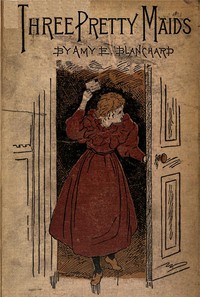
“Where are you going, my pretty maid?”
Then the door burst open and Persis Holmes appeared.
“Where are you going, my pretty maid?” Mrs. Holmes asked. “At the rate at which you are travelling I think you will go straight through the wall. Where are the others?”
Persis laughed. “I am going at something of a gait,” she replied. “I always do that way. I can’t be stately to save me. Where are the others? Let me see. Lisa was too dignified to run home, and Mellicent is so daft about Audrey Vane that she must walk home with her every day, consequently I,—only I,—the unqueenly, the unsentimental, am here, as you see, to get the kiss you have all fresh for me.” And Persis gave her mother a vigorous hug.
“I’m not sure but that you have more real sentiment than your sisters,” replied Mrs. Holmes, as she disengaged herself from the close hold of her daughter’s arms.
“I?” exclaimed Persis, opening her eyes very wide. “Why, mamma, I am the most practical child you have. Don’t I fly into the kitchen when Prue is out, and with real housewifely mind make gingerbread and ‘other country messes,’ like the neat-handed Phyllis in L’Allegro? And doesn’t papa always send me to pay bills when he cannot go himself? And—why, mamma, I’m not queenly like Lisa, nor seraphic like Mellicent. I am just plain me, the least good-looking of your trio. I am the mortal, Lisa the queen, Mellicent the fairy. But a mortal can love you just as hard; can’t she, mamma?”
“Very hard,” laughed her mother, as a kindling glance of Persis’s eye showed signs of a second energetic attack.
“I spare you, mamma! I spare you,” began Persis. “Here comes Lisa. I must go and hunt up something to eat. I am half starved. Heigho, Miss Dignity! I beat you home, didn’t I?”
“I should hope so, if it depended upon my making a tom-boy of myself in order to get here first,” replied Lisa, lifting her hat from off her well-set little head. “Mamma, you have no idea what a terror Persis is. She romps home like a great hulk of a peasant girl.”
“Lisa was so mad because I tagged her ‘last,’” laughed Persis. “Lady Dignity was covered with confusion to that extent that you could scarcely see her.”
“Mamma, do make her behave properly,” entreated Lisa. “I shall choose some one else with whom to walk if this continues,” she said, imperiously, to her sister, who made a little grimace and escaped from the room.
“Persis is perfectly incorrigible,” continued Lisa, giving a gentle pat to the curling locks about her temples as she glanced toward the mirror.
“Oh, never mind her, dear,” advised her mother; “she is full of life and as spontaneous as the flowers that grow. I don’t believe in too much self-repression. How is Mellicent’s headache?”
“Headache! She trumped it up. I don’t believe she had any to speak of. It wasn’t so bad but what she could traipse all the way home in the sun with Audrey Vane.”
“My dear, you are in a very fault-finding humor, it seems to me,” gently reproved Mrs. Holmes. “You have been working too hard and are hungry. I think you will feel better when you are rested and have taken a bit of something to eat.”
“It is such a bother to go and get it. I hate fussing with food and that sort of thing,” grumbled Lisa, throwing herself on the lounge.
“Well, lady fine, you don’t have to fuss,” said Persis, who had just entered the room with a tray in her hand. “Will your majesty deign to trifle with this humble fare which your cringing slave has brought you?” And Persis set the tray on a chair by her sister’s side.
“Oh, that looks good,” exclaimed Lisa, raising herself on her elbow. “What kind of preserves, Perse? Strawberry? That will be fine with biscuits and that glass of milk.” And she looked with appreciation at the dainty way in which Persis had prepared the modest luncheon. “Persis is a born housekeeper,” she said, graciously. “She has the most domestic turn of mind, mamma. I wonder that she has so good a record at school,” with a little air of superiority.
Persis’s eyes danced, and it was evident that a sharp rejoinder was on the tip of her tongue; but at a warning glance from her mother she refrained from answering Lisa, and turned to greet Mellicent, who now entered the room. She was the youngest of the three daughters, and many persons thought her the prettiest. Her delicate complexion, large blue eyes, and golden hair truly gave her a spirituelle appearance, upon which the little girl quite prided herself, and of which she was apt to make capital. She had been rather delicate as a small child, and never quite outgrew the idea that, in consequence, she must always be considered.
Lisa, the eldest, on her part, demanded with great exactness what she called “her rights.” She was a tall, handsome girl, with brilliant complexion, brown eyes, and soft curling chestnut hair. Her girl friends pronounced her “so stylish,” and envied her fine presence.
Persis was quite aware of the superior claims of her two sisters, and when quite a little girl she was discovered by her grandmother looking very thoughtful and serious before her mirror. Grandmother Estabrook was a dear old lady, rather given to old-fashioned ideas of what was meet and proper for children to do, and on this occasion she spoke with decision.
“Persis, my child, have you nothing better to do than to sit there gazing at yourself. Take care, my child; beware of vanity!”
“But it isn’t vanity, grandma,” Persis had replied, looking up with tears in her eyes. “I wish I had to be vain, ’cause I couldn’t help it. Mellicent is the youngest and looks like an angel, and Lisa is the oldest and looks like a queen, and I’m just the middle sizedest and don’t look like anything.”
“Never mind, my child,” replied grandma, now quite softened, “you can always look like a lady.” And this Persis never forgot, although the acting like a lady was something she did not always remember. In secret she mourned over her dusky black hair and wished it were curly like Lisa’s or golden like Mellicent’s. Her mouth, she was wont to say, was like a buttonhole, and as for gray eyes, she hated them; the curling black lashes she did not consider worth a moment’s consideration, nor did she take into account the fact that the despised black hair grew in the “five artist points” upon a smooth, low, broad forehead. “I might as well have a lump of dough for a nose,” she complained. “Oh, mamma, why didn’t I inherit your nose! It is so beautifully straight, and Lisa’s is just like it.”
“Your nose does very well,” said grandma, who overheard the remark. “Fortunately mere outline of feature is not everything; expression is much more.” And Persis was somewhat comforted, although she admired with the intenseness which was a distinctive characteristic of hers the beauty of her sisters. Nevertheless, her own simplicity and lack of consciousness gave her a charm which neither of the others possessed, and which won her more affection than she realized. She maintained, however, that Lisa was her mother’s pride, and that Mellicent was her father’s pet. There might have been some little truth in this; but it was quite as true that Grandma Estabrook and Persis thoroughly understood each other, and confidences passed between them of which the rest did not know. So, doubtless, it was a balance, so far as affections went.
“Now, my pretty maids,” said Mrs. Holmes, when Mellicent had laid aside her hat and books, “I have a piece of news to tell you. Sit there all in a row, so I can note the effect it will have upon you. Your father’s wards, Basil and Porter Phillips, arrived this morning very unexpectedly, and are to be with us all winter.” Then Mrs. Holmes laughed softly as she glanced from one to the other.
The girls caught sight of her merry face. “How did we look, mamma? Tell us. You took us so by surprise that we didn’t have a chance to put on politeness if we didn’t feel it,” said Persis. “How did we look?”
“Lisa, complacent; you, slightly vexed; Mellicent, resigned.”
“Then there is no use in our pretending to any other feelings. So please tell us how it all happened,” said Mellicent.
“Your father had a telegram just as he was leaving the house, and the boys came an hour later. Mrs. Phillips was called upon suddenly to go to California with her invalid sister, and there had been, as you know, some talk of the boys preparing for the university, so it was decided that they should enter the Latin school at once, and they packed up and came. They are rather young to go alone into a boarding-house; moreover, your father feels responsible for them and thinks he should have them under his eye.”
“I think it’s rather a cool proceeding, myself,” ventured Persis, “without so much as saying by your leave, to come swooping down on us in this fashion. Oh, dear!”
“How old are they, mamma?” asked Lisa, whose interest had caused her to alter her recumbent position on the lounge to one of alert attention.
“Basil is in his seventeenth year and Porter in his fourteenth.”
“There! I knew it. The middle-sized one always gets left. Porter will tag after Mell’s golden curls, and Basil will do honor to Lady Dignity. A girl of fourteen never has a chance if there is a baby on one side and a sweet sixteener on the other,” declared Persis.
“Why, Persis!” reproved her mother. “Don’t say such things. I do not want you to have such notions about these boys. You are to be sisters and brothers together, friends by selection. Now, don’t let me hear any such talk again. Go along, all of you; I have letters to write.” And the girls proceeded to gather up their books.
“I do wish people wouldn’t get ill, so that mothers must send their boys where they’re not wanted,” grumbled Persis to Lisa, when they had reached the seclusion of their own room.
“Oh, but you know it isn’t as if they had done that. You know papa himself suggested to Mrs. Phillips last summer that if the boys were to go to college it would be a good thing to send them to the Latin school this year. They talked it all over. Mamma told me so.”
“Well, it amounts to the same thing. We don’t want them; at least I don’t, whatever the rest of you may like.”
“But you know their board will be an item.”
“I hadn’t thought of that. Well, I suppose we are not such bloated bondholders but what a little windfall like that counts nowadays when times are hard. All the same, I wish they didn’t have to be here.”