Public-domain ebook
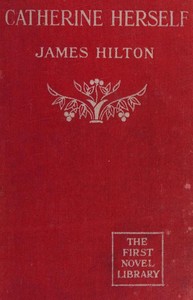
Catherine herself
by James Hilton
Language: en510 downloads on Project Gutenberg
Subjects
Public-domain ebook sourced from Project Gutenberg #71786.
Public-domain ebook
by James Hilton
Language: en510 downloads on Project Gutenberg
Subjects
Public-domain ebook sourced from Project Gutenberg #71786.
The opening · free to read
Father was an elementary school teacher at the Downlands Road Council School. In winter and on wet nights in summer he sat indoors and put great sprawling ticks and crosses on exercise-books. Sometimes he frowned while he was working: Catherine used to watch him.
He was a little man and he wore cycling stockings under his trousers. Every fine night he put on an old Norfolk tweed jacket and went out into the garden with the two ends of the waistband dangling behind him. He would bend down and make minute examinations of plants. He would twine sweet-pea tendrils round their sticks. Sometimes he would pounce upon a weed and remove it with cruel precision.... On Saturday afternoons he took a bucket and went into the roads to collect horse-manure. To Catherine Saturday afternoon was always signalized by the hard scraping of the kitchen shovel on the gritty surface of the roadway.
Mother was big and billowy. She kept her hair in papers during the mornings and wore stays whose ribbed outline showed through the back of her blouse. She talked more than father. At the Duke Street Methodist Chapel she appeared in the front row of the choir, whilst father took round the collection-plate. She was vaguely religious and vaguely patriotic and vaguely sentimental. When she said “John!” very slowly, father knew he had better be careful.
Catherine sat in the front pew on a Sunday morning, and wondered what it was all about. Why had mother got her hat on? ... Why did everybody come here once a week? What was the man in the round box talking about? Her mother had said, “About God, Cathie.” But he didn’t say God; he said Gahd. Sometimes Ch-artinevin was mentioned and Catherine caught the words with enthusiasm. It was plain that Ch-artinevin was a well-known personage.
The little boy next to her had curly hair. He was eating peppermints. During the prayer he kept taking them out of his mouth to see if they got smaller. Once he gave her one. It was very nice, but she cracked it during the benediction, and it was a loud crack.
Father stood at the door shaking hands with people. He said: “Good evening, Mrs. Lawson”--“Good evening, Ethel”--“Good evening, Miss Picksley, shall we be seeing you at the Band of Hope on Tuesday?”
Father, being an elementary schoolteacher, did not send Catherine to an elementary school. She went to Albany House (principal, Miss Leary, L.R.C.P.). Miss Leary wore her hair in a knob and said to Catherine: “Darling, if you do that again I shall have to smack you hard.”
Catherine learnt: Solomon was the wisest man that ever lived; Gibraltar belongs to England; the fear of the Lord is the beginning of wisdom; Henry the First never smiled again; three barleycorns one inch; the messenger rushed up to Wolfe saying, “They run, they run!”--“Who run, who run?” cried Wolfe....
On wet winter days the fireguard was hung with steaming clothes. The row of benches was a mere misty vista of wet noses and pocket-handkerchiefs. Everywhere was the stench of damp mackintoshes. Catherine sat by the window and looked through the streaming panes. She could see Polly, who brought them cups of cocoa in the middle of the morning, washing up the breakfast things in the kitchen. Every now and then the water gurgled out of the slopstone into the sink and made Jack, the black retriever dog, cautiously open one eye in his kennel. Catherine liked Jack. He was very staid and solemn, his sole dissipation being the crunching of snails. Miss Leary said: “Catherine, I do declare you are looking out of that window again! How often have I told you ...” etc., etc.
Every Friday afternoon as a special treat they had reading out of a reading-book. It was not like “Pat sat on the mat: is that Pat’s mat?” and the sentences about the cat and rat; it was a real book of adventures, the adventures of a boy and his uncle at the seaside. The avuncular relationship seemed to consist entirely in a readiness to return prompt and plausible answers to all sorts of questions. Uncle Tom and his nephew carried between them a complete outfit of odds and ends, marbles, pieces of string, oranges, scissors, card-board, cubes and prisms, even jars and glass-funnels, and it was their custom to perform experiments with these upon all suitable occasions, wherever they might chance to be. The observations of passers-by, including park-keepers and bath-chairmen, were not recorded. Local byelaws seemed never to impede them from digging up roots and defacing flower-beds.
Day followed on day and Catherine grew. As she walked by the sides of brick walls her eye ran along the lines of mortar tapering into the distance. Even she noticed how she kept rising brick by brick until the mortar-line that her eye followed was somewhere between four and five feet high. She left off her very childish habits, such as walking on the cracks of the pavements.... She ceased to ask absurd unanswerable questions about trams and buses; she stopped lamenting if she failed to secure a window-seat in the train. But she was still a child. She still sang out after old father Jopson.
She discovered that the second line of the hymn was not “Nighties drawing nigh,” as she had naturally supposed, but “Night is drawing nigh.” The discovery was a disappointment.
She began to read. She read Alice in Wonderland and The Walrus and the Carpenter. She even began to write. At Albany House she wrote in large copybook style: “Honesty is the best policy.” Once also she wrote on the back of a birthday card: “Dear Auntie Ethel, Many Happy Returns of the Day, from Your Affectionate Niece, Catherine.” ... And on the wooden fence at the end of the road she wrote in chalk: “Freddy McKellar is a Soppy Fool.”
She began to do naughty things. She played in the game of “last across”; she hung on to the backs of passing motor-lorries. She danced in the streets to the tune of itinerant barrel-organs. Something may here be said of her appearance. She had hair of a rich and fiery red, and eyes of a fierce compound of brown and green. In the summer-time her face was freckles all over. She was not good-looking, and few people would have called her even pretty. But she was known everywhere in the vicinity of Kitchener Road as “Cathie Weston, that red-haired girl.”
In the Co-operative Stores the shopman kept her waiting out of her turn. He had seen her sticking “transfers” on his shop-window and he did not like her. The Bockley and Upton Rising Friendly Co-operative and Industrial Society was an imposing institution with patent bacon-slicers and profuse calendar-distributing habits. Behind the polished mahogany counter the shopman fluttered about, all sleek and dapper, and in front stood Catherine, tired and impatient. There was a large co-operative almanac on the wall, and this she used to peruse diligently, supplementing therefrom the meagre knowledge of English history given her at Albany House. The almanac introduced a sort of miscellaneous historical calendar--for example: September 22nd. Battle of Zutphen, 1586. September 23rd. Massacres in Paris, 1789. Then in great staring red letters: September 24th. Opening of the Head Office of the Bockley and Upton Rising Friendly Co-operative and Industrial Society by Lord Fitzroy, 1903. With absolutely no sense of historical perspective at all, Catherine was quite prepared to believe that the last of these was the most prominent because it was also the most important.
When Kitchener Road was first built, in the full-flood of the Soudanese war-fever, it was for a time drowsily suburban. Then a too enterprising religious organization built a tin-mission at one end of it. The mission had a corrugated iron roof. Until then Kitchener Road had not quite decided whether it would tend in the social sense to rise or to fall. The corrugated iron roof forced a decision. Kitchener Road fell, and fell rapidly. From drowsiness it degenerated into frowsiness. A sleek off-licence appeared, with yellow-glazed tiles and an ungrammatical notice board: “No beer to be drank on the premises nor on the public highway.” Passing the tarred fence at the upper end the pedestrian ran the whole gamut of flippancy and indecency. And on the gate of the corner house could be seen--a final tribute to disappointed hopes--that sultry hall-mark of respectability: “No Hawkers, No Circulars, No Canvassers.” When the headmaster of the Downsland Road Council School heard that an intending pupil lived in Kitchener Road, he generally said: “I am very sorry, but we have no more room. If I were you I should try at Cubitt Lane.” ... The headmaster of the Downsland Road Council School did not like the headmaster of the Cubitt Lane Council School.... And on all the tram-standards in Bockley a handbill declared that “On July 11th, at the Upton Rising Petty Sessions, Gabriel Handcote, 21, and Richard Moulton, 19, both of Kitchener Road, Bockley, were fined 40s. and costs for travelling on a tramway-car with intent to avoid payment of fare.”
Bockley was a sprawling urban district on the edge of the metropolitan area. Itself and Upton Rising had spread till they touched like adjacent blobs of ink on blotting-paper. But Upton Rising was aristocratic, plutocratic.... Its inhabitants had first-class season-tickets, wore spats, and read The Times on the 9.27 “Up.” They became district councillors, bazaar-openers, hospital-subscribers and such like. They wrote letters to the Bockley and Upton Rising Advertiser complaining of municipal apathy in the matter of water-carts. They said “Bockley must have a park to keep it out of mischief,” and lo! Bockley had one, with “keep-off-the-grass” notices and geometrical flower-beds, and a code of byelaws half a yard long, and a constant clientele of old-age pensioners and children flying paper windmills....
And in the meantime Bockley became conscious of its destiny. It bore all the unmistakable signs of a township that expects to be great some day--insurance agencies out of all proportion to the population, a Carnegie library, and a melancholy statue outside the Town Hall....
The origin of Bockley is simple and unconfusing.
Somewhere early on in the latter half of the nineteenth century the Great Eastern Railway Company, seeking parliamentary sanction to extend its suburban lines to Bockley, was compelled by law to carry workmen to and from Bockley and the City for twopence.... It was that twopence which made Bockley....
Catherine watched him as he tightened the wires and prodded the notes. At the end he played Thalberg’s “Home, Sweet Home,” with variations.
That night Mrs. Weston said: “Now that the pianer’s bin tuned you might start havin’ lessons.... I’ll see Mr. Monkhouse about it to-morrer.”
And Catherine bought a shilling instruction book and learned: E G B D F--Every Good Boy Deserves Favour....
Mr. Monkhouse was a versatile man. In the Bockley Advertiser he announced: “Mr. Reginald Monkhouse has still a few dates vacant during April and May for engagements as entertainer, expert conjurer, pianist, accompanist or children’s lecturer Write Box 77.” At Masonic dinners Mr. Monkhouse sang “Where did you get that hat?” and other relics of the Victorian music-hall stage. Every evening from 8 till 11 he played the piano and conducted the orchestra at the Victoria Hall, Bockley, vamping with his left hand and beating time with the first finger of his right. And on Saturdays and at odd times whenever possible he gave pianoforte tuition at the rate of sixpence a lesson.... He was always shabbily-dressed, always good-humoured, patient and not too conscientious. The little front parlour where he lodged in Cubitt Lane was full of playbills and concert programmes and signed menu-cards....
The book keeps going
Reading is free forever. Sign up and watch scenes appear while you read.



Scenes Storieta drew for other classics.
New illustrated classics
Once or twice a month: the latest books to get full character casts, scene art, and free comic editions. No account needed.