Public-domain ebook
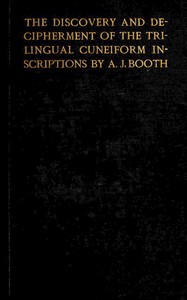
The discovery and decipherment of the trilingual cuneiform inscriptions
English4,110 downloads on Project GutenbergDownload EPUB
Public-domain ebook sourced from Project Gutenberg #71905.
Public-domain ebook
English4,110 downloads on Project GutenbergDownload EPUB
Public-domain ebook sourced from Project Gutenberg #71905.
Arthur John Booth’s work is a scholarly survey of the discovery and decipherment of the trilingual Achaemenian cuneiform inscriptions. The book opens with a practical note about the need for a cuneiform‑capable font, then presents a detailed frontispiece of Persepolis and a contents list that maps out a chronological narrative, from early travelers such as Barbaro and the Portuguese missions in the 15th and 16th centuries, through the systematic efforts of scholars like Grotefend, Rawlinson, and Hincks in the 19th century. Booth traces each stage of the process, from the initial identification of the three parallel columns and the relatively simple Old Persian script, through the more complex Susian and Babylonian columns, to the eventual recognition of their linguistic families. The introduction frames the whole enterprise as one of the great nineteenth‑century achievements, emphasizing the painstaking, collaborative scholarship that turned mysterious wedge‑shaped marks into a key to ancient Near Eastern history.
The text is written in a formal, academic voice characteristic of early‑20th‑century philology, with extensive footnotes, tables, and references to contemporary expeditions and publications. Its style is dense but clear, favoring precise description over narrative flourish, and it assumes a reader comfortable with historical and linguistic terminology. Scholars of ancient Near Eastern studies, historians of archaeology, and anyone interested in the evolution of decipherment methods will find Booth’s meticulous account rewarding, while general readers seeking a more accessible story of ancient scripts may prefer a modern synthesis.
Transcriber’s Note: For this book you will need to have a font installed that can render cuneiform characters such as 𐎠, 𐎡, 𐎢. If these do not display for you, then one suitable option is the font ‘Segoe ui historic’. Cuneiform signs that have no Unicode equivalent are given as [Persian] or [Susian], and as images in the HTML version. …
Keep reading free · start reading with no account
New illustrated classics
Once or twice a month: the latest books to get full character casts, scene art, and free comic editions. No account needed.