Public-domain ebook
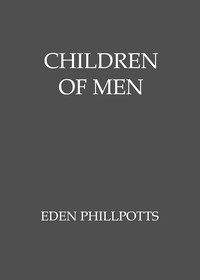
Children of men
Language: en673 downloads on Project Gutenberg
Subjects
In: Romance·Novels·British Literature
Public-domain ebook sourced from Project Gutenberg #71941.
Public-domain ebook
Language: en673 downloads on Project Gutenberg
Subjects
In: Romance·Novels·British Literature
Public-domain ebook sourced from Project Gutenberg #71941.
The opening · free to read
On a day in high summer the valley was full of light, and Auna River, her moorland journey ended, bowed under a plantation of pine and fir, then sparkled forth, to learn what welcome awaited her in the lower lands. Above the stream, easterly, a green hill towered against the sky; stunted thorns broke the sweep of the eagle fern, grey rock clitters spread and cloud shadows drifted over all, to cool the brightness.
A wood massed beneath in the mouth of the vale, and from this dusky retreat there leapt the river, in a succession of planes broken at each little fall by an apron of granite. Here the ripples flashed with foam; here the blue of the sky was caught in the gliding surface between, where Auna's tresses twined soberly, and fern, heather, woodrush cast their reflections into her tremorous mirror.
Two stone shelves presently barred the waterway and, leaping one, the river made a circular sweep above the second and eddied in a little backwater. The later ledge was gentle and its steps sloped to three feet above the stream. It was fringed with herbage and flowers, and here Auna loitered, making shadows for fingerling trout to play in. Through the limpid crystal there shone agate and amber tones of rock and pebble beneath; and these warm colours were repeated in the tunic, breeches and gaiters of a girl who sat above the pool.
Round her thronged a dozen lesser lives, that wove a restless, ruddy pattern about her feet, in her lap and upon her shoulders. Girl and puppies completed the harmony and made a splash of rich, auburn light beside the river. The Irish terriers kept on the move about their kennel-maid and seemed to flow over her, as the stream flowed over the stones. They nuzzled her cheeks, licked her fingers, thrust their noses into the black hair coiled up under her cap. She was a slim, brown girl with grey eyes, that seemed large for her small features, and a pretty, yielding mouth. She was tall and of maidenly slimness; her little breasts moved under the light garments that she wore; she laughed and played with the puppies; but a deeper joy than they could give lighted her face.
"Leave me alone, my chicks!" she said, and pushed them away from her with both hands. They scattered, tugging and tumbling; then, while the girl tidied her hair and stilled her laughter, the puppies set up their infant barking; and she knew that somebody must be upon the by-road that ran parallel with the stream.
She rose, jumped over the narrow neck of the pool and joined the man who was coming up the valley. The puppies already swarmed round his heels.
"Could you get it?" she asked, and the man held up a large tin.
"Just in time," he answered. "They were starting off with the cream to Brent, but Mr. Winter spared me a pound."
"Are they settling in pretty clever?"
"Yes; they're getting straight."
Jacob Bullstone stood half a foot taller than the girl and was fifteen years older. Now a great thing had happened to him, and, at thirty-five, one whom his neighbours declared would remain a bachelor was in love with his kennel-maid and engaged to be married. He owned varied possessions and, thanks to an industrious and prosperous father, inherited some fortune. Two farms were his property in the lap of Ugborough Beacon, at the foothills of the moor a few miles from his home; while here, beside the river behind the pine wood, he dwelt with his widowed mother and pursued the business dearest to his own heart.
Bullstone bred a famous strain of red Irish terriers and sustained the reputation that his father had won before him. He was a man of good education, great energy and high principle, and he lived a narrow life. He had never roamed, but found his intelligence and spirit of enquiry satisfied in his native environment of moor and vale, comfortable state and interesting occupation. He did not guess that his outlook was limited, for he had been educated at a grammar school and thought himself to possess clearer wits than most of his neighbours. The fact, together with his prosperity, made him satisfied with his own accomplishments and wits. His old mother did nothing to modify his self-judgment; but none ever found the man unfriendly or puffed up, for he was of a kindly, generous disposition, did good things and held it no fault in another to differ from his opinions.
Love, however, opened Jacob's mind to a lack in himself that he had not suspected. He still felt timid and distrustful before the depths of ignorance revealed by his new emotions.
In person Jacob Bullstone was large and heavily modelled, with broad shoulders and a clean-cut, swarthy face. His eyes were dark brown and of a sulky cast in repose, but the expression belied him. He had a low, wide forehead, a square jaw and heavy chin. He shaved clean and his mouth was large and well shaped. He kept his black hair so short that the lines of his skull were clearly seen. It sloped rather steeply backward from the brow and bulged a little above his small ears.
He was hatless and clad in tawny tweeds with black leggings and a dirty, red waistcoat. He walked with a long stride, that he was now taming to go with Margery Huxam's footsteps, and for adornment he wore his father's gold signet-ring on the little finger of his left hand and the silver mask of a fox in his green tie.
The lovers proceeded together deep in their own concerns, for they had been betrothed a week; the startling news was known at Margery's home in Brent, four miles away down the valley, and to-day her parents and her brother were coming to the kennels, that they might dine with Mr. Bullstone and his mother.
The cream from Shipley Farm was for them.
Margery Huxam had turned kennel-maid for love of the life and not because any reason existed that she should earn her own living. Barlow Huxam, her father, kept the post-office at Brent as an addition to his own prosperous drapery establishment. He had but two children living, and Margery, who adored dogs and understood them, came to Red House, Jacob Bullstone's home, that she might fill the vacancy until he should be suited with a new assistant.
The families were long acquainted and Mr. Huxam, little dreaming that such a great matter would spring from the incident, raised no objection to his daughter's wish.
She came for a fortnight in friendship, but liked the work so well that she presently proposed to stop on at a salary; and since she had proved herself skilled and had won the affection of old Mrs. Bullstone and Jacob's head kennel-man, he was glad to secure her.
Her parents, however, protested and, after six months, began to agitate for the return of their only daughter; but when Judith Huxam demanded that Margery should come home again, the dog-breeder had discovered that his future happiness depended upon her.
Their courting, at first almost unconscious, proceeded quickly towards the finish, for man and woman were of a mind, and though a gap of fifteen years separated them and made Bullstone fearful when he found the truth, circumstances combined to diminish this disparity, for the girl had been bred in a puritanical home under a strenuous mother, who regarded happiness at best as doubtful. Margery's experience of young men was exceedingly limited and, to her, Jacob's sobriety, steadfast outlook and fixed opinions were more attractive than the happy-go-lucky attitude of her own generation. She loved him very heartily before he had given a gleam that he also was in love; but her emotion had been of a gentle pattern and thrust away with secret blushes as something near akin to wickedness. She felt a gulf was fixed between such an important, well-to-do man and her young self. Indeed she did not even suffer, but rather laughed at herself for her moonshiney dreams. Then came the evidence from the other side and she was overwhelmed to find her power over one regarded as unyielding before women. He approached her with humility, declared genuine pride and satisfaction on the discovery of her love, rejoiced to learn that he seemed not too old to her and instantly acquainted her parents with the fact that she had consented to wed him.
Barlow Huxam declared gratification, but his wife was not so well pleased.
The match, while in every respect a brilliant one and beyond what they might have hoped for Margery, found her mother in some doubt. She suspected that fifteen years was too great a difference of age; and she professed uncertainty concerning the past life of a bachelor of thirty-five. She did not know anything against Bullstone, or his parents before him; she could not name the quality of her suspicions, yet she questioned Margery very closely and warned her of the step that she designed. But no permanent cloud appeared and Jacob conducted himself in a manner to disarm Mrs. Huxam; for his views of matrimony satisfied her and he proposed a settlement that could only be regarded as generous. In this matter, however, Barlow Huxam was not behind his future son-in-law.
Twice on Sundays the lover brought Margery to her family, and twice he worshipped with them at their tabernacle. His behaviour was agreeable to Mrs. Huxam and her doubts finally dwindled.
To-day, while Margery and Jacob walked side by side towards Red House, nestling under a shoulder of the hill behind the pine woods, the girl's parents and her brother were already upon their way, tramping through shady lanes upward through the valley to Shipley Bridge.
"I'd best change into a petticoat before they come," said Margery. "Mother little likes my breeches, and thanks God I shan't wear 'em much longer."
"I feel the same," said the man. "You know I'm at you to doff them once for all."
"I love 'em," she declared. "I'll miss them cruel. You courted me while I was in 'em, and I shall put them on now and again--for luck. Petticoats slow your going and be tame after breeches."
"'T was never heard that man and wife both wore 'em," he said.
They passed through the woods with the puppies galloping round about, and then they came to the stone-built home of the Bullstones--a granite house under red tiles, which covered the upper storey of the walls also. It basked under the hot sun in a hollow notch of Black Tor, while the river ran at its feet and a grass lawn spread before the windows. Above, on the hillside, were scooped terraces where grew cabbage and turnip, and beyond sprang the trees to the hill crest westerly. Laurel and rhododendron made the slope snug; the kennels extended behind the house, while Bullstone's property spread to the other side of the river also and there an acre or two had been cleared, where potatoes grew in the rich alluvial. Fowls and ducks flourished at stream side and the link between Red House and the outlying cultivation was a bridge of pine logs thrown across Auna, where her banks rose high.
Everything about the place was neat, trim and stern. The hedges were clipt, the ground clean; for Jacob Bullstone's mother was an old-fashioned woman and had lived with a husband inspired by the same ideas.
"The highest beauty be tidiness," Mrs. Bullstone never wearied of declaring, and her son was content to echo that opinion. His home and its surroundings proclaimed the distinction of use, but none other. There were no flower beds, no attempt to decorate house, garden, or river. Indeed Auna was chastened by stone-built banks, until she passed southerly away to the rocks and rapids and the deep mossy pools, where Red House ducks and geese spent their pleasantest hours. Nature strove with man, but man conquered for a little space.
The book keeps going
Reading is free forever. Sign up and watch scenes appear while you read.



Scenes Storieta drew for other classics.
New illustrated classics
Once or twice a month: the latest books to get full character casts, scene art, and free comic editions. No account needed.