Public-domain ebook
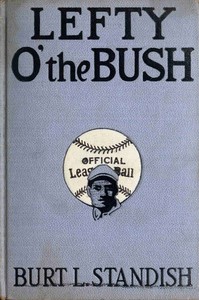
Lefty o' the bush
English462 downloads on Project GutenbergDownload EPUB
Public-domain ebook sourced from Project Gutenberg #72013.
Public-domain ebook
English462 downloads on Project GutenbergDownload EPUB
Public-domain ebook sourced from Project Gutenberg #72013.
The opening · free to read
After running his eye over the Kingsbridge batting order, Mike Riley, manager of the Bancroft “Bullies,” rolled the black cigar well into the corner of his mouth, lifted himself ponderously to his feet, and walked across toward the bench of the home team.
Kingsbridge had taken the field for practice, the visitors having warmed up already. The Northern League, a genuine “bush” organization, had opened two days earlier in Bancroft and Fryeburg, but this was to be the first game of the season in Kingsbridge, a hustling, crude, though ambitious pulp-mill town.
As it was Saturday afternoon, when the mills closed down at three o’clock, there was certain to be a big crowd in attendance, double assurance of which could be seen in the rapidly filling grand stand and bleachers, and the steady stream of humanity pouring in through the gates.
As Riley approached, a lean, sallow man, with a hawk-beak nose, rose from the home bench and nodded, holding out a bony hand, which, cold as a dead fish, was almost smothered in the pudgy paw put forth to meet it.
“Hello, Hutch!” gurgled the manager of the Bullies, with a show of cordiality, although he quickly dropped the chilling hand. “How’s tricks? See you took a fall outer Fryeburg yistidday.”
“Yes, we got away with it,” answered the local manager, in a monotonous, dead-level voice, lacking wholly in enthusiasm. “But the ‘Brownies’ are a cinch; nothing but a bunch of raw kids.”
“Uh-huh!” grunted Riley, twisting his thumb into the huge watch chain which spanned the breadth of his bulging waistcoat; “that’s right. Still, you didn’t have much leeway to spare, did ye?”
“Put it over by one measly run, that’s all. Deever’s arm went on the blink in the seventh, and the greenhorns came near hammering out a win. Locke managed to hold ’em.”
“Who is this Locke? I see he’s down to wing ’em for you to-day. Where’d you find him, huh?”
“Don’t ask me who he is. I never heard of him before. He’s some green dub of a port-side flinger old man Cope picked up. You know Cope used to play the game back in the days of the Deluge, and he thinks he knows all about it. As he’s chairman of the Kingsbridge Baseball Association, and one of the heaviest backers of the team, folks round here let him meddle enough to keep him appeased. All the same, long as they’ve hired me to manage, I’m going to manage, after I’ve shown ’em how much Cope don’t know about it.”
“That’s the talk, Hutch,” chuckled the Bancroft manager. “You’ve got some team, and you oughter be able to make it interestin’ for the rest of us, if the rubes let you have your swing. It was that old fox, Cope, who got Deever away from me arter I had Pat as good as signed, which makes me feel a bit raw, natural. Outside of Deever, and Locke, and a few others, I s’pose the team’s practically your make-up?”
“Then you’ve got another guess coming,” returned Bob Hutchinson. “Skillings, Lace, Crandall, and Hickey make the whole of my picking; Cope practically got together the rest of the bunch. But wait; some of ’em won’t hold their jobs long, between you and me, Mike.
“Perhaps we hadn’t better chin any longer, for I see we’re being watched, and the people of this town are so hot against Bancroft, and you in particular, that they might get suspicious, and think there was something crooked doing if we talked too long.”
“Guess that’s right,” admitted Riley. “They ain’t got no love for me in Kingsbridge, ’count of our rubbing it inter them last year. Makes me laugh, the way they squealed. They were so sore they swore they’d have a team to beat us this year at any cost. That’s how you got your job; they decided to have a reg’ler manager, who could give all his time and attention to handlin’ the team. Sorry for you, Hutch, but if they beat Bancroft under the wire with the bunch they’ve scraped together, I’ll quit the game for good. So long.”
Having learned that Hutchinson was not wholly responsible for the make-up of the Kingsbridge nine, Riley did not hesitate to express himself in this manner, thus betraying the disdain in which he really held his opponents of the day.
Only once since the organization of the so-called Northern League, which really had very little organization whatever, being run, like many small, back-country “leagues,” in a loose, hit-or-miss fashion――only once had Bancroft failed to win the championship; and that year Riley, a minor leaguer before age and avoirdupois had deposited him in the can, had not handled the club.
Bancroft was a city, and it cut her fans deeply to be downed on the diamond by a smaller place, besides severely wounding in their pockets some of the sports who had wagered real money. Hence the former successful manager was called back to the job, at which he was always prepared to make good through any means available.
Kingsbridge had entered the league the previous season, filling the place of a town that, loaded with baseball debts, and discouraged by poor success, had dropped out. Owing its existence to Cyrus King, lumberman and pulp manufacturer, Kingsbridge was barely four years old, yet its inhabitants already numbered nearly five thousand.
Furthermore, it was confidently looking forward to the time, believed to be not far distant, when it should outstrip the already envious city of Bancroft, and become the “metropolis” of that particular region.
While pretending to scoff at the “mushroom village,” Bancroft was secretly disturbed and worried, fearing the day when Kingsbridge, through the enterprise of its citizens, the interest and power of its founder, and the coming of a second railroad, which was seeking a charter, would really forge to the front, and leave the “big town down the river” in the lurch. Therefore, quite naturally, the rivalry between the two places was intense in other things besides baseball.
There is nothing like the game, however, to bring to the surface the jealousies and rivalries existing between towns having contending teams; something about the game is certain to tear open old sores and stir up ancient animosities apparently long forgotten.
Especially is this true in minor leagues and “out in the bush,” where not infrequently it appears to the chance stranger that whole towns――men, women, and children――have gone baseball crazy.
It is in such places that one may see the game, as a game, at its best――and its worst. Here victory or defeat assumes a tragic importance that must seem laughable to the ordinary city fan; the former being frequently the cause of rejoicing and celebrating, sometimes with fireworks and brass bands, while the latter will cast over the community a cloud of gloom which could be equaled only by an appalling catastrophe.
This intensity of feeling and emotion may scarcely be understood by a person who has never followed with individual interest the fortunes of a backwoods team, tasting the sweet intoxication of triumph, hard earned and contested to the last ditch, or the heartbreaking bitterness of defeat and shattered hopes.
Kingsbridge, with its pulp-mill and saw-mill laborers, was precisely the sort of a place to back a team to the limit, and to demand a winning club, regardless of expense.
On Saturdays, because of the early shutting down of the mills, nearly all the laborers could get out to witness the contests, and few there were who failed to attend, unless sickness or imperative necessity kept them away. In fact, on the last day of the week, the attendance in that town was as large as the average turnout in Bancroft.
The mill town’s initial experience had been most unsatisfactory and discouraging. Starting out with a nine made up of youngsters, among whom were college men and high-school boys, it had made a promising beginning, actually standing at the head of the league for almost three weeks, and then fighting Bancroft for first place for an equal length of time.
But the youngsters did not seem to have staying qualities, and this, combined with poor management and the “fair-or-foul” methods of the Bullies, had eventually sent Kingsbridge down the ladder to finish the season at the very foot of the list.
This failure, however, simply aroused the town to grim determination, bringing about the organization of a baseball association which included many of the leading citizens, Henry Cope, who kept the largest general store in town, being chosen chairman. The association pledged itself to put a winning team on to the field, and Cope, having considerable knowledge of baseball and players, set to work in midwinter preparing for the coming campaign. He was given a comparatively free hand by his associates, although, in order that Bancroft might not hear and get wise, the purpose of his movements was kept secret until it was almost time for the league to open.
Then it became known that Bob Hutchinson, a manager who had handled teams in one of the well known minor leagues, had been secured to take charge of the “Kinks.” It was also made public that a team of fast and experienced players throughout had been signed, and the names of several of these players were printed in the sporting column of the Bancroft News.
Hope flamed high in Kingsbridge. The topic of the street corners was baseball. It was freely proclaimed that the town was prepared to take a heavy fall out of Bancroft, and would begin by downing the “hated enemy” in the very first clash, which was scheduled to occur in the down-river city.
Of course a few pessimistic killjoys, of whom every community must have its quota, scoffed at the efforts and expectations of the enthusiasts, declaring it was not possible for a place no larger than Kingsbridge, no matter how earnestly it might try, to defeat a city with Bancroft’s record and resources. These croakers were not popular, yet their gloomy prophecies awakened misgivings in many a heart.
In Bancroft the midwinter silence of Kingsbridge had aroused some alarm lest the mill town, troubled with cold feet, should fail to come to the scratch when the season opened, which would make it necessary to lure some other place into the fold, or run the league three-cornered, something most unpleasant and undesirable.
Even when Kingsbridge sent a representative to attend the usual annual meeting of the league association, the quiet declination of that representative to give out any particulars concerning the personnel of the up-river team had left a feeling of uneasiness, despite his repeated assurance that there would be such a team.
Later, on the appearance of the newspaper report that Kingsbridge had engaged Bob Hutchinson as manager, and the publication of an incomplete roster of the mill-town players, Bancroft’s relief and satisfaction had been tempered by alarm of a different nature. For it now became apparent that the city’s ambitious rival had all along been quietly at work preparing to spring a surprise in the form of an unusually strong nine that would make the other clubs go some, right from the call of “play.”
Mike Riley had not sought to allay this final feeling of apprehension; on the contrary, for purely personal reasons, he fostered it. For would it not encourage the backers of his team, believing as they did in his sound baseball sense, to give him even greater liberty in management? And when he should again win the championship, as he secretly and egotistically felt certain of doing, the luster of the accomplishment must seem far more dazzling than usual.
The book keeps going
Reading is free forever. Sign up and watch scenes appear while you read.



Scenes Storieta drew for other classics.
New illustrated classics
Once or twice a month: the latest books to get full character casts, scene art, and free comic editions. No account needed.