Public-domain ebook
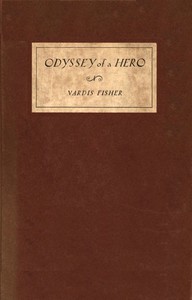
Odyssey of a hero
Language: en312 downloads on Project Gutenberg
Subjects
In: Novels·American Literature
Public-domain ebook sourced from Project Gutenberg #72037.
Public-domain ebook
Language: en312 downloads on Project Gutenberg
Subjects
In: Novels·American Literature
Public-domain ebook sourced from Project Gutenberg #72037.
The opening · free to read
When, in 1919, Private John Benton returned from France, he was not a hero of the proportions of three or four who, alone and unaided, had slain six or a dozen of the enemy and captured a hundred; but he was a warrior not to be sneezed at. He had been decorated by three nations and kissed by half the women in Paris, and the welcome given him by natives of his home town was one that rocked Idaho from end to end. There were seven speeches and a dozen bands and two truckloads of flowers, and more flags and friends and goodwill than John had ever seen before. His mother sat between two mayors, and his gawky young sister was deferred to and flattered by all the politicians between Boise and the Wyoming line.
And it all went to John’s head a little; but he remembered, even so, that war had been a dark and sightless butchery, and that German soldiers, hungry for cigarettes and peace, were human beings much like himself. He was sick of war and he wanted quiet and forgetfulness. He was a little terrified by the sadistic ardor of these homeland patriots who had never seen horror in young faces or a bayonet in the belly of a man. “We licked them all right!” cried a neighbor. “Hey, John, didn’t we whack it to them?” And the man looked at John and burst with happy, victorious laughter. “The Huns learned something when the Yanks got over there,” said another. “By God, don’t tell me they didn’t!” “How was it over there?” asked a third. “A lot of fun, wasn’t it, now? Hey, John, you lucky devil!” And to all this, John’s answer was a pitying shrug and a wan smile.
His smile became almost ghastly as he listened to the principal speaker. The man shouted in furious rhetoric and aroused the great audience to wild and prolonged applause. “We have with us today one of the mightiest heroes in that great struggle to make all nations and all peoples the guardians of peace: a native son, one of our own boys. We have gathered here to honor his name and to write it high among the selfless knights who march under the flags of war to make the world safe for the mothers of men! In profound humility we are gathered to pay homage to this soldier and patriot, this son of the Idaho mountains and valleys, who captured, single-handed, the machine-gun nest of the enemy, and marched his foes, beaten and vanquished, down the soil of France where the name of the great Lafayette still rings like a bell in the hearts of civilized nations!”
And when, after seven speeches and such applause as he had never dreamed of, John Benton was called to the flag-draped stand to say a few words to his friends and neighbors, he went with a sinking heart. He looked at ten thousand faces, so hushed and listening that he could hear his own breath; and for so long a moment he was speechless, staring at the throng, that a voice from far out yelled: “Atta boy, John! Tell us how you licked the Huns!” John cleared his voice and a man yelled: “_Louder!_” and another shouted: “Atta boy, John!” “Friends and neighbors,” said John at last, “I am grateful for this welcome.” A hand clapped and then the great throng roared with applause that made the rostrum tremble. A thousand automobile horns picked up the greeting and rolled it in thunderous volume, and for five minutes John waited, with the tremendous welcome like madness in his ears. “I appreciate your kindness,” said John, when silence fell again, “and all that you have done for me. But war, my friends, is not what you seem to think it is.” He paused and licked his dry lips and the audience waited. When he spoke again, those sitting close by were startled by his vehemence. “War, my friends, is murder. We soldiers learned that the German soldiers were not our enemy. Maybe it was a good war, fought in a good cause, and maybe it was not. I don’t know. All I know is that I’m sick of war and I won’t ever fight in another war and now I want peace and I want to forget. And—well, I guess that’s about all I have to say.”
There was no applause now. There was only stunned silence and then a low murmur that was like that of rage, gentle and baffled. Private John Benton had spoken simply from his heart, little suspecting that his words were to lay waste to his life.
John Benton, son of uneducated farmers, was a senior in high school when English propaganda drew his country into war. He was a shy and neurotic young man, deeply ashamed of his social background and his illiterate relatives. He was among the first to enlist. He went not as a patriot but as one without social or cultural anchor and without friends, who saw in war an opportunity to prove his courage and his worth. Nobody in his home town had ever spoken to him, except one barber and the neighboring farmers whom he met on the streets. And now he was to be a policeman or a night watchman or assistant to the sheriff; he was called by his first name; he was invited into the best homes. And in these first days he was very happy and loved his townsfolk and began to fancy himself as a man of national importance. But after his brief reply to the great welcome there had been a sudden and drastic change. When he met the mayor now or any of the other plump and prosperous men who had made his homecoming a memorable day, he was acknowledged with a curt nod or not at all. He got no job of any kind and he wandered up and down the streets or sat in pool halls watching the poker chips, feeling a little vengeful and deeply unhappy, and wondering why he had become only John Benton of the Benton farm on Mill Creek.
It was Bill Hawkworth who gave him an idea. Bill was a lean man with shrewd and cynical eyes and a tubercular cough. He worked in a pool hall with a cigarette hanging from his white mouth and a fixed and changeless contempt in his pale eyes. He sat by John one day and looked at him with leering pity.
“What’s the matter, buddy? Ain’t they treatun you right any more?”
“I don’t know what you mean,” said John, looking at Bill’s wet dead cigarette.
“Oh, you know, all right. The mayor,” said Bill, and jerked his sallow head toward city hall. “All them fat guys, buddy.” He smiled. His upper lip curled and the hair of his ragged mustache fell like a hedge across his yellow teeth. “You fanned out quick, didn’t you? Well, buddy, do you know why?”
John turned a little angrily and looked at the lidless cynicism of Bill’s eyes. “No,” he said.
“Want me to tell you?”
“Well, sure—if you can.”
“All right, buddy, it’s this way. You come back from war a big hero and the city gives you a big bust and there’s speeches and flags and popcorn for everyone and they wanted to hear how you licked hell out of them Huns. And right there’s where you fanned. You come to bat all right, but you just wouldn’t swing at the ball.” Bill’s lips curled against his teeth and his eyes flickered. “You get me?” he said.
“You mean—? No,” said John, “I don’t know what you mean.”
“I mean you coulda put this town right in your pocket. You coulda jumped plumb into the middle of society and married the richest girl around here and had a truckload of fortune drive right down your alley. But what did you say when they asked what you thought of the popcorn?”
“I don’t remember.”
“I’ll tell you, buddy. You said war is murder. You said you guessed mebbe the Germans wasn’t your enemy at all. You said you wouldn’t fight in another war to please God Almighty hisself. And all them,” said Bill, curling his lips in cruel mockery, “was a hell of a crack. Did you think they got all them-there brass bands and speeches and popcorn trimmings to hear you throw them Christian sentiments in their teeth? Was they intendun to make you assistant sheriff if you didn’t like to fight?” Bill’s smile was evil. “Buddy,” he said, “you fanned. You swung plumb hard and missed and fell right on your mug.”
“What did they expect?” asked John, staring, fascinated, at Bill’s sinister eyes.
“God damn, buddy, that’s a stupid question. They wanted you to tell how you made them Huns jump back over the Rhine like a buncha frogs—.”
“But I didn’t,” John said.
“Oh, the jumped-up holy ghost!” Bill drew the weak muscles of his face down until his upper lip lay across his lower teeth. He smiled with mirthless cunning and looked at John with gentle pitying amazement. “Buddy, you wanta know how to be a hero again? I’ll tell you. You say war’s a swell thing if you’re on the right side—and you was on the right side, buddy—” Bill’s grin was chilling. “You tell how you rammed them Huns in their guts and piled them up in the Rhine until it run backwards. And if you could tell how you saved a virtuous woman—say, for the love of virgins, couldn’t you tell a story like that? Buddy, that would put you right on top of the popcorn pile with a cigar in your face a yard long. Well,” he said, and spit straight down between his knees, “you get the idea.”
But it was a difficult idea for John Benton to grasp. He walked around like a tall pale ghost of a man, with spiritual anguish in his thin, sensitive face. He wanted persons to like him. He wanted persons to remember Jesus, as he had remembered Him for two years in France, and to look far into the ways of kindliness and mercy. But Bill, meeting him now, gave him a cynical yellow smile and a jab in his ribs. “Be fierce,” he said, smirking wisely, “and blow your horn.” And again: “Buddy, stop lookun like one of the twelve apostles, huntun around for the coast of Galilee. Sail out and tell them-there big stomachs what they wanta hear.” And John, after days of wretched indecision, resolved to try.
He approached the matter gently, experimentally, at first, telling only the less horrifying details of war; and in the men here who had remained at home he found an eager response. They gathered round him in the pool hall, and when his tale faltered, or when he broke off, feeling sick and traitorous, they urged him to resume. “Hey, John, tell us how you captured that there machine-gun nest.” And simply, without exaggeration, John told of the lone exploit for which he had been decorated by three nations. He said he crept out at daybreak and came to the nest and surprised the gunners and marched them back to the American line. Such a bald narrative, he learned after a while, would not do at all. His listeners wanted heroics and a breath-taking clash and a picture of a lone American fighting hand to hand with a dozen of the enemy and licking the whole lot of them. It took John a long time and many tellings to learn what was wanted. The questions helped. “And didn’t them cowards put up no fight at all?” “Hey, John, you don’t mean they just laid down like a bunch of sheep!” No, John perceived, he could not afford to mean anything like that. “You’re too modest,” they said, never doubting that he had more amazing things to tell; and with increasing recklessness John became less modest. He elaborated the tale, adding to it in every recital some breathless episode, some additional moment in which he missed death by a hair, some new cunning ferocity in the foe. And he was a strange person, this tall, grave man, telling his legends and feeling sickened by the telling.
The book keeps going
Reading is free forever. Sign up and watch scenes appear while you read.



Scenes Storieta drew for other classics.
New illustrated classics
Once or twice a month: the latest books to get full character casts, scene art, and free comic editions. No account needed.